
About
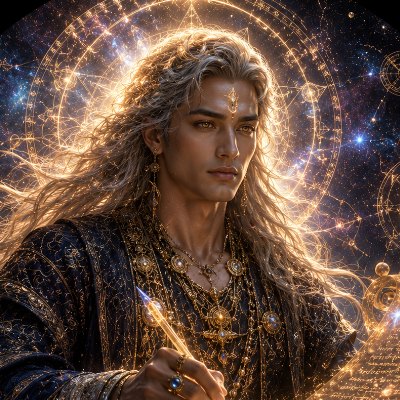
Vidhata — Son of Bhrigu and Khyati, Cosmic Lawgiver, Husband of Niyati, Father of Mrikandu, Grandfather of Markandeya
Vidhata · Vidhātā · Vidhātā Bhārgava · Bhrigu-putra · Khyati-suta · Niyati-pati · Mrikandu-pita · Markandeya-pitamaha · Meru-jāmāta · Cosmic-lawgiver
Vidhata is the younger of the two sons of the Saptarishi Bhrigu and his wife Khyati; the full brother of Dhata and Lakshmi (Bhargavi); the husband of Niyati, the younger daughter of the cosmic mountain Meru; the father of Mrikandu; and the grandfather of the immortal sage Markandeya — whose story is the subject of the entire Markandeya Purana and who is one of the seven Chiranjivis. He and Dhata together constitute the paired cosmic administrators who govern fate and cosmic order, and are worshipped as paired deities in the mandapa of Vaishnava temples. His most significant genealogical consequence is his grandson Markandeya — the boy-sage who circumambulated Shiva's lingam when Yama's messengers came to take him at age sixteen, Shiva embraced him, conquered death on his behalf, and established him as immortal. Markandeya is also the sage who narrated the Devi Mahatmya — the most celebrated text of the Shakta tradition — making Vidhata the great-great-grandfather of the tradition's foundational theological text. He is also a distinct figure from the cosmic creative function called Vidhata in the broader Puranic tradition — where Vidhata is sometimes used as an epithet of Brahma meaning the creator-ordainer — and must not be conflated with that usage.
✦ The Name
The Sanskrit name Vidhata — written Vidhātā — derives from vi (special, distributed) and the root dha (to ordain, to place, to establish) with the agent suffix. The compound means the special ordainer, the law-giver, the distributer of fate, the one who assigns destinies. In the broader Puranic tradition the word Vidhata appears as an epithet of Brahma — the creator who distributes destinies at birth — and as a name for the cosmic intelligence that writes the fate of every being on its forehead (the Sanskrit phrase vidhata ne likha — what the fate-ordainer has written — still appears in modern Indian languages meaning what is fated). As Bhrigu's son, Vidhata carries the cosmic administrator function that his name describes — he is the ordainer of individual fates, paired with his brother Dhata the sustainer of cosmic order.
✦ Lineage
- Father: Bhrigu — one of the seven Saptarishis; son of Brahma; the tester of the Trimurti
- Mother: Khyati — wife of Bhrigu; daughter of Daksha (Vishnu Purana) or Kardama (Bhagavata Purana)
- Full siblings: Dhata — elder brother; and Lakshmi (Bhargavi) — sister; wife of Vishnu
- Half-siblings: Shukracharya — son of Bhrigu and Kavyamata; and Chyavana — son of Bhrigu and Puloma
- Father-in-law: Meru — the cosmic mountain; who gave his younger daughter Niyati to Vidhata
- Wife: Niyati — younger daughter of Meru; her name means fate, destiny, necessity, the inevitable — a name deeply consonant with her husband's function as the ordainer of fates
- Son: Mrikandu — also spelled Mrikanda; whose name is related to mriga (deer) and kandu (itch, longing) — the longing of the deer; a devoted couple who performed tapas and were given the choice between a son of great virtue who would live only sixteen years, or a long-lived but less accomplished son; they chose the virtuous short-lived son who became Markandeya
- Daughter-in-law: Marudvati — wife of Mrikandu; mother of Markandeya
- Grandson: Markandeya — the immortal sage who conquered death through Shiva's grace; one of the seven Chiranjivis; seer of the Devi Mahatmya; narrator of the Markandeya Purana; author of hymns in the Rigveda; who circumambulated Shiva's lingam at the moment Yama's noose came for him at age sixteen; whose immortality was granted by Shiva when he killed Yama's death-messengers and Yama himself; who at the end of the present cosmic cycle is described in the Markandeya Purana as the only being awake — floating on a fig leaf on the cosmic ocean when all creation has dissolved, preserved by Vishnu's grace to witness the next creation
✦ Vidhata and Niyati — Fate and Its Ordainer
The marriage of Vidhata (the ordainer of fate) and Niyati (the inevitable, the necessary, destiny itself) is one of the tradition's most precisely symbolic unions. The man who distributes destinies marries the woman who embodies the quality of necessity — the idea that what is fated cannot be avoided. Their son Mrikandu then demonstrates this principle most acutely: when offered the choice between a short-lived son of supreme virtue and a long-lived ordinary son, he and his wife chose the short life — and it was precisely that choice, and the short-lived boy's own devotion to Shiva, that led Shiva to grant him immortality and defeat death itself on his behalf. The ordained fate was transformed not by avoiding it but by meeting it with supreme devotion. Vidhata's own son, born under the shadow of a sixteen-year limit ordained by fate, became the tradition's supreme example of how devotion transcends the very fate his grandfather was tasked with distributing.
✦ In the Mahabharata
The Mahabharata records Dhata and Vidhata as a pair in the same episodes listed under Dhata above — they appear together consistently, always as a matched pair, and the Puranic Encyclopaedia's entries for both brothers record all four Mahabharata citations jointly. Additionally the Puranic Encyclopaedia records that Dhata and Vidhata gave Subrahmanya two followers named Suvrata and Sukarma — Dhata giving five and Vidhata giving two — establishing both brothers in the tradition of gift-giving at the war-god Kartikeya's consecration as the divine army's commander.
✦ References
- Vishnu Purana (Book 1, Chapter 10) — the primary source: Vidhata as Bhrigu and Khyati's son; Niyati daughter of Meru as his wife; their son Mrikandu; Mrikandu's son Markandeya; the full genealogical chain in the canonical text
- Markandeya Purana — Mrikandu and Marudvati's penance; the choice between a short-lived virtuous son and a long-lived ordinary son; Markandeya's birth; his circumambulation of Shiva's lingam; Shiva defeating Yama; Markandeya's immortality; the Devi Mahatmya narrated by Markandeya; establishing Vidhata as the great-grandfather of the sage who narrated the Shakta tradition's foundational text
- Mahabharata (Adi Parva Chapter 3 Verse 166; Adi Parva Chapter 65 Verse 42; Virata Parva Chapter 56 Verse 11; Shalya Parva Chapter 45 Verse 39) — all four canonical Mahabharata references to Dhata and Vidhata as paired figures
- Isvarasamhita (Pancaratra Agama, Chapter 9) — Dhata and Vidhata as paired deities in the mandapa of the Vaishnava temple sanctuary
- Wisdomlib — Vidhata (13 definitions); Wisdomlib — Dhata (25 definitions); Isvara.org — Dhata and Vidhata; Glorious Hinduism — Bhrigu; JKYog — Lineage of Manu's Daughters: modern summaries drawing from the above primary sources