
About
Jayanta — Son of Indra and Shachi, Divine Prince of Svarga, the Crow Who Tested Rama
Jayanta · Jayant · Jayantah · Indra-putra · Shachi-suta · Puloman-pautra · Jayanti-bhrata · Svarga-yuvaraja · Kaka-rupa · Brahmastra-bhakshita
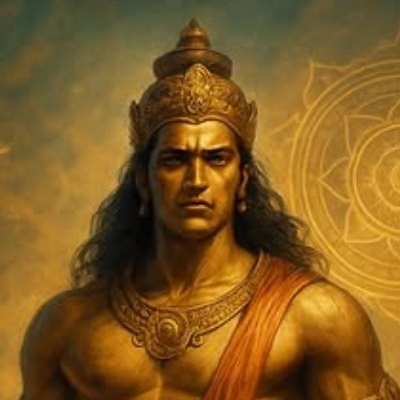
Jayanta is the son of Indra — the king of the devas, the lord of Svarga — and his queen Shachi (Indrani); the brother of Jayanti — who married Shukracharya for ten years and bore him Devayani; and the grandson of the Asura king Puloman through his mother Shachi. He resides in Svarga and is described in the tradition as a valiant celestial warrior who fought in the battles between the devas and the Asuras on his father's behalf. He is known across four distinct canonical episodes: the crow attack on Sita during Rama's exile at Chitrakuta in the Valmiki Ramayana; the battle with Meghanada (Indrajit) in the Uttara Kanda during Ravana's assault on Svarga; the battle with Pradyumna during the Parijata episode in the Harivamsa; and the curse of Agastya that transformed him into a bamboo tree in the Vayu Purana. His most celebrated episode — the crow attack and the consequent pursuit by Rama's Brahmastra — is narrated retrospectively by Sita to Hanuman in the Valmiki Ramayana's Sundara Kanda (Sarga 38) and is the tradition's most precise illustration of the consequence of testing a divine incarnation out of arrogant doubt. His genealogy places him in the descent from Vishnu through the line: Vishnu — Brahma — Marichi — Kashyapa — Indra — Jayanta, as recorded in the Mahabharata (Adi Parva, Chapter 112, Stanzas 3–4). A textual note on his naming in the Ramayana: the Valmiki Ramayana does not name him explicitly in the crow episode itself. Various commentaries on the text — including the Tilaka and Govindaraja's Bhushana — identify the son of Indra as Jayanta. The Puranic Encyclopaedia records the same identification.
✦ The Name
The Sanskrit name Jayanta — written Jayanta — derives from the root ji (to conquer, to be victorious) with the suffix anta (end, completion), meaning the completely victorious one, the fully triumphant. It is the masculine form of his sister Jayanti's name, and both siblings share the same root-name in masculine and feminine forms — a naming pattern common in divine sibling pairs where both children carry their father Indra's quality of victory. As a name for Indra's son it records the divine royal inheritance of the lord of conquest. The name's irony in the crow episode is quiet: the fully triumphant one was reduced to begging mercy from a mortal exile, and was blinded in one eye as the price of his arrogant test.
✦ Lineage
- Father: Indra — the king of the devas; lord of Svarga; son of Kashyapa (the universal progenitor) and Aditi (daughter of Daksha and Prasuti); who is one of the twelve Adityas; the divine warrior who defeated Vritra; who was himself temporarily replaced as king of Svarga when Nahusha — the ancestor of the Kuru dynasty — was chosen as regent during Indra's absence
- Mother: Shachi — also called Indrani and Pulomaja (daughter of Puloman); the most celebrated of Indra's consorts; daughter of the Asura king Puloman; who tricked Nahusha into making the impossible demand that the Saptarishis carry his palanquin, which led to Agastya's curse and Nahusha's downfall
- Maternal grandfather: Puloman — the Asura king who was Shachi's father; who in the battle between Ravana and Indra rescued the unconscious Jayanta and hid him in the ocean, saving his life; the same Asura grandfather thus saved the grandson who bore Indra's name against the same Asura forces
- Sister: Jayanti — who was sent by Indra to interrupt Shukracharya's penance but instead served him devotedly for a thousand years; who became Shukracharya's wife for ten years; who bore him the daughter Devayani; whose descendants through Devayani-Yayati-Yadu include Krishna
- Residence: Svarga — Indra's celestial kingdom; the divine realm whose governance he supported through all the battles between the devas and Asuras
✦ The Crow Episode — Testing Rama at Chitrakuta
The episode for which Jayanta is universally known occurs during Rama's forest exile at Chitrakuta mountain — early in the fourteen-year exile, before Ravana's abduction of Sita. Rama, Sita, and Lakshmana were living in a hermitage. One day, exhausted from walking in the forest, Rama lay down to rest with his head in Sita's lap. Lakshmana was absent, gathering fruits near a waterfall. Jayanta, curious and arrogant, had doubts about Rama's divinity — the exiled prince of Ayodhya who had left his kingdom and his throne to fulfil his father's promise did not look like a god. Jayanta decided to test him. He took the form of a crow. The Valmiki Ramayana and the tradition consistently identify his motivation as either testing Rama's divinity, youthful arrogance and curiosity, or fascination with Sita. He swooped down and pecked Sita — in the Valmiki Ramayana's Aranya Kanda account it was her breast; in Sita's retrospective narration to Hanuman in the Sundara Kanda it was her feet; the Glorious Hinduism source says he pecked at her feet twice. Sita cried out. Rama woke and saw the crow. He saw Sita's blood. He understood that this was no ordinary crow. Rama picked a blade of kusha grass from the ground and charged it with the power of the Brahmastra — the most powerful weapon in creation, associated with Brahma himself, which once launched could not be recalled until it had struck its intended target. He unleashed it against Jayanta. Jayanta, terrified, abandoned the crow form and fled through the three worlds at full divine speed. The Brahmastra followed him relentlessly across every region of the cosmos — to Svarga, to the earth, to the netherworld, through every realm and realm-boundary. Jayanta flew to his father Indra and begged for protection. Indra refused — he could not shield his son from a Brahmastra launched by Rama. Jayanta flew to Brahma, to Vishnu, to Shiva, to the assembled celestials and great sages. Every one of them turned him away. None of them could or would protect him from the Brahmastra's pursuit. Exhausted and without any refuge, Jayanta returned to Rama and fell at his feet in complete surrender. He admitted what he had done and begged mercy. Rama told him plainly that the Brahmastra could not be recalled without striking — it had to complete its mission. He asked Jayanta where he wished the weapon to strike. Jayanta, seeking the least destructive outcome, requested that it strike his right eye. The Brahmastra struck his right eye. Jayanta was blinded on the right side permanently, but his life was spared. Rama's mercy — in allowing the target to choose which eye would be struck — is described in the tradition as the compassion of the divine: the punishment was just, the mercy was real, and the lesson was permanent.
✦ Sita's Narration to Hanuman
The crow episode's primary canonical location is not in the Aranya Kanda (the forest book) where it chronologically occurred, but in the Sundara Kanda (Sarga 38) — where Sita, held captive in Lanka, narrates it retrospectively to Hanuman as evidence of Rama's divine power and as a way of authenticating his message. She tells Hanuman: this man who sleeps with his head in my lap — this is the same man who launched a Brahmastra from a blade of grass and chased Indra's son across the entire universe with no one able to protect him. The narration functions as Sita's testimony about Rama's supreme power — spoken to the most devoted of his servants, in the place of her greatest distress, as an argument for why Hanuman should trust without reservation that Rama can and will rescue her. Jayanta's humiliation in the crow episode thus becomes, through Sita's narration, Rama's credentials for the Lanka campaign that follows.
✦ The Battle with Meghanada
The Valmiki Ramayana's Uttara Kanda narrates a war between Indra's deva army and Ravana's Rakshasa army that preceded the events of the main Ramayana narrative. In this earlier war, Indra engaged Ravana while Jayanta was assigned to fight Ravana's son Meghanada — who would later be known as Indrajit, the conqueror of Indra. The battle between Jayanta and Meghanada was fierce — Meghanada had extraordinary weapons and immense power. He struck Jayanta with a weapon that rendered him unconscious. Jayanta fell from the battlefield. At this critical moment his maternal grandfather Puloman — the Asura king, Shachi's father — came to his rescue. Though Puloman belonged to the Asura side, his love for his daughter's son superseded the conflict's allegiances: he quietly and unseen removed Jayanta from the battlefield and hid him in the ocean, preserving him from further harm. The episode records the tradition's understanding that blood loyalty — even across the deva-asura divide — could override the allegiances of cosmic war.
✦ The Battle with Pradyumna
The Harivamsa (Vishnu Parva, Chapter 73) records Jayanta's involvement in the Parijata episode — the conflict between Krishna and Indra over the divine Parijata tree that Krishna took from Svarga at Satyabhama's request. When Krishna and Satyabhama arrived at Svarga to take the tree, Indra defended his realm with the full deva army. Jayanta fought against Krishna's son Pradyumna in this battle. Pradyumna — himself the reincarnation of Kamadeva, the god of desire, who had been burned to ash by Shiva and reborn as Krishna's son — was a warrior of extraordinary quality. Jayanta was defeated by Pradyumna in the engagement. The battle ended with Krishna taking the tree and Indra eventually making his peace with the situation.
✦ The Bamboo Curse — Agastya and Urvashi
The Vayu Purana records an episode in which Jayanta was cursed into the form of a bamboo tree. The sage Agastya came to Indra's court and was received with full honour — Indra organised a dance performance by the apsara Urvashi in the sage's honour. During the performance Urvashi's eyes met Jayanta's and she fell in love with him. Distracted by his gaze, she missed a beat, breaking the rhythm of the performance. Narada, who was playing his veena as musical accompaniment, also went out of time as a consequence of Urvashi's error. Agastya, furious at the broken performance, cursed all three in turn: Urvashi to be born on earth as a devadasi (a temple dancer); Narada that his veena Mahati would become the instrument of common performers; and Jayanta to become a bamboo tree in the Vindhya mountains. The three bowed in reverence and prayed for mercy. Agastya relented partially and offered a condition of release: the curse would end when Urvashi was presented with a bamboo staff (Jayanta himself, in his bamboo form) at her debut dance performance (Arangetram) as a devadasi. The episode explains the tradition of presenting a bamboo staff to the dancer at her debut — a ritual that persists in the South Indian Bharatanatyam Arangetram tradition to this day — as the release of Jayanta from Agastya's curse.
✦ The Samudra Manthana Episode
The Wikipedia article on Jayanta records that in some versions of the Samudra Manthana — the churning of the cosmic ocean — Jayanta is described as having assumed the form of a crow in an episode connected to the Kumbh Mela tradition. In this account Jayanta carried the Kumbha (pot) of amrita (nectar of immortality) as it emerged from the churning, and drops fell at the four sites that are now the Kumbh Mela pilgrimage locations: Prayagraj, Haridwar, Nashik, and Ujjain. The drops fell where Jayanta rested during his flight with the pot, pursued by the Asuras who sought to take it. This tradition is not in the primary Vyasa Mahabharata or the Valmiki Ramayana but in the devotional literature and pilgrimage tradition associated with the Kumbh Mela.
✦ References
- Valmiki Ramayana (Aranya Kanda — the crow episode at Chitrakuta; Sundara Kanda, Sarga 38 — Sita's retrospective narration of the episode to Hanuman; Uttara Kanda — the war between Ravana and Indra; Jayanta fighting Meghanada; Puloman rescuing Jayanta and hiding him in the ocean)
- Mahabharata (Adi Parva, Chapter 112, Stanzas 3–4) — Jayanta confirmed as the son of Indra and Shachi; his genealogical descent from Vishnu through Brahma-Marichi-Kashyapa-Indra
- Harivamsa (Vishnu Parva, Chapter 73) — Jayanta fighting Pradyumna in the Parijata episode; his defeat by Krishna's son
- Vayu Purana — Agastya's curse: the dance performance; Urvashi falling in love with Jayanta; her missed beat; Agastya's triple curse; Jayanta cursed to become a bamboo tree in the Vindhya mountains; the condition of release at Urvashi's Arangetram
- Padma Purana — Jayanta fighting in the battle between the devas and Asuras
- Skanda Purana (Asura Kanda) — Jayanta defeated by the Asura Surapadman, who was later killed by Kartikeya
- Puranic Encyclopaedia (Vettam Mani, Wisdomlib) — the complete Jayanta entry: the Chitrakuta crow episode; Rama's Brahmastra; the blinding; Sita's Sundara Kanda narration; the Meghanada battle; the bamboo curse; all canonical references listed
- Wikipedia — Jayanta; Grokipedia — Jayanta; Glorious Hinduism — Jayanta; Devi Mandir — Story of Jayant as a Crow; Queennandini — Animal of the Day Jayant as a Crow; Bingepods — Story of Jayanta Indra's Son: modern summaries drawing from the above primary sources