
About
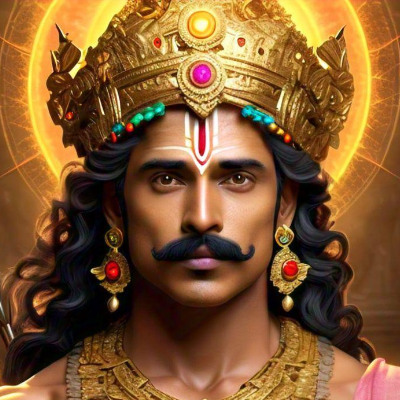
Sharyati — King of the Solar Dynasty, Son of Vaivasvata Manu, Father of Sukanya and Anarta
Sharyati · Śaryāti · Saryati · Vaivasvata-putra · Manu-suta · Sukanya-pita · Anarta-pita · Raivata-pitamaha · Chyavana-shvaśura · Suryavamsha-nripa
Sharyati is a king of the Solar Dynasty (Suryavamsha); a son — or in one textual tradition, a grandson — of Vaivasvata Manu, the seventh Manu and the primordial progenitor of all humanity in the current cosmic age; the father of Sukanya, the devoted wife of the sage Chyavana, and of Anarta, who gave his name to the Anarta kingdom in Gujarat and was the ancestor of King Raivata (Kakudmi), the father of Revati who married Balarama; and the father-in-law of the sage Chyavana, whose youth he inadvertently caused to be destroyed and whose restoration he witnessed with joy. He is described across the primary texts as a great scholar of the Vedas, a righteous king, and a man whose decision to give his daughter Sukanya in marriage to the afflicted sage was a model of both parental sagacity and dharmic responsibility. His most celebrated association is with the soma sacrifice at which Chyavana — restored to youth by the Ashvini Kumaras — officiated as his priest and secured the right of the Ashvins to receive the soma offering by creating the demon Mada. The Satapatha Brahmana, the Mahabharata (Vana Parva, Chapters 122–125), the Bhagavata Purana (Canto 9), and the Harivamsa (Adi Parva, Chapter 10) all confirm his identity as Vaivasvata Manu's son and Sukanya's father. Three distinct positions in Manu's lineage are attributed to him across the primary texts, and all are recorded below.
✦ The Name
The Sanskrit name Sharyati — written Śaryāti — is formed from sharya (an arrow, a bolt; from the root shri or shar — to hurt, to pierce) and the suffix ati (crossing, going beyond). The compound may be interpreted as the arrow-crosser, the one who passes beyond the arrow, the one who transcends the piercing. A traditional alternate derivation connects it to shara (an arrow) and ati (abundance) — giving the abundantly sharp one. The name in the context of the tradition's narrative carries a quiet irony: it was his daughter's piercing of Chyavana's eyes with a thorn — an arrow-like act — that set the entire story of Sukanya and Chyavana in motion. The king whose name means the arrow-crosser was the father of the girl whose arrow-like stick changed the course of events for the Bhrigu lineage.
✦ Lineage — Three Textual Traditions
Three distinct positions are attributed to Sharyati in the lineage of Vaivasvata Manu across the primary texts, and they cannot be harmonised. The Harivamsa (Chapter 10) lists nine sons of Vaivasvata Manu: Ikshvaku, Nabhaga, Dhrishnu, Sharyati, Narishyan, Pramsha, Nabhagarishtha, Korusha, and Prishadhra — placing Sharyati as the fourth son. The Mahapurana.com source (drawing from the Bhagavata Purana tradition) and the Boloji source describe Sharyati as the second son of Vaivasvata Manu — placing him after Ikshvaku alone. The Vishnu Purana's version (through the Boloji source) records that Pramshu had one son celebrated as Sharyati — which would make Sharyati the son of Pramshu, himself a son of Vaivasvata Manu, thereby making Sharyati Manu's grandson rather than his son. This is confirmed by the Harivamsa's own text at a different point (Chapter 10, Stanzas 31–32) where it records: Pramshu had one son celebrated by the name of Sharyati. The inconsistency is one of the Puranic genealogical tradition's most noted — Sharyati is described both as a direct son of Manu and as a son of Manu's son Pramshu in the same Harivamsa text. Both traditions are recorded here. The most common popular attribution — son of Vaivasvata Manu — is followed as the primary identification in this profile.
- Father (primary tradition): Vaivasvata Manu — the seventh and current Manu; son of Vivasvat (Surya, the sun god) and Sanjna; the first of the current era's humanity; progenitor of both the Solar and Lunar Dynasties through his children Ikshvaku, Ila, and others
- Father (alternate Vishnu Purana tradition): Pramshu — a son of Vaivasvata Manu; making Sharyati Manu's grandson in this tradition
- Position among Manu's sons: fourth son (Harivamsa) or second son (Bhagavata Purana tradition)
- Mother: not individually named in primary canonical sources; Vaivasvata Manu's wife in the primary tradition is Shraddha (also called Nadbala) — daughter of the sage Vishvakarma
- Brothers: Ikshvaku — the eldest; founder of the Ikshvaku Solar Dynasty whose line produced Rama; Nabhaga; Dhrishnu; Narishyan (Narisyanta); Pramsha; Nabhagarishtha; Korusha (Karusa); and Prishadhra — described collectively as equal in heroism and courage to their father Manu
- Daughter: Sukanya — extremely beautiful; described in the Mahabharata as one of the most devoted wives in the tradition; who pierced Chyavana's eyes inadvertently; who became his wife; who identified him from among three identical-looking young men by the observation that the devas do not blink while mortals do; who refused all attempts to lure her away from her husband
- Son (twin with Sukanya per the Harivamsa): Anarta — who inherited the Anarta kingdom in the region of present-day Gujarat; whose son Raiva built the capital at Kushasthali (present-day Dwaraka); whose son Raivata (also called Kakudmi) went to Brahmaloka with his daughter Revati for musical counsel, returned to find many Yugas had passed, and gave Revati in marriage to Balarama — making Sharyati the ancestor of Balarama's wife
- Son-in-law: Chyavana — son of Bhrigu and Puloma; whose youth was restored by the Ashvini Kumaras; who created the demon Mada; who officiated at Sharyati's soma sacrifice
✦ The Chyavana Encounter — Giving Sukanya in Marriage
The primary episode of Sharyati's canonical story occurs in the Mahabharata's Vana Parva (Chapters 122–125) and is first recorded in the Satapatha Brahmana (IV.1.5.1–13). Sharyati came to a beautiful lake near Chyavana's hermitage at Dhosi Hill with his army, retinue, harem, and daughter Sukanya. Sukanya wandered in the forest near the lake and, seeing two glowing lights in what appeared to be a termite mound, poked them with a stick. She had pierced the eyes of Chyavana — so long in meditation that white ants had built their mound over his entire body, leaving only his eyes visible. Chyavana's curse immediately afflicted Sharyati's entire army — in the Satapatha Brahmana the curse prevented Sharyati's family from entering or leaving their tents (the calls of nature were obstructed); in the Mahabharata the obstruction was of the natural bodily functions of the entire army. Sharyati, alarmed, investigated and discovered the cause. The Mahabharata records his response directly: joining his hands, the king asked the sage to forgive what his daughter had done through ignorance and inexperience. Chyavana's response was pointed — the sage had been disregarded, his eyes had been pierced from pride, and now he was without help or sight. He demanded restitution. Sukanya herself stepped forward. She told her father she was ready to go to the service of Chyavana and offered herself as his companion. Sharyati recognised the gravity of the dharmic obligation and, without delay, bestowed his daughter on Chyavana in marriage with all ordained rites. Having won the sage's grace through this gift, the king returned to his city with his army. The affliction was lifted. Sukanya remained with Chyavana and became his devoted wife.
✦ The Return — Seeing His Daughter's Husband Transformed
After some time — the Mahabharata does not specify how long — Sharyati returned to the forest to visit Sukanya. He came with his army. At the hermitage he saw Sukanya in conversation with a strikingly handsome young man of divine appearance. He was immediately alarmed — his daughter, married to an ancient blind sage, appeared to be keeping company with a beautiful youth. He scolded her. Sukanya told him that the young man before him was her husband Chyavana himself — restored to full youth, sight, and health by the Ashvini Kumaras, who had given him a new form. Sharyati was overcome with joy. The Mahabharata records his delight as being as great as if the king had conquered the entire world. He embraced his son-in-law with warmth. Chyavana, pleased, proposed to officiate at a religious ceremony on the king's behalf. Sharyati joyfully accepted. He ordered the erection of a splendid sacrificial shrine. Chyavana officiated as his priest and at that sacrifice offered the soma portion to the Ashvini Kumaras — the offering that Indra objected to, that led to Chyavana paralysing Indra's arm, and that produced the demon Mada. Sharyati thus became the patron-king of the sacrifice that won the Ashvins their permanent right to the soma portion in all Vedic rituals.
✦ The Anarta Kingdom and the Revati Connection
Through his son Anarta, Sharyati is the ancestor of one of the tradition's most celebrated genealogical episodes. Anarta's son Raiva built the capital city of Kushasthali — identified by the tradition with present-day Dwaraka in Gujarat. Raiva's son Raivata (also called Kakudmi) ruled the Kushasthali kingdom as a great and pious king. He had a daughter named Revati of great beauty and accomplishment. Unable to find a suitable husband for her among ordinary men, Kakudmi took Revati to Brahmaloka to ask Brahma's counsel. Brahma was engaged in musical performances and could not be interrupted for some time. When Brahma finally attended to Kakudmi's question, he explained that the time spent in Brahmaloka was incommensurable with earthly time — many yugas had passed on earth during the apparently brief wait in Brahmaloka. All the kings who had been Revati's contemporaries and potential suitors were long dead; entire dynasties had risen and fallen. Brahma directed Kakudmi to give Revati in marriage to Balarama — the elder brother of Krishna, who would be alive in the current era. Kakudmi returned to earth and gave Revati to Balarama, despite the difference in their cosmic ages. Sharyati is thus the ancestor of Balarama's wife — and through this connection, a distant ancestral relation to the Yadava dynasty's founding family.
✦ References
- Satapatha Brahmana (IV.1.5.1–13) — the earliest canonical account: Sharyati as son of Manu; his coming near Chyavana's hermitage while hunting; Sukanya's piercing of the sage's eyes; the curse; Sharyati's offer of Sukanya in marriage; the restoration of normal function when the sage was appeased
- Mahabharata (Vana Parva, Chapters 122–125) — the fullest narrative account: Sharyati's visit to the lake with his army and harem; Sukanya's curiosity at the anthill; the piercing; the army's affliction; Sharyati's investigation; his apology and offering of Sukanya; the marriage; his return and discovery of Chyavana's transformed youth; his joy; Chyavana's proposal to officiate; the soma sacrifice; the Indra-Mada episode
- Harivamsa (Adi Parva, Chapter 10, Stanzas 1–2 and 31–32) — Sharyati as the fourth of nine sons of Vaivasvata Manu; and simultaneously as the son of Pramshu (Manu's son) — the two accounts creating the internal Harivamsa inconsistency; the twin children Anarta and Sukanya; Anarta's kingdom at Kushasthali; Raivata and the Brahmaloka episode
- Bhagavata Purana (Canto 9) — Sharyati as son of Vaivasvata Manu; Sukanya's marriage to Chyavana; the Anarta-Raivata-Revati line confirmed
- Wikipedia — Sharyati; Wikipedia — Sukanya; Wikipedia — Chyavana; Vyasaonline.com — Sukanya; Radha.name — Chyavana Rishi; Mahapurana.com — Tale of Sharyati; Boloji — Dynasty of Vaivasvata Manu; Wisdomlib — Harivamsa Chapter 10 Vaivasvata Manu's Offspring: modern summaries drawing from the above primary sources