
About
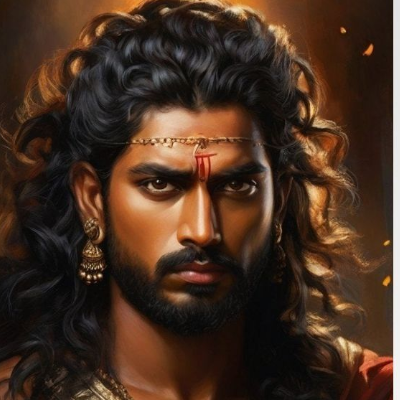
Anarta — Son of Sharyati, Founder of the Anarta Kingdom, Ancestor of Revata and Kakudmi, Eponymous King of Gujarat
Anarta · Ānarta · Anartta · Sharyati-putra · Sukanya-bhrata · Revata-pita · Kakudmi-pitamaha · Revati-prapitamaha · Kushasthali-adhipati · Anartadesha-sthapaka
Anarta is the son of King Sharyati — a son of Vaivasvata Manu and the father-in-law of the sage Chyavana — and the twin brother of Sukanya, the devoted wife of Chyavana; the father of Revata (also called Reva); the grandfather of Raivata (also called Kakudmi or Kukudmi), the pious king who went to Brahmaloka for musical counsel and returned to find several yugas had passed on earth; and the great-grandfather of Revati — who married Balarama, the elder brother of Krishna. He is the eponymous founder of the Anarta kingdom — the ancient Indian region corresponding to the present-day north Saurashtra and north Gujarat region — whose capital was Kushasthali, the ancient name for Dwaraka. Every primary text that records him agrees on four facts: he was Sharyati's son, he was Sukanya's twin, he founded or presided over the Anarta region, and his son Revata ruled Kushasthali. Beyond these genealogical facts no personal episode is recorded for Anarta in any primary canonical source. The Harivamsa (Chapter 10) is the primary source recording his position in the lineage. The Vishnu Purana (as cited through the Wisdomlib Dynasties source) and the Bhagavata Purana (Skandha 9, Chapter 3) confirm the same lineage. A note on a conflicting tradition: the Wikipedia article on the Anarta kingdom describes an Anarta who was the father of Vaivasvata Manu — making him an ancestor of Manu rather than Manu's grandson through Sharyati. This tradition is inconsistent with every other primary source and is not followed here.
✦ The Name
The Sanskrit name Anarta — written Ānarta — is of disputed etymology. One interpretation connects it to the negative prefix a and narta (dancing, the art of dance — from the root nrt, to dance), giving the meaning the one who does not dance, the unmoving, the non-dancing one. Another traditional interpretation connects it to an (not) and rta (the cosmic order, truth, righteous) — giving the not-orderly, the one outside the cosmic order — which some sources read as a description of the wild and difficult terrain of the western coastal region. The region of present-day Gujarat — ancient Saurashtra and the northern coastal areas — took its name Anartadesha (the land of Anarta) from him, becoming the Anarta country that is mentioned multiple times in the Mahabharata as the region ruled by the Yadavas and specifically by Krishna from Dwaraka. Panini's Ashtadhyayi (4.2.127) mentions Anarta in the Dhumadi group as a country name — one of the earliest linguistic attestations of the geographical name.
✦ Lineage
- Father: Sharyati — son of Vaivasvata Manu (or of Pramshu, Manu's son, per one Harivamsa passage); king of the Solar Dynasty; whose daughter Sukanya married the sage Chyavana; at whose soma sacrifice Chyavana officiated and created the demon Mada; already profiled separately in this series
- Paternal grandfather: Vaivasvata Manu — the seventh Manu; son of Vivasvat (Surya) and Sanjna; survivor of the great flood; progenitor of all present-day humanity; father of Ikshvaku (founder of the Solar Dynasty of Rama) and Ila (founder of the Lunar Dynasty of the Pandavas and Krishna)
- Twin sister: Sukanya — born with him as twins per the Harivamsa (Chapter 10, Stanza 31–32); wife of the sage Chyavana; whose inadvertent piercing of Chyavana's eyes led to his marriage to her; who remained faithful to him through the Ashvini Kumaras' attempt to lure her away; who identified Chyavana from among three identical youths after his transformation
- Mother: not named in the primary canonical sources
- Son: Revata — also called Reva in some sources; whose city Kushasthali was built in the province of Anarta per the Harivamsa; who preceded Raivata as the ruler; the river Narmada is called Reva after this descendant in some traditions
- Grandson: Raivata — also called Kakudmi or Kukudmi; described in the Harivamsa (Chapter 11) as Saryati's grandson; pious king of Kushasthali; father of a hundred sons; who along with his daughter Revati received instructions in music from Brahma in Brahmaloka; at whose departure from Brahmaloka his capital Kushasthali was described as already having become Dwaraka, filled with Yadavas; Satyaki the Pandava general is described in the Mahabharata (Shalya Parva, Chapter 9) as a chief of the Anartas — recording the geographical name's continued use in the Mahabharata period
- Great-granddaughter: Revati — daughter of Raivata (Kakudmi); who went to Brahmaloka with her father; who was given in marriage to Balarama — Krishna's elder brother — on Brahma's direction, establishing the connection between Anarta's lineage and the Yadava dynasty
- The Dwaraka connection: through the chain Anarta → Revata → Raivata (Kakudmi) → the Yadava settlement, Anarta is the eponymous ancestor of the region that became Krishna's capital city — the city of Dwaraka, one of the seven sacred cities (Saptapuris) of the Hindu tradition, built by the Yadavas on the site of Kakudmi's abandoned Kushasthali
✦ The Anarta Kingdom — Geography and Historical Record
The Anarta kingdom corresponded to the present-day north Saurashtra and north Gujarat region of India — the western coastal peninsula of the subcontinent. Its capital Kushasthali was located in the Anarta province and was built or expanded by Revata, Anarta's son. The Harivamsa records precisely: Reva's city Kushasthali was in the province of Anarta. The identification of Kushasthali with present-day Dwaraka is attested in the Mahabharata's Sabha Parva (Chapter 13), which records that the eighteen tribes of Vrishnis fled from Mathura under threat from Jarasandha and went west to Kushasthali, which they rebuilt and fortified into an impregnable city — renaming it Dwaraka. Krishna's own words to the Pandavas in the Mahabharata confirm this: the town towards the west called Kushasthali, adorned by the mountains of Raivata — the mountain named for Raivata, Anarta's grandson — is where the Yadavas settled. The Mahabharata mentions the Anartas as a distinct people in several contexts: Satyaki, one of the greatest Yadava warriors who fought for the Pandavas at Kurukshetra, is described as a chief of the Anartas (Shalya Parva, Chapter 9.17). Kritavarman — who fought for the Kauravas — is described as the dweller of the Anarta country, the son of Hridika (Shalya Parva, Chapter 9.17). The Upapandavas (the sons of the Pandavas and Draupadi) spent time in the Anarta kingdom learning military science from eminent Yadava warriors during the Pandavas' exile. The geographic and political importance of the Anarta country in the Mahabharata period is thus established not merely through genealogy but through direct narrative reference — the kingdom that bore Anarta's name was the western bastion of the Yadava power that allied with the Pandavas. After Kakudmi's departure to Brahmaloka — which the Harivamsa records as resulting in many Yugas passing on earth — his capital Kushasthali was destroyed and for a time became a forest and wasteland occupied by Punyajana Rakshasas. The Yadavas later reclaimed and rebuilt the site as Dwaraka under Krishna's leadership. The archaeological and textual geography of Dwaraka — whether it corresponds to the present-day Dwaraka in Jamnagar district, or to Bet Dwaraka, or to Junagadh at the foot of Girnar (the mountain also called Raivataka after Anarta's grandson Raivata) — remains a subject of scholarly debate, with the Junagarh rock inscription of the Saka ruler Rudradaman I (circa 150 CE) being among the earliest epigraphic confirmations that the Anarta region was a historically recognised geographical designation in ancient India.
✦ References
- Harivamsa (Adi Parva, Chapter 10, Stanzas 31–32) — the primary canonical source: Sharyati had a twin son and daughter; the son was named Anarta and the daughter Sukanya became the wife of Chyavana; Anarta's successor was the highly effulgent Reva; his city Kushasthali was in the province of Anarta; Reva's son Raivata (Kakudmi) was pious and obtained the kingdom of Kushasthali
- Harivamsa (Adi Parva, Chapter 11) — Raivata (Kakudmi) as Sharyati's grandson; the question of why he did not age; the departure to Brahmaloka; the destruction of Kushasthali after his departure
- Bhagavata Purana (Skandha 9, Chapter 3) — Sharyati → Anarta lineage confirmed; the Revata-Raivata-Revati chain leading to Balarama's marriage
- Vishnu Purana (through the Wisdomlib Dynasties source) — Sharyati had a son named Anarta; Anarta had a son named Revata; Revata had one hundred sons, the eldest being Kakudmi; Kakudmi's daughter Revati was given in marriage to Balarama on Brahma's direction
- Mahabharata (Sabha Parva, Chapter 13, Verse 49) — Kushasthali mentioned as the city the Yadavas fled to from Mathura; the fortification of Kushasthali into Dwaraka; the mountain Raivataka named for Kakudmi
- Mahabharata (Shalya Parva, Chapter 9.17) — Satyaki described as chief of the Anartas; Kritavarman described as the dweller of the Anarta country; the Anarta people as participants in the Kurukshetra War on both sides
- Panini — Ashtadhyayi (4.2.127) — Anarta mentioned in the Dhumadi group as a recognised country name; one of the earliest linguistic attestations of the geographical designation
- Junagarh Rock Inscription of Rudradaman I (circa 150 CE) — one of the earliest epigraphic confirmations that the Anarta region was a historically recognised geographical designation
- Wikipedia — Anarta; Wikipedia — Anarta kingdom; Jatland Wiki — Anarta; Jatland Wiki — Kushasthali; Hindu Blog — Story of King Anarta; Wisdomlib — Harivamsa Chapter 10; Reflections.live — The Mahabharata's Impact on Saurashtra's Culture and Heritage: modern summaries drawing from the above primary sources