
About
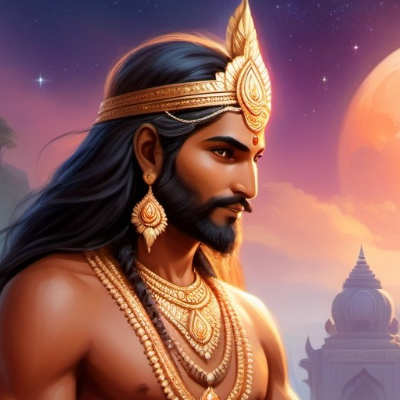
Kakudmi (Raivata) — King of Kushasthali, Father of Revati, the King Who Waited in Brahmaloka
Kakudmi · Kakudmin · Raivata · Kukudmi · Kukudmin · Revata-putra · Anarta-pautra · Sharyati-prapautra · Revati-pita · Balarama-shvaśura · Kushasthali-raja · Brahmaloka-gamaka
Kakudmi — also called Raivata (son of Revata) and Kukudmi in variant manuscript traditions — is the eldest of the hundred sons of King Revata (son of Anarta, son of Sharyati, son of Vaivasvata Manu); the king of Kushasthali — the prosperous island city in the Anarta province, later rebuilt and renamed Dwaraka by Krishna and the Yadavas; the father of Revati, who married Balarama the elder brother of Krishna; and the central figure of one of the Puranic tradition's most celebrated meditations on cosmic time. His story — the king who went to Brahmaloka seeking a husband for his daughter, waited through what seemed a brief musical interlude, and returned to find that twenty-seven chaturyugas (astronomical units of time each spanning approximately 17,280,000 years) had passed on earth — is the Hindu tradition's most vivid narrative illustration of the incommensurability of divine and human time. His account is recorded in the Harivamsa (Adi Parva, Chapter 11), the Bhagavata Purana (Canto 9, Chapter 3), the Vishnu Purana (Book 4, Chapter 1), and the Mahabharata.
✦ The Names
The name Kakudmi — written Kakudmin — derives from kakud (hump, peak, summit, the hump of a bull) with the suffix min (possessing). The name means the humped one, the one with a peak, the summit-possessor. As a king's name it may refer to his lordship over a mountainous region — his city Kushasthali lay near the Raivataka (Girnar) hills. His patronymic name Raivata — meaning son of Revata — is the name used most consistently in the Bhagavata Purana and becomes his primary designation in most secondary sources. The Harivamsa (Chapter 11, Verse 1) records the question directly from Janamejaya: why were Revati and Revata's son Kakudmi not visited by decrepitude although they lived for many years?
✦ Lineage
- Father: Revata — builder of Kushasthali; son of Anarta; grandson of Sharyati; great-grandson of Vaivasvata Manu
- Brothers: ninety-nine younger sons of Revata — all of whom fled from Kushasthali when Punyajana Rakshasas occupied the city after Kakudmi's departure; who established smaller kingdoms throughout the Anarta region
- Kingdom: Kushasthali — described in the Puranas and Harivamsa as a magnificent city in the Anarta island province comparable to Amaravati; near the Raivataka (Girnar) hills; the city that later became Dwaraka after Kakudmi's departure made it available for the Yadava settlement
- Daughter: Revati — who had grown to the physical stature of the earlier Treta Yuga era in which she was born; whose extraordinary beauty and accomplishment made Kakudmi unable to find a suitable husband among ordinary men; who married Balarama; who was described as tall enough that Balarama gently pressed her height with his ploughshare to bring her to the appropriate scale of the current diminished Kali Yuga era; who is associated with the mother goddess tradition in the Skanda Purana where she fights the demon Dirghajihvi in Shasthi form
- Son-in-law: Balarama — the elder brother of Krishna; also called Baladeva, Halayudha (plough-wielder), and Sankarshana; the eighth avatar of Vishnu in the Bhagavata Purana's listing (before Krishna); whose marriage to Revati brought the Anarta Solar Dynasty lineage into permanent connection with the Yadava-Lunar Dynasty lineage
✦ The Journey to Brahmaloka — Cosmic Time's Most Vivid Illustration
Kakudmi's daughter Revati had grown to such extraordinary beauty, grace, and accomplishment that no man in the three worlds seemed to Kakudmi to be a worthy husband for her. He decided to go directly to Brahmaloka — the highest of the divine realms, beyond the reach of ordinary time — to ask Brahma's personal counsel on the matter. He took Revati with him. When they arrived at Brahmaloka, Brahma was listening to a musical performance by the Gandharvas Haha and Huhu. Kakudmi and Revati waited respectfully — unwilling to interrupt the divine music — until the performance concluded. It seemed to them a brief wait, perhaps a few hours at most. When Brahma finally turned his attention to them, Kakudmi bowed, explained his purpose, and presented a list of kings he had in mind as potential husbands for Revati. Brahma laughed gently and shook his head. He explained the nature of time across different planes of existence: while Kakudmi and Revati had been waiting through a single musical performance in Brahmaloka, the equivalent time on earth had not been hours or days or years but a vast cosmic span. The Bhagavata Purana records the specific duration: twenty-seven chaturyugas had passed. A chaturyuga spans the entire cycle of all four Yugas — 4,320,000 years. Twenty-seven of these is approximately 116,640,000 years. Every king Kakudmi had named on his list was dead. Their sons were dead. Their grandsons were dead. Their entire dynasties had risen, flourished, and vanished. The city of Kushasthali itself — which Kakudmi had ruled — was now a ruin. Everything Kakudmi had known was gone. Brahma comforted the stunned king. He told him that Vishnu himself was now incarnate on earth in the present Dvapara-Kali Yuga transition, in the forms of Krishna and Balarama. He recommended Balarama — the elder brother, plough-wielder, partial incarnation of Vishnu's Shesha-serpent aspect — as the worthy husband for Revati. Kakudmi and Revati returned to earth. The Wikipedia article on Kakudmi records their reaction precisely: they were shocked by the changes that had taken place. Not only had the landscape and environment changed but mankind was at a lower level of development than in their own time — the race of men had become dwindled in stature, reduced in vigour, and enfeebled in intellect. Kushasthali was now called Dwaraka. They found Balarama and proposed the marriage; it was accepted. Balarama, seeing that Revati had grown to the taller and larger physical scale appropriate to the earlier cosmic age — when humanity was larger and longer-lived — gently pressed the top of her head with the tip of his ploughshare to bring her height down to the scale of the current era. The Bhagavata Purana records this as a loving adjustment rather than a diminishment. The marriage was celebrated. Kakudmi, having given his daughter to the worthy husband Brahma had identified, then retired to the Himalayan forests to perform penance — accepting the cosmic displacement he had experienced and renouncing the world he could no longer find.
✦ The Cosmic Time Teaching
The Kakudmi episode is one of the Puranic tradition's most precise and humanly felt statements about the nature of cosmic time. Other texts describe the different durations of time in different planes of existence in abstract terms — the Puranas enumerate the exact ratios of human years to divine days throughout. The Kakudmi story makes these abstract ratios emotionally concrete: the king who went to ask about his daughter's marriage returned to find that over 116 million years had passed; everything he had known and loved had turned to dust; the world his body remembered was completely gone. The story is also a rare instance in the Puranic tradition of a human being actually experiencing the time-dilation between cosmic planes — not as a philosophical concept but as a lived event whose human consequences are recorded: the shock, the disorientation, the changed landscape, the diminished people, the ruined city, the retirement to penance. The Harivamsa records this as a question asked by Janamejaya — why did Revata's son Kakudmi and Revati not age although they lived many years? The answer is that they did not age in Brahmaloka because there is neither decrepitude nor death in Brahma's region.
✦ References
- Harivamsa (Adi Parva, Chapter 11) — the primary canonical source: Janamejaya's question about why Kakudmi and Revati did not age; Vaishampayana's answer about the nature of time in Brahmaloka; the city Kushasthali destroyed after Kakudmi's departure; his ninety-nine brothers fleeing to different regions
- Bhagavata Purana (Canto 9, Chapter 3, Verses 27–36) — Kakudmi as Raivata, son of Revata; the journey to Brahmaloka with Revati; the musical performance; the wait; Brahma's laughter and explanation of time; the twenty-seven chaturyugas; the death of all named candidates; Brahma's recommendation of Balarama; the return to earth; the dwindled race of men; Kushasthali renamed Dwaraka; the marriage; Balarama pressing Revati's height with his ploughshare; Kakudmi retiring to penance
- Vishnu Purana (Book 4, Chapter 1, Verses 63–65) — the same episode with slightly variant details; Kakudmi as the eldest of Revata's hundred sons
- Wikipedia — Kakudmi; Wikipedia — Revati; Wisdomlib — Kushasthali; Wisdomlib — Revata; Authoralka — The Riddles of Dwaraka; Devdutt Pattanaik — The Gates of Dwaraka: modern summaries drawing from the above primary sources