
About
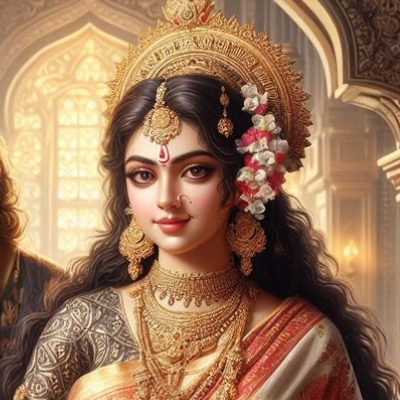
Revati — Daughter of Kakudmi, Wife of Balarama, the Time-Displaced Princess, Goddess and Matrika
Revati · Revatī · Kakudmi-putri · Raivata-suta · Balarama-patni · Nishatha-mata · Ulmuka-mata · Shashirekha-mata · Revata-pautrī · Anarta-prapautrī · Lakshmi-amsha · Shashthi-svarupini · Matrika-devi
Revati is the only daughter of King Kakudmi (Raivata) — the king of Kushasthali in the Anarta province, son of Revata, grandson of Anarta, great-grandson of Sharyati, and great-great-grandson of Vaivasvata Manu — and the wife of Balarama, the elder brother of Krishna, the eighth avatar of Vishnu in some traditions and an incarnation of the cosmic serpent Shesha in others. She is the mother of two sons — Nishatha and Ulmuka — and a daughter — Shashirekha (also called Vatsala). She is the great-granddaughter of Sharyati who was the father-in-law of the sage Chyavana — establishing her place in the long chain of the Solar Dynasty lineage from Vaivasvata Manu. She is one of the tradition's most unusual figures: born in the Krita (Satya) Yuga, she lived through the wait in Brahmaloka while twenty-seven chaturyugas passed on earth, and married Balarama in the Dvapara-Kali Yuga transition — making her a woman of one cosmic age who became the wife of a divine being in a vastly later age, without herself aging in the interval. The Bhagavata Purana (Canto 9, Chapter 3) records her story through the account of her father's journey to Brahmaloka. The Lakshmi Tantra (Chapter 8) identifies her as an amsha (partial manifestation) of Lakshmi — recording that when Vishnu descended as Balarama and Krishna, Lakshmi herself descended as Revati and Rukmini respectively. The Skanda Purana and the Devi Bhagavata Purana identify her as a form of the mother goddess Shakti who fought the demon Dirghajihvi in the vixen-form Shalavriki, and as Shashthi — the goddess worshipped on the sixth day after a child's birth, the protector of mothers and newborns. Her story spans cosmology, theology, mythology, and the most humanly poignant of all Puranic episodes — the woman who went to Brahmaloka as a young princess in one era and returned to earth to find herself in a world she could no longer recognise.
✦ The Name
The Sanskrit name Revati — written Revatī — is the feminine form of Revata, meaning daughter of Revata or pertaining to the Revata line. The root rev or ri (to flow, to move like a river, to shine) gives the name the sense of the radiant, the flowing, the brilliant one. Her great-grandfather's mountain — the Raivataka (Girnar hills) — bore the same root name, as did her grandfather Revata. The name also connects to Revati Nakshatra — the twenty-seventh and final Nakshatra in the Vedic lunar mansion system, named after the star Zeta Piscium. The Revati Nakshatra is associated with nourishment, completion, and transition — the last of the twenty-seven mansions, the point of cosmic completion before the cycle begins again. The naming of Kakudmi's daughter Revati after this final Nakshatra is consistent with her cosmic role: she is the last princess of an age that has already ended, the woman who bridges two cosmic eras, the point of completion and transition between the old world and the new.
✦ Lineage
- Father: Kakudmi (Raivata) — king of Kushasthali; son of Revata; grandson of Anarta; who could find no suitable husband for his daughter among ordinary men; who went to Brahmaloka and waited through twenty-seven chaturyugas; who gave her in marriage to Balarama on Brahma's direction; who then retired to Badarikaashrama for penance
- Paternal grandfather: Revata — builder of Kushasthali; son of Anarta; the king after whose name both the Raivataka mountain and the Revati Nakshatra are connected through the lineage-name root
- Paternal great-grandfather: Anarta — son of Sharyati; twin brother of Sukanya (wife of sage Chyavana); eponymous founder of the Anarta kingdom (Gujarat)
- Paternal great-great-grandfather: Sharyati — son of Vaivasvata Manu; whose daughter Sukanya married the sage Chyavana
- Paternal great-great-great-grandfather: Vaivasvata Manu — the seventh Manu; son of Surya; the flood survivor; progenitor of all present-day humanity
- Cosmic identity (Lakshmi Tantra): an amsha of Lakshmi — the goddess of fortune, Vishnu's eternal consort; the text records: when Vishnu would descend in four forms as Balarama, Krishna, Pradyumna, and Aniruddha, Lakshmi would also manifest in four forms as Revati, Rukmini, Rati, and Usha; making Revati and Balarama the Lakshmi-Vishnu divine pair in the Dvapara-Kali transition, as Rukmini and Krishna are the divine pair in the Kali Yuga's primary narrative
- Previous birth (one tradition): Urmila — the daughter of King Janaka of Mithila and the wife of Lakshmana (Rama's brother, who is himself an earlier incarnation of Balarama as the elder brother of Vishnu's avatar); the tradition records a precise symmetry across two avatars — Rama-Lakshmana and Krishna-Balarama — with their divine consorts Sita-Urmila and Rukmini-Revati respectively reincarnating to maintain the cosmic pairing
- Husband: Balarama — the elder brother of Krishna; son of Vasudeva and Devaki (embryo transferred to Rohini's womb at birth); the divine warrior whose weapon was the plough (Hala) and the pestle (Musala); who is an incarnation of Shesha — the cosmic serpent on whom Vishnu rests; who married only Revati among all women; who taught Duryodhana the art of mace-fighting; who did not participate in the Kurukshetra War; who died sitting in meditation after witnessing the destruction of the Yadava clan, a white serpent emerging from his mouth as his soul departed — returning to the cosmic ocean as Shesha
- Sons: Nishatha — also written Nishata; and Ulmuka — both confirmed in the Wikipedia article on Balarama and multiple Puranic sources as Balarama and Revati's sons
- Daughter: Shashirekha — also called Vatsala; the most celebrated of Revati and Balarama's children in the folk tradition; who was betrothed to Lakshmana (son of Duryodhana) but whose own love was for the Upapandava Abhimanyu; whose marriage story — in which Ghatotkacha assumed Abhimanyu's form and the form of a priest to enable the marriage against Duryodhana's wishes — is one of the most celebrated regional episodes in the Mahabharata tradition particularly in Telugu and Kannada literature
✦ The Return From Brahmaloka — The Cosmic Displacement
When Revati and her father returned from Brahmaloka, the Bhagavata Purana records with quiet precision the nature of what they encountered. The world they had left was gone in every meaningful sense. The landscape had changed — forests, rivers, and geography no longer matched their memories. Kushasthali — the magnificent, prosperous city her father had built and ruled — had become Dwaraka, settled by the Yadavas under Krishna's leadership. The race of human beings had diminished — shorter in stature, reduced in vitality, enfeebled in intellect compared to the people of the Krita Yuga in which she had grown up. Every king on her father's list of potential husbands, every court minister, every friend and relative — all were gone, their dynasties dust. Revati herself had not aged — her body remained that of the young woman who had entered Brahmaloka. But the body that had not aged was now the body of a Krita Yuga woman living in a Kali Yuga world — taller, larger, stronger than the people around her, formed to the physical scale of an earlier cosmic era. When Balarama accepted the marriage and Revati stood before him, the difference in scale was immediately apparent. Balarama — the divine warrior of prodigious strength, the elder brother of Krishna — was shorter than his new bride. He adjusted the difference not through words or negotiation but with the gentle decisive action that defined his character throughout the tradition: he laid the tip of his ploughshare on her head and lightly pressed her height down to the scale of the present era. The Bhagavata Purana (Canto 10, Chapter 52[b], Verse 12) records: he laid his plough on her shoulder and pulling her down made her of his equal stature. The gesture is the tradition's most compact statement about the meeting of different cosmic ages. The Krita Yuga woman and the Kali Yuga man were made equal not by her diminishment alone but by his divine intervention — the plough that tilled the earth of his era pressing the stature of the old world into the measure of the new, making possible a marriage across time that no ordinary instrument could have achieved.
✦ As Goddess — The Warrior Against Dirghajihvi
The Skanda Purana records Revati's independent divine identity as a warrior goddess. When the demon Dirghajihvi (the long-tongued one) threatened the devas, the gods sought the assistance of Kartikeya (Skanda), who in turn requested Revati to fight the demon. Revati took the form of the vixen Shalavriki and wrought havoc in the demon army — her vixen-form moving through the ranks with a ferocity that overwhelmed the demons, who fled in terror and sought refuge inside the wombs of human women to escape her pursuit. Revati then took the form of Jataharini — the one who seizes the unborn — and attacked the demons before their conception, cleansing the women of the wickedness that had entered them. The episode establishes Revati as a protective deity of the most intimate kind — defending the space of conception and gestation itself, the threshold between the unborn and the born. The Devi Bhagavata Purana associates Revati with Shashthi — the goddess worshipped on the sixth day after a child's birth, who protects mothers during the vulnerable post-natal period and newborns from the dangers of the first week of life. This identification makes Revati-Shashthi one of the most practically important goddesses in the domestic devotional tradition — present at every birth, propitiated by every new mother in the first six days of a child's life. The medium.com Exotic India source notes that the Devi Bhagavata equates her with Shashthi Devi (Chathi Devi) who is worshipped on the sixth day of a child's birth and by couples who want to be blessed with children. As Balarama's consort who represents the protective, agricultural, and generative dimensions of the divine, Revati and Balarama together symbolise creative energy, auspiciousness, and fertility — the divine couple of the earth's abundance and the womb's protection.
✦ In Temple Tradition
Revati is worshipped alongside Balarama in several important temple traditions. The Revati-Balarama Temple at Dwaraka in Gujarat is dedicated to the divine couple in their agricultural and protective aspects. In Odisha's Jagannath Temple tradition at Puri, Balarama is one of the three primary deities — with Jagannath (Krishna) and Subhadra — and Revati is venerated as his consort in the tradition's extended family theology. At the Balarama Mandir in Vrindavan, Uttar Pradesh, Revati is present in the temple's iconographic programme. At other Balarama temples in Gujarat — particularly in the Saurashtra region — the Balarama-Revati pairing reflects the tradition's memory that this is the land of Kushasthali, Revata's kingdom, Anarta's country — the land that Revati herself came from.
✦ References
- Bhagavata Purana (Canto 9, Chapter 3, Verses 27–36; and Canto 10, Chapter 52[b], Verses 1–12) — the primary canonical source: Revati as the only daughter of Kakudmi; her extraordinary beauty and accomplishment; the journey to Brahmaloka; the twenty-seven chaturyugas; Brahma's recommendation of Balarama; the return to the changed earth; the dwindled race of men; the renamed city Dwaraka; the marriage; Balarama pressing her height with his ploughshare; Kakudmi's retirement to Badarikaashrama
- Vishnu Purana (Book 4, Chapter 1) — the parallel account; Revati as Kakudmi's only daughter; the Brahmaloka episode; the marriage to Balarama
- Harivamsa (Adi Parva, Chapter 11) — Kakudmi and Revati in the context of the Kushasthali-Dwaraka lineage; the city's destruction after their departure; the Yadava settlement
- Skanda Purana — Revati as the warrior goddess who fought Dirghajihvi; the vixen form Shalavriki; the Jataharini form; the protection of pregnant women and newborns
- Devi Bhagavata Purana — Revati as a form of Shakti; her identification with Shashthi — the goddess of the sixth day after birth; the protection of mothers and children
- Lakshmi Tantra (Chapter 8) — Revati as an amsha of Lakshmi; when Vishnu descended as Balarama and Krishna, Lakshmi descended as Revati and Rukmini respectively
- Wikipedia — Revati; Isvara.org — Revati Devi; Vedadhara — Who Is Balarama's Wife; Bhagavatam-katha.com — Baladeva's Marriage with Revati; Exotic India Medium — Balaram the Warrior with a Plough; Wikipedia — Balarama: modern summaries drawing from the above primary sources