
About
Dosha — The Vasu of Evening, Son of Vasu and Dharma
Dosha · Dosa · attested only in the Bhagavata Purana · not to be confused with Dosha the wife of Pushparna, nor with dosha as a common noun meaning fault or the tridosha of Ayurveda
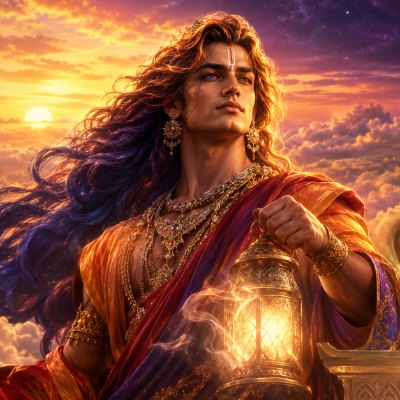
Dosha is one of the eight Vasus — the group of elemental divine beings associated with fire and light who form part of the thirty-three principal gods of the Vedic and Puranic tradition. He is the son of Vasu, daughter of Daksha Prajapati and his wife Asikni, and of Dharma, the personification of cosmic righteousness. Among the eight Vasus, Dosha is associated with evening, dusk, and darkness — his name being a Sanskrit word meaning the evening or the dark period — and he is listed as the sixth of the eight in the Bhagavata Purana's enumeration of the Vasus in Skandha 6, Chapter 6. He is the most minimally attested of all eight Vasus: his name appears exclusively in the Bhagavata Purana's genealogical scheme and is absent from the Mahabharata, Harivamsa, Vishnu Purana, Agni Purana, and Padma Purana name-lists, each of which assigns the sixth position to a differently named Vasu. What is recorded of Dosha in the primary texts amounts to three essential facts: his place in the Bhagavata Purana's list of eight, his wife Sharvari — Night personified — and his son Shishimara, who is identified in the Bhagavata Purana's cosmological scheme with the celestial arrangement of stars known as the Shishumara chakra. The Wisdomlib Puranic Encyclopaedia adds that Dosha is also described as a kala — a partial manifestation — of Vishnu, in keeping with the Bhagavata Purana's Vaishnava theological framework in which each of the eight Vasus is understood as an aspect of the supreme deity.
✦ The Name
The name Dosha in its first and primary sense as applied to this Vasu means evening, dusk, or darkness — the period of declining light at the end of the day. The Monier-Williams Sanskrit-English Dictionary records this meaning explicitly and notes that in this sense the word appears only in the Bhagavata Purana, where it is personified as one of the eight Vasus and husband of Night. The same dictionary records a second and entirely separate meaning of the word dosha: fault, defect, vice, or disease — the sense most familiar in modern usage through the tridosha system of Ayurvedic medicine, which classifies all bodily conditions according to three humours or constitutive forces named vata, pitta, and kapha, collectively called doshas in the sense of agents that can disturb health. The two meanings are distinct in Sanskrit, deriving from different roots — the first from a root associated with darkness, the second from the root dus meaning to be corrupted or to go wrong. As a Vasu, Dosha embodies the evening in its quality of natural elemental darkness, complementing Pratyusha the dawn. The Vedic and Puranic cosmological scheme consistently personifies the divisions of the day and night as divine beings; Dosha as the sixth Vasu represents the liminal transition from light to darkness, the hour of the evening that stands at the boundary between day and night.
✦ Lineage
- Father: Dharma — the personification of cosmic righteousness and duty; one of the creations of Brahma; husband of ten daughters of Daksha and Asikni in Daksha's second birth.
- Mother: Vasu — daughter of Daksha Prajapati and Asikni; mother of all eight Vasus.
- Brothers: The seven other Vasus as enumerated in the Bhagavata Purana, Skandha 6: Drona, Prana, Dhruva, Arka, Agni, Vasu, and Vibhavasu; and their equivalents in the Mahabharata, Harivamsa, and Vishnu Purana traditions — Dhara, Dhruva, Soma, Aha or Apa, Anila, Anala, Pratyusha, and Prabhasa.
- Wife: Sharvari — Night personified; her name is one of the Sanskrit words for night or the dark period of the cycle of day, particularly the deep night marked by stars. The pairing of Dosha the evening with Sharvari the night as husband and wife is cosmologically coherent: evening precedes and gives way to night, and the personification of evening as the husband of Night reflects the natural temporal sequence embedded in the divine genealogy.
- Son: Shishimara — also spelled Shishumara; the Porpoise or Dolphin; identified in the Bhagavata Purana's cosmological chapters with the celestial arrangement of stars known as the Shishumara chakra, a revolving wheel of stars in the shape of a porpoise or dolphin whose body maps specific constellations and luminaries in the northern celestial sphere, with Vishnu or the cosmic form of Dharma residing at its tail. This identification of Dosha's son with the stellar Shishumara places Dosha's lineage directly within the Bhagavata Purana's distinct cosmological vision of the universe.
✦ Dosha and the Bhagavata Purana's Cosmological Scheme
The Bhagavata Purana's enumeration of the eight Vasus in Skandha 6 is distinctive among the principal sources in two ways: it uses a different set of names from the Mahabharata and Vishnu Purana traditions, and it embeds those names in a richly elaborated theological framework in which each Vasu is understood as a partial manifestation or kala of Vishnu. The Wisdomlib Puranic glossary records that Dosha is described in this framework as a kala of Vishnu — one of the sixty-four or more partial aspects through which the supreme deity is held to pervade and sustain all cosmic phenomena. The evening, as the time of transition from light to darkness, is here invested with divine significance as an aspect of the all-pervading Vishnu, and Dosha as its personification is a Vasu whose elemental domain expresses one facet of that pervasion. The Bhagavata Purana's Skandha 2 and Skandha 5 develop a detailed cosmological picture of the universe in which stellar, planetary, and temporal phenomena are all understood as aspects of the cosmic form of Vishnu or of Dharma; the identification of Dosha's son Shishimara with the stellar chakra connects this Vasu's lineage directly to that cosmological vision.
✦ Position Among the Eight Vasus and the Question of Equivalents
Dosha holds the sixth position in the Bhagavata Purana's list of eight Vasus — Drona, Prana, Dhruva, Arka, Agni, Dosha, Vasu, Vibhavasu. This position corresponds to the sixth Vasu in the Mahabharata's list — Anala or the fire-Vasu — which creates an immediate problem of equivalence. The two lists do not align neatly, and there is no scholarly consensus on whether any specific Vasu in the Bhagavata Purana's enumeration corresponds one-to-one to a specific Vasu in the Mahabharata's. Some secondary sources suggest that Dosha may correspond to Aha — the Mahabharata's fourth Vasu, whose name means the day or the diurnal period — on the grounds that both are temporal personifications, but this identification is not established in any primary text. What is clear from the primary sources is that the Bhagavata Purana's list of eight Vasus is substantively different from the other principal lists and cannot be mapped onto them with certainty. Dosha as a named individual appears only within the Bhagavata Purana's scheme and has no direct equivalent in the other Vasu enumerations.
✦ The Curse of Vasishtha
As one of the eight Vasus, Dosha would by implication be among those cursed by the sage Vasishtha to take mortal birth following the theft of the divine cow Nandini, as narrated in the Mahabharata. The Bhagavata Purana itself does not separately narrate this episode in the context of its Skandha 6 enumeration of the Vasus. Since Dosha is named only in the Bhagavata Purana's list and not in the Mahabharata's, no individual narrative detail specific to Dosha appears in any primary source in connection with the curse, the mortal birth, or the episode with Ganga and Shantanu.
✦ Disambiguation
The name Dosha in the Hindu textual tradition designates at least three distinct figures or concepts that must be carefully separated. First, Dosha the Vasu treated in this profile: the son of Dharma and Vasu daughter of Daksha, the sixth of the eight Vasus in the Bhagavata Purana's enumeration, the personification of evening, husband of Sharvari, and father of Shishimara. Second, Dosha as a female figure: the Bhagavata Purana, Skandha 4, Chapter 13, records a figure named Dosha who is the wife of a king named Pushparna and the mother of three children named Pradosha — the evening twilight — Nishitha — the midnight — and Vyushtha — the dawn. This female Dosha is a personification of darkness in a different genealogical context from the Vasu Dosha, and the two must not be conflated. Third, dosha as a common Sanskrit noun meaning fault, defect, or vice — the sense in which it is most widely encountered in philosophical, legal, and Ayurvedic literature — which has no connection to the Vasu or the female figure bearing this name as a proper noun. Within Ayurveda specifically, the three doshas — vata, pitta, and kapha — are the three bodily humours whose balance or imbalance determines health, and while these are sometimes personified in a general sense as forces, they are entirely unrelated to the Vasu Dosha.
✦ Scarcity of Sources and Honest Assessment
Dosha is the most sparsely attested of all eight Vasus across the primary literature. He appears as a named individual exclusively in the Bhagavata Purana's Skandha 6, Chapter 6 genealogical passage. The Mahabharata, Harivamsa, Vishnu Purana, Agni Purana, and Padma Purana do not name him; the Puranic Encyclopaedia of Vettam Mani treats him only within the summary of the Ashtavasu entry and provides no independent article on Dosha as a figure. The three facts recorded about him — his place in the Bhagavata Purana's list, his wife Sharvari, and his son Shishimara — constitute the entirety of his individual attestation across all known primary sources accessible through modern scholarship. Any further information would require either consultation of unpublished or untranslated manuscript traditions or would risk entering the domain of inference rather than attested fact. This profile accordingly limits itself to what the primary sources directly record.
✦ References
Primary Sources
- Bhagavata Purana, Skandha 6, Chapter 6, verses 11 and 14 — the sole primary source naming Dosha among the eight Vasus, identifying him as the sixth Vasu in the Bhagavata's enumeration, and recording his wife and son. Verse 11 gives his place in the list; verse 14 records the genealogical detail of his family.
- Bhagavata Purana, Skandha 4, Chapter 13 — records the separate figure Dosha as the wife of Pushparna, from whom this Vasu Dosha must be distinguished; relevant for disambiguation.
- Bhagavata Purana, Skandha 5, Chapters 22–23 — describes the Shishumara chakra, the celestial arrangement of stars associated with Dosha's son Shishimara, within the Bhagavata Purana's distinctive cosmological vision.
Modern Reference Works
- Monier-Williams, A Sanskrit-English Dictionary (1899), entry on dosha — provides the clearest lexicographic confirmation of the primary meaning of the word as evening or darkness in its application to this Vasu, and explicitly notes its restriction to the Bhagavata Purana in this sense.
- Vettam Mani, Puranic Encyclopaedia (1975), entry on Ashtavasu — records Dosha among the eight Vasus in the Bhagavata Purana's list and notes his wife Sharvari and son Shishimara; does not provide a separate extended treatment.
- Wisdom Library (wisdomlib.org), entry on Dosha (Purana) — provides the Puranic glossary definition identifying Dosha as a Vasu, husband of Sharvari, father of Shishimara, and kala of Vishnu, with verse references to Bhagavata Purana Skandha 6.