
About
Shishumara — Partial Expansion of Vishnu and Presiding Deity of the Stellar Sphere
Shishumara · Shishumara-chakra-adhipati · Vishnu-amsha · Dosha-putra · Hari-svarupa
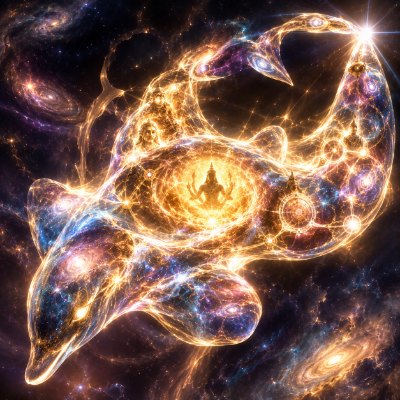
Shishumara is one of the most cosmologically distinctive figures in the Puranic tradition — simultaneously a being generated within the Vasu genealogical lineage and a partial expansion of Lord Vishnu himself, the supreme divine reality of the Vaishnava tradition. He is identified in the Bhagavata Purana at Canto 6, Chapter 6, Verse 14 as the son of the Vasu Dosha — one of the eight elemental cosmic powers — and his wife Sharvari, and is described in the same verse as a Vishnu amsha, a partial manifestation of Vishnu, and as the presiding deity of the stellar sphere. The most detailed account of Shishumara's cosmic identity and significance is found in the Bhagavata Purana's fifth canto, which describes the Shishumara chakra — the great celestial configuration in the form of a porpoise or aquatic creature whose body encompasses the arrangement of the stars and planets, with the pole star Dhruva located at its tail and the various planetary and stellar bodies distributed across its form. Shishumara is also the father of Bhrami, who married Dhruva Maharaja — the celebrated royal devotee elevated to the position of the pole star — and bore him the sons Kalpa and Vatsara, connecting Shishumara's divine lineage to the royal genealogical tradition of the Puranas. His narrative spans cosmological description, genealogical record, and Vaishnava theology in a manner that makes him one of the most theologically layered figures in the sixth and fifth canto material of the Bhagavata Purana.
✦ The Name
The name Shishumara is a Sanskrit compound of two elements. The first, shishu, means a young creature, an infant, or a young of any species — the word used for a child or baby in Sanskrit and also applied to young animals. The second element, mara, is connected to the verbal root mri, meaning to kill or to die, but in compound names of aquatic creatures it functions as a descriptive element identifying the animal type. Together the compound has been interpreted as referring to the Ganges river dolphin or the porpoise — an aquatic mammal known in Sanskrit as the shishumara — whose sinuous, curving body provided the visual template for the celestial configuration that bears the name. The Bhagavata Purana's fifth canto describes the Shishumara chakra as having the form of this aquatic creature coiled in the heavens, its body tracing the arrangement of the stars and planets in a configuration that the tradition understood as the visible form of the cosmic divine order. As a personal divine name, Shishumara therefore identifies its bearer as the presiding deity of this celestial configuration — the divine person whose body is the starry heavens in the form of the great aquatic creature. The epithet Shishumara-chakra-adhipati means "lord of the Shishumara wheel or circle," and Vishnu-amsha means "partial expansion of Vishnu."
✦ Lineage
- Father: Dosha, one of the eight Vasus, the elemental cosmic being whose name means dusk or twilight, the transitional period between the light of day and the darkness of night during which the stellar sphere that Shishumara governs begins to become visible.
- Mother: Sharvari, whose name means night, the divine consort of Dosha identified in the Bhagavata Purana at Canto 6, Chapter 6, Verse 14 as the mother of Shishumara. The pairing of dusk and night as his parents gives Shishumara's origin a cosmological coherence: he is the presiding deity of the stellar heavens, and the heavens in their stellar aspect are visible only in the darkness that dusk inaugurates and night sustains.
- Daughter: Bhrami, whose name means "she who revolves" — an epithet of profound appropriateness for the daughter of the presiding deity of the revolving stellar sphere — identified in the Bhagavata Purana at Canto 4, Chapter 13, Verse 13 as the wife of Dhruva Maharaja and the mother of Kalpa and Vatsara.
- Daughter: Shambhu, identified in the Puranic tradition as another daughter of Shishumara who also became a wife of Dhruva Maharaja and the mother of Shlishti, though the specific primary source verse confirming Shambhu's parentage from Shishumara has not been registered in this series at the time of this profile's composition.
✦ Shishumara as Vishnu Amsha
The theological identification of Shishumara as a Vishnu amsha — a partial expansion or partial manifestation of Vishnu — is the most theologically significant detail in the Bhagavata Purana's genealogical verse at 6.6.14. The concept of amsha in Vaishnava theology refers to the process by which the supreme divine reality of Vishnu manifests in partial or differentiated forms without diminishing its own completeness — a theological principle articulated most systematically in texts such as the Brahma Samhita and elaborated throughout the Bhagavata Purana. The partial expansions of Vishnu in Puranic theology range from the great avatars such as Rama and Krishna, who are understood as complete or near-complete manifestations, to more partial expansions that govern specific cosmic functions. Shishumara's identification as a Vishnu amsha places him in this latter category — a divine being whose specific function as the presiding deity of the stellar sphere represents a particular and bounded manifestation of Vishnu's universal sovereignty over the cosmic order. This means that the worship of Shishumara as the presiding deity of the stellar configuration is, within the Vaishnava theological framework, a form of Vishnu worship — a point made explicit in the Bhagavata Purana's fifth canto account of the Shishumara chakra.
✦ The Shishumara Chakra — The Stellar Form
The Bhagavata Purana's fifth canto contains the most detailed description of the Shishumara chakra — the great celestial configuration whose form is that of the aquatic creature called the shishumara, coiled in the heavens with specific stars and planets identified with specific parts of its body. The pole star Dhruva — the fixed celestial point around which the entire stellar sphere revolves, and the transformed form of Dhruva Maharaja himself following his elevation by Vishnu's grace — is located at the tail of the Shishumara's body. The various stars of what modern astronomy identifies as the constellation Draco and adjacent regions are distributed across the configuration's coiling body, with specific divine beings and cosmic principles associated with each stellar location. The planets and other celestial bodies are also positioned within the Shishumara's form in the fifth canto's description, giving the configuration a comprehensive cosmological scope that encompasses the entire visible heavens as understood within the Puranic astronomical tradition.
The Bhagavata Purana instructs that the contemplation and worship of the Shishumara form — the visualisation of the entire stellar sphere as the body of this divine aquatic being who is a partial expansion of Vishnu — is a legitimate and meritorious form of devotional practice. This instruction transforms the astronomical description of the fifth canto from a merely cosmological account into a devotional one, in which the act of observing the night sky becomes, for the properly instructed practitioner, an act of divine contemplation. Shishumara as the presiding deity of this configuration is therefore not merely a genealogical figure but an object of contemplative worship whose body is literally visible in the heavens every clear night.
✦ Shishumara's Daughters and the Connection to Dhruva
The genealogical connection between Shishumara and Dhruva Maharaja — established through the marriages of Shishumara's daughters Bhrami and Shambhu to Dhruva — carries a cosmological resonance of extraordinary elegance within the Puranic tradition. Dhruva, through his childhood austerities and Vishnu's grace, was elevated to the position of the pole star — the fixed point at the tail of the Shishumara's celestial body in the fifth canto's cosmological description. He became, in other words, a part of Shishumara's own stellar form. The subsequent marriage of Shishumara's daughters to Dhruva therefore represents a genealogical union between the presiding deity of the stellar sphere and the being who had been elevated to become that sphere's fixed central point — a union whose cosmological dimensions mirror and reinforce its genealogical ones. The children of Dhruva and Bhrami — Kalpa and Vatsara — and of Dhruva and Shambhu — Shlishti — descend from both the devotee who became the pole star and the deity whose body encompasses the heavens, a lineage of remarkable cosmic density.
✦ Connection to the Wider Genealogy
Shishumara's genealogical position connects the Vasu cosmic order to the royal human genealogies of the Puranic tradition through the medium of his daughters' marriages to Dhruva. Through his father Dosha he is connected to the eight Vasus and through them to the Daksha genealogical framework of the sixth canto. Through his mother Sharvari he is connected to the cosmological principle of night as a divine reality. Through his daughter Bhrami and her sons Kalpa and Vatsara he is the grandfather of figures who appear in the Puranic genealogical lists of the early royal lines. Through his daughter Shambhu and her son Shlishti he is the ancestor of a line that descends through Ripu and Chakshusa to Chakshusha Manu — the sixth of the fourteen Manus who preside over the cosmic time cycles — giving his lineage a significance that extends to the very structure of cosmic time as the Puranic tradition understands it. As a Vishnu amsha he is simultaneously a particular genealogical figure and a universal theological one, his identity as the stellar deity inseparable from his identity as a partial manifestation of the divine sovereignty that the Bhagavata Purana places at the centre of all existence.
✦ References
Primary Sources
- Bhagavata Purana, Canto 6, Chapter 6, Verse 14: The primary genealogical source for Shishumara, explicitly naming him as the son of the Vasu Dosha and his wife Sharvari, and identifying him as a partial expansion of Vishnu and the presiding deity of the stellar sphere.
- Bhagavata Purana, Canto 5: Contains the most detailed cosmological account of the Shishumara chakra — the celestial configuration in the form of the aquatic creature whose body encompasses the arrangement of the stars and planets — and the instruction for its contemplation as a form of Vishnu worship, providing the essential theological and cosmological context for understanding Shishumara's divine identity.
- Bhagavata Purana, Canto 4, Chapter 13, Verse 13: Records the marriage of Shishumara's daughter Bhrami to Dhruva Maharaja and the birth of Kalpa and Vatsara, establishing the continuation of Shishumara's lineage through the royal genealogical tradition of the Puranas.
Modern Reference Works
- Vettam Mani, Puranic Encyclopaedia (1975): Provides consolidated entries on Shishumara and the Shishumara chakra, summarising the cosmological and genealogical material across the Bhagavata Purana's fifth and sixth cantos and situating Shishumara within the broader Vaishnava theological tradition of divine partial expansions.
- Wisdomlib (wisdomlib.org), entries on Shishumara and the Shishumara chakra: Aggregates Sanskrit textual references to Shishumara across Puranic sources, useful for cross-referencing the genealogical account of the sixth canto against the cosmological account of the fifth canto.