
About
Dadhicha (Dadhichi) — The Sage Whose Bones Made the Vajra, Knower of the Madhu Vidya, Supreme Example of Bodily Sacrifice
Dadhicha · Dadhichi · Dadhīci · Dadhyanga · Dadhyanca · Dadhyak · Ashvashira · Bhargava · Chyavana-putra · Atharvan-putra · Suvarcas-pati · Pippalada-pita · Vajra-asthi-data · Vritra-vadha-nimittakartr · Madhuvidya-jnata
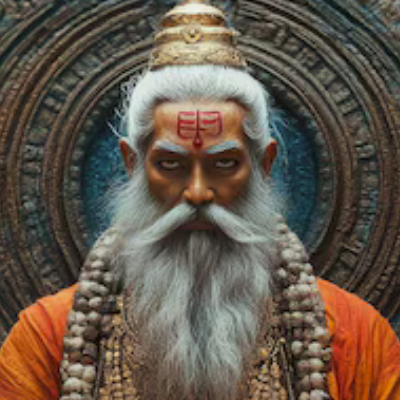
Dadhicha — also written Dadhichi, Dadhyanga, and Dadhyak — is one of the most celebrated sages in the Hindu tradition; the husband of Suvarcas (also written Suvarcha and Swarcha); the father of the sage Pippalada — the founder of the Pippalada school of Vedic thought and the narrator of the Prashna Upanishad; the knower of the secret Madhu Vidya (the knowledge of immortality); the sage whose head was replaced with a horse's head — earning him the name Ashvashira, the horse-headed one — when Indra beheaded him for teaching the Madhu Vidya to the Ashvini Kumaras; and, above all, the sage who willingly gave his life — dissolving his life force through yogic power after consuming all the holy rivers at Naimisharanya — so that the divine craftsman Vishvakarma (or Brahma or Tvashtr, depending on the source) could fashion the Vajrayudha (the divine thunderbolt) from his spine, the weapon with which Indra killed the cosmic demon Vritra and restored the flow of all blocked rivers and waters to the world. He is described as one of the greatest sages of the Bhrigu clan, the possessor of bones so hard that they could not be matched by any substance in the three worlds — hardness given to him by Shiva as a boon — and as a devotee of both Shiva and Vishnu. The symbol of his spine-derived Vajra is used on India's highest military honour, the Param Vir Chakra. The Dadhich Brahmins of Rajasthan trace their lineage to him. His ashrama at Misrikh in Naimisharanya near present-day Lucknow in Uttar Pradesh is mentioned in all the Puranas and the site still exists as a place of pilgrimage. His story is attested in the Rigveda (Mandala 1), the Mahabharata (Vana Parva), the Bhagavata Purana (Canto 4 and 6), the Devi Bhagavata Purana, the Brahma Purana, the Shiva Purana, and the Linga Purana.
✦ The Names
The name Dadhicha — written Dadhīci — is explained by Panini (Ashtadhyayi) as deriving from dadhya (curd, from dadhi — curdled milk) and anga (body) — meaning he whose body is made strong by curd or the curd-bodied one. The curd-connection is more than etymological: the tradition records that Dadhicha's bones were especially hard because of his practice of rubbing his body with curd while reciting Vedic mantras — a spiritual-physical discipline that over time transformed the texture of his bones to the hardest substance in the three worlds. The alternate name Dadhyanga (sometimes Dadhyanca or Dadhyancha) is the longer form of the same compound: dadhi (curd) + anga (body). The name Ashvashira — the horse-headed one — records the episode in which his head was replaced with a horse's head to protect him from Indra's threatened beheading. The name Dadhyak appears in the Rigveda (Mandala 1, Hymn 84, Verse 13–15) in the context of the Ashvins and the Madhu Vidya.
✦ Lineage — Two Incompatible Traditions of Parentage
Two incompatible traditions record Dadhicha's parentage and they cannot be resolved from the available primary evidence. The Bhagavata Purana (Canto 4, Chapter 1) identifies Dadhicha as the son of Atharvan — a sage who is the son of Brahma and is considered the author or perceiver of much of the Atharvaveda — and his wife Chitti, who was the daughter of the sage Kardama (and thus the sister of the divine philosopher Kapila and the eight other daughters given to the Prajapati sages, including Khyati who married Bhrigu). In this tradition Dadhicha belongs to the Atharvan-Brahma lineage rather than the Bhrigu-Chyavana lineage. The Brahmanda Purana and several secondary sources drawing from the broader Bhrigu lineage tradition identify Dadhicha as the son of Chyavana (son of Bhrigu and Puloma) and his wife Sukanya (daughter of King Sharyati) — and thus a grandson of Bhrigu through Chyavana. This tradition is consistent with the Vedadhara source's statement that his father was Bhrigu Maharshi, and with the broader Bhrigu clan tradition in which Dadhicha is counted among the Bhargavas. The TemplePurohit source records a narrative that quotes Chyavana explicitly as Dadhicha's father. Both traditions agree that Dadhicha belonged to the broad Bhrigu-Bhargava clan in some capacity — whether as Bhrigu's direct lineage descendant through Chyavana, or as a figure whose Bhargava connection is through clan association rather than direct patrilineal descent. The Chyavana-son tradition is followed in this series as the primary identification, consistent with the genealogical framework already established in the Chyavana, Sukanya, and Apnavana profiles. The Atharvan-son tradition is recorded here for completeness.
- Father (primary tradition — Bhrigu lineage): Chyavana — son of Bhrigu and Puloma; the sage restored to youth by the Ashvini Kumaras; creator of Chyavanaprasham; father of Apnavana; profiled separately in this series
- Mother (primary tradition): Sukanya — daughter of King Sharyati; the devoted wife who identified Chyavana among three identical divine youths; profiled separately in this series
- Father (Bhagavata Purana tradition): Atharvan — son of Brahma; author or perceiver of the Atharvaveda; a distinct figure from Bhrigu's lineage entirely
- Mother (Bhagavata Purana tradition): Chitti — daughter of the sage Kardama; sister of the divine philosopher Kapila
- Brother (Chyavana-son tradition): Apnavana — the other son of Chyavana and Sukanya; whose son was Aurva; whose descendant was Jamadagni and then Parashurama; profiled separately in this series
- Wife: Suvarcas — also written Suvarcha and Swarcha in variant spellings; who was about to enter her husband's funeral pyre after his death when a celestial voice stopped her by revealing she was pregnant; who then removed the foetus from her womb and placed it at the foot of a banyan tree before ending her own life; from that foetus grew Pippalada
- Son: Pippalada — born from the foetus placed at a banyan tree after his father's death and his mother's self-immolation; who grew to be a great sage; the founder of the Pippalada school of the Atharvaveda; the narrator of the Prashna Upanishad — one of the ten principal Upanishads — in which six disciples came to him with six questions about the nature of the cosmos, consciousness, and liberation; whose name Pippalada (from Pippala, the sacred fig or Ashvattha tree, associated with Vishnu and with the Brahma Vidya) records his birth at the foot of a banyan or fig tree
- Spiritual lineage: counted among the greatest sages of the Bhrigu-Bhargava clan; ancestor of the Dadhich Brahmin community of Rajasthan who trace their descent to him; revered in all major Puranas as the supreme example of selfless sacrifice for the world's good
✦ The Madhu Vidya — The Horse-Head Episode
Dadhicha was the master of the Madhu Vidya — a form of Brahma Vidya, the knowledge of ultimate reality, described in the Rigveda (Dadhyak is called the teacher of Madhu Vidya in Mandala 1) as the secret knowledge through which one could attain immortality in Brahmaloka. Indra, ever insecure about his position as king of heaven, feared that any mortal who possessed this knowledge could use it to challenge his supremacy. He warned Dadhicha that if he ever taught this knowledge to anyone else, he would behead him. The Ashvini Kumaras — the twin divine physicians — desperately wanted to learn the Madhu Vidya. They approached Dadhicha and proposed a plan: they would remove his head and replace it temporarily with a horse's head. Dadhicha would teach them the Madhu Vidya through the horse's mouth. When Indra arrived and beheaded the horse-headed sage in his fury — thinking he was stopping the transmission — the real Dadhicha's head would be safely preserved. After Indra's departure, the Ashvini Kumaras would restore his original head and revive him with the same Madhu Vidya they had just learned. The plan was carried out exactly. Dadhicha taught the Madhu Vidya through his horse-head. Indra, discovering that Dadhicha had defied his prohibition, beheaded the horse-headed sage and departed. The Ashvini Kumaras restored Dadhicha's original head. Dadhicha was revived. He came to be known as Ashvashira — the horse-headed one — for the period he bore the horse's head. The same horse's head that Indra cut off became useful to Indra later in a different episode. This sequence also established the pattern of Dadhicha's relationship with Indra: the two were in repeated conflict and then mutual service — Indra who had once beheaded him being the same Indra who would later come to him for his bones.
✦ The Boon from Shiva — Bones of Indestructible Hardness
The Shiva Purana and Linga Purana record the episode in which Dadhicha received the boon of indestructible bones. A dispute broke out between Dadhicha and King Kshuva — a great devotee of Vishnu — about the relative superiority of Brahmin knowledge over Kshatriya force. The argument escalated to physical violence. Dadhicha struck the king on the head with his left fist. The king retaliated with the Vajra (the divine thunderbolt), which struck Dadhicha with such force that it nearly killed him. Dadhicha called on his ancestor Shukra — identified in this Shiva Purana episode as his ancestor rather than his father, consistent with the broader Bhrigu-Bhargava clan connection — who employed his yogic powers to restore Dadhicha's limbs and taught him the Mahamrityunjaya Mantra to propitiate Shiva. Shiva appeared before Dadhicha and offered him any boon. Dadhicha asked for three: indestructible bones, immortality, and freedom from distress. Shiva granted all three. The boon of indestructible bones — given by Shiva — is the theological foundation for why Dadhicha's bones alone could make the Vajra that no other material could produce. When Dadhicha later offered his bones to the devas, he was offering the indestructibility that Shiva had given him.
✦ The Weapons of the Devas — The Dissolved Arsenal
The Brahma Purana and one tradition within the Bhagavata Purana record a different prelude to the bones episode. During a period when the Asuras were employing arcane arts to steal the weapons of the devas, Indra and the other gods came to Dadhicha and asked him to safeguard their divine weapons in his hermitage. Dadhicha agreed, though his wife warned him of the dangers. He kept the weapons faithfully — for an extraordinarily long time. The devas did not return. Dadhicha waited. He waited for so long — different sources give different durations, the Vedadhara source suggesting thousands of years — that he eventually concluded that the devas were not coming back. Rather than allowing the weapons to fall into Asura hands by simple neglect, he took the entire divine arsenal, reduced it to water through his Vedic power of mantra, and drank it. The divine weapons dissolved into the water and were absorbed into his body — becoming part of his bones, infused into the calcium and marrow of his skeleton. The divine weapons and the already-indestructible bones were now one. When the devas eventually returned and discovered what had happened, Dadhicha informed them: their weapons were now in his bones. There was only one way to get them back — they could use his bones to make new weapons, which would carry the power of the original divine arsenal plus the hardness of Shiva's boon. Dadhicha offered his life freely.
✦ The Sacrifice — The Most Celebrated Act of Bodily Renunciation
When Vritra — the cosmic demon — had been defeated Indra in battle, expelled him from heaven, and blocked all the rivers and waters of the world, Indra and the devas went to Brahma in desperation. Brahma directed them to seek the bones of Dadhicha — and revealed that only a weapon made from those bones could kill Vritra. Indra and the devas came to Dadhicha's ashrama at Naimisharanya. They found the sage and explained their need. Dadhicha gave his immediate consent — without hesitation, without negotiation, without regret. He asked only for one grace: to be allowed to complete a pilgrimage to all the holy rivers before giving up his life. Indra — who had once beheaded him — now brought all the holy rivers to Naimisharanya rather than delay the sacrifice by the time it would take for the aged sage to travel. With this act of Indra's extraordinary generosity, Dadhicha's final wish was fulfilled at his own doorstep. The sage bathed in the assembled holy waters. He sat in deep meditation. He drew his life force upward through the yogic process of Prana Utkramana — the release of the vital breath — and departed. His body remained. The devas — or Brahma, or Vishvakarma, or Tvashtr in different sources — fashioned from his bones an enormous arsenal of divine weapons. The Vajrayudha — the thunderbolt — was made from his spine. With it, Indra killed Vritra. The rivers flowed again. Heaven was restored. The cosmic waters returned to the world. All of this was the consequence of a single act of voluntary self-dissolution by a sage who said — this body will anyway wither away one day. If it can serve some useful purpose, so be it. The words are among the most compressed theological statements in the tradition. They locate the body's value not in its duration but in its use — and they locate the highest use not in personal achievement but in service to the world's continuity. Dadhicha's sacrifice is remembered not as a tragedy but as the most complete expression of what the tradition calls Nishkama Karma — action without attachment to the results, without even attachment to the actor's continued existence.
✦ Pippalada's Grief — The Posthumous Son
When Suvarcas heard of her husband's death she prepared to enter his funeral pyre. A celestial voice — an Ashareerivani — stopped her, informing her she was pregnant. She removed the foetus from her womb with a stone and placed it at the foot of a banyan tree, then ended her own life. The child — Pippalada — grew to manhood sustained by the banyan's fruit and by the power of his father's spiritual lineage. When he grew up he was consumed with grief and fury at the devas who had caused his father's death and his mother's suicide. He sought revenge on the Navagrahas (the nine planetary deities). The devas and Brahma appeased him, explaining the cosmic necessity of his father's sacrifice. Pippalada was eventually reconciled and redirected his enormous intelligence and spiritual inheritance toward teaching — producing the Prashna Upanishad in the form of six disciples' six questions about ultimate reality.
✦ Legacy — Param Vir Chakra and the Dadhich Brahmins
The Param Vir Chakra — India's highest military honour, awarded for acts of extraordinary bravery in the presence of the enemy — bears on its reverse the image of the Vajra made from Dadhicha's bones. The designer of the medal, Savitri Khanolkar, chose this symbol specifically to represent the willingness to sacrifice one's body for the country's protection — the precise quality for which the award is given. Every Param Vir Chakra winner shares, in the tradition's symbolism, in the quality that Dadhicha embodied. The Dadhich Brahmin community of Rajasthan — also called Dadhicha Brahmins — trace their patrilineal descent to the sage and have maintained this genealogical identity across many generations, their gotra and pravara recitations preserving his name in the living ritual tradition alongside the Srivatsa gotra's Apnavana-Aurva-Jamadagni chain.
✦ References
- Rigveda (Mandala 1, Hymns 84 and 116–117) — the earliest canonical attestation: Dadhyak (Dadhicha) named as the teacher of Madhu Vidya; the Ashvini Kumaras receiving the secret teaching; the horse-head episode implied in the Vedic hymns
- Mahabharata (Vana Parva — the Vritra and Dadhicha episode narrated by Lomasha to Yudhishthira during the forest pilgrimage) — the primary epic account: Dadhicha's willing sacrifice; the Vajra fashioned from his spine; Indra killing Vritra
- Bhagavata Purana (Canto 4, Chapter 1 — genealogy identifying Dadhicha as Atharvan's son; Canto 6, Chapters 9–12 — the Vritra episode and Dadhicha's sacrifice narrated in full)
- Brahma Purana — the divine weapons entrusted to Dadhicha; his dissolving them into water and drinking; informing the devas they are now in his bones; the free offering of his life
- Shiva Purana and Linga Purana — the Kshuva episode; the Vajra strike nearly killing Dadhicha; Shukra's restoration; the Mahamrityunjaya Mantra; Shiva's boon of indestructible bones
- Devi Bhagavata Purana — Dadhicha's role as Hinglaj Devi's rishi; his protecting Kshatriyas from Parashurama's wrath at his ashrama; Hinglaj Devi invoked for their protection
- Wikipedia — Dadhichi; Vedadhara — Dadhichi; TemplePurohit — Story of Maharishi Dadhichi; Bhakti4Mukti — How Did Indra Get Vajrayudha; Bhagavan Bhakthi — Dadhichi Sacrifice Story; Ananta Himalayas — Sage Dadhichi; The Jaipur Dialogues — Maharshi Dadhichi; Amritapuri — Dadhichi Saves the Gods: modern summaries drawing from the above primary sources