
About
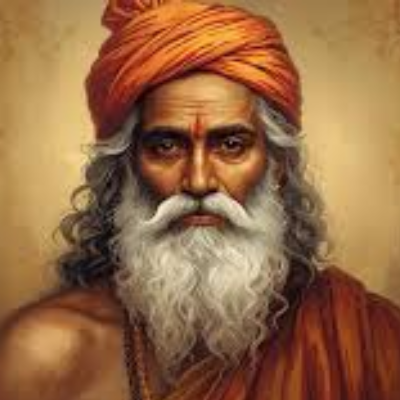
Pippalada — Son of Dadhicha, Founder of the Pippalada School, Narrator of the Prashna Upanishad, Amsha of Shiva, Subduer of Shani
Pippalada · Pippalāda · Pippala-putra · Dadhicha-suta · Suvarcas-tanaya · Padma-pati · Prashna-Upanishad-vakta · Atharvaveda-acharya · Shiva-amsha · Shani-vijetr · Pippalada-shakha-sthapaka
Pippalada is the son of the sage Dadhicha — who gave his bones for the Vajra — and his wife Suvarcas; a great sage and philosopher; the founder of the Pippalada school of Vedic thought which taught the Atharvaveda; the narrator of the Prashna Upanishad — one of the ten principal Mukhya Upanishads, addressing six fundamental questions about the cosmos, consciousness, sleep, and liberation; an amsha of Shiva according to the Shiva Purana's Saturudra Samhita, which lists Pippalada as one of Shiva's incarnations across the Yuga cycles; the sage who in his grief and rage performed intense tapas and attempted to destroy the devas by summoning a mare-like Asura from Shiva's third eye; who was reconciled by Brahma and eventually settled down; who met and married the princess Padma, daughter of King Anaranya; and the sage whose encounter with the planet Shani (Saturn) resulted in Shani's defeat and Pippalada extracting significant concessions regarding Saturn's impact on humanity — restrictions that the tradition still observes. He was raised under a banyan or pipal tree with no human guardian, nourished by the amrita that Chandra (the moon) sent through the tree, protected by Vishnu, found and named by the sage Narada — his entire early life was formed outside the human household, under the sky and the tree, sustained by the cosmos itself.
✦ The Name
The Sanskrit name Pippalada — written Pippalāda — is a compound of pippala (the sacred fig tree, the Ashvattha, Ficus religiosa — the tree under which the Buddha also attained enlightenment, and which in the Hindu tradition is associated with Vishnu and with eternal Brahma Vidya) and ada (eating, one who eats — from the root ad, to eat). The compound means the one who ate of the pippala tree, the one sustained by the sacred fig. The name directly records his childhood — the infant placed at the foot of the banyan or pipal tree who survived by consuming its sap and fruit. Narada, finding him there, named him for this sustaining relationship with the sacred tree. The Prashna Upanishad and the Pippalada school of the Atharvaveda both take their names from his, making the pipal tree's nourishment permanently recorded in the titles of the texts he founded.
✦ Lineage
- Father: Dadhicha — son of Chyavana and Sukanya (primary tradition) or of Atharvan and Chitti (Bhagavata Purana); who gave his bones for the Vajra; the supreme example of bodily sacrifice for the world's good; profiled separately in this series
- Mother: Suvarcas — who removed the foetus from her own womb before entering the funeral pyre; profiled separately above
- Paternal grandparents (primary tradition): Chyavana and Sukanya — the sage restored to youth by the Ashvini Kumaras and his devoted wife; both profiled separately in this series
- Paternal great-grandfather (primary tradition): Bhrigu — one of the seven Saptarishis
- Childhood guardian: the pipal tree — which sheltered him; Chandra who sent amrita through it; Vishnu who protected him; and eventually Narada who found him, named him, and initiated him
- Wife: Padma — daughter of King Anaranya; recorded in the Shiva Purana; who came to Pippalada when he was consumed by lust on his way to the Pushpabhadra river in the Himalayas; who was given to him in marriage by her father; described in the Hindu Temple Talk source as devoted and virtuous even in the face of her husband's demanding and unconventional nature
- Cosmic identity (Shiva Purana, Saturudra Samhita): an amsha of Shiva — one of Shiva's incarnations across the Yuga cycles; listed among the nine Shiva avatars alongside Dakshinamurti, Virabhadra, Durvasa, Ashvatthama, Shuka, Sharabha, Bhairava, and Grihapati
- Alternate birth tradition (Hindu Temple Talk source): the Hindu Temple Talk source records a second birth tradition in which Pippalada was born of an accidental insemination involving the hermit Yajnavalkya and his sister Kamsari — Yajnavalkya and his two wives found the unconscious Suvarcas under a tree, revived her, and she died of shame; the child was then cremated and Pippalada sustained himself on the pippala tree's juice; Narada found him and explained he was an incarnation of Brihaspati whose duty was to preach the Atharvaveda; this tradition cannot be harmonised with the primary Dadhicha-Suvarcas tradition and is recorded here for completeness
✦ Childhood — Under the Tree, Found by Narada
The infant Pippalada lay at the foot of the sacred tree with no human guardian. The tree sheltered him. Chandra sent amrita — the nectar of immortality — through the tree to sustain the child. Vishnu watched over him. The cosmos that had demanded his father's death now nurtured his life. When Narada came upon him, he understood immediately who the child was — the posthumous son of the great sacrifice. He explained to the child, when the child was old enough to understand, exactly what had happened: his father had been Dadhicha, who had given his bones for the Vajra and thereby made possible the killing of Vritra and the restoration of the cosmic waters; his mother had been Suvarcas, who had removed him from her own womb and placed him under this tree before entering the fire. Both parents were gone because of the devas' demand for his father's life. Narada initiated Pippalada with the sacred thread ceremony and gave him his name — Pippalada, the one fed by the pipal tree. Then Narada departed. Pippalada was left with the knowledge of his origins, alone under the tree, with the full weight of his parents' sacrifices and deaths now comprehended.
✦ The Vendetta — Shiva's Third Eye and the Mare Asura
The Brahma Vaivarta Purana records that Pippalada, now fully aware that the devas had caused both his parents' deaths — his father by demanding his bones, his mother by the cosmic chain that followed — was consumed with rage and resolved to destroy them all. He performed the most intense tapas of his life to propitiate Shiva, seeking the power to annihilate the devas. Shiva, pleased with his penance, told him he would be given the power to see Shiva's third eye — the eye that had incinerated Kamadeva — and that from this third eye a mare-like Asura would emerge to carry out his vendetta. When Pippalada's tapas was complete and he gained the sight of Shiva's third eye, a fierce mare-like Asura emerged from it. Pippalada commanded the Asura to destroy the devas. The Asura began to comply. The devas fled in terror. No divine being could stop the advance of an Asura born from Shiva's own third eye. Brahma came before Pippalada and argued that the destruction of the devas would not bring his parents back — that his father had given his life willingly, as the supreme act of a sage who understood that the body's highest use is service to the world's good; that his mother had made her own decision at the fire; and that a sage of Pippalada's lineage and potential was not meant for revenge but for teaching. The argument reached Pippalada. He agreed to stop the vendetta. But before releasing the Asura he extracted two concessions from the assembled cosmos — described in different sources as requests made of Brahma, or of Shani, or both.
✦ The Subduing of Shani — The Orphan's Compassion
Two parallel versions of Pippalada's encounter with Shani (the planet Saturn) exist — one in the Brahma Vaivarta Purana tradition and one in the folk tradition recorded in the Medium source. In the Brahma Vaivarta Purana tradition, Pippalada invoked Shani and began burning him with a gaze empowered by a boon from Brahma. Shani burned. The gods and Surya (Shani's father) were helpless. Brahma intervened, offering Pippalada two boons to release Shani. The requests Pippalada made reflect not vengeful demands but the compassion of a child who knew what orphanhood and planetary adversity meant: that Shani would not appear in the horoscope of any child under the age of five, so that no child would become an orphan as he had; and that anyone who worshipped the pippala tree before sunrise would be protected from Shani's adverse influence — so that the tree that had saved his own life would protect others from the suffering he had known. Brahma granted both. Pippalada freed the burning Shani. Shani's injury from the burning — his legs were damaged — left him with a slow, limping gait, which explains his name Shanaicharah, the one who moves slowly. In the folk tradition from the Bali Padma Bhuwana source, the encounter is framed as a fight in which the young Pippalada — still a child — took a branch from the banyan tree and physically went to Shani's planet, fought him, and defeated him, extracting the same two concessions by force before returning. Both versions record the same concessions and the same compassionate logic behind them — the orphan under the tree demanding that the planet of adversity spare other children the experience he had known.
✦ Reconciliation — Reunion With His Parents
The Wikipedia Pippalada article records that after Pippalada's reconciliation with Brahma and the cessation of his vendetta, his parents — Dadhicha and Suvarcas — appeared before him in divine form. They asked him to settle down and bear children. Their appearance was both a reunion and a release — the parents whose deaths had defined his entire early life came to him not as ghosts of grievance but as completed divine beings asking him to live fully and continue the lineage. He accepted. He met and married Padma. He composed the Prashna Upanishad. He established the Pippalada school of the Atharvaveda. The sage who had been born without parents, who had been raised by a tree and a god, who had tried to destroy heaven in grief, became the narrator of one of the tradition's most philosophically profound texts about the nature of consciousness, breath, sleep, and liberation.
✦ The Prashna Upanishad — Six Questions, Six Answers
The Prashna Upanishad — one of the ten Mukhya (principal) Upanishads, belonging to the Pippalada school of the Atharvaveda — is a dialogue in which six sages come to Pippalada with six fundamental questions about the nature of existence. The six were Sukesha Bharadvaja, Saivya Satyakama, Sauryayanin Gargya, Kaushalya Ashvalayana, Bhargava Vaidarbhi, and Kabandhin Katyayana. Pippalada asked them to live with him for a year, performing tapas and practising brahmacharya, before he would answer. At the end of the year they asked their questions. The six questions addressed: the origin of all beings (Praja Pati as the source); the question of which deity is greatest among those who sustain the body (Prana — the life breath); the question of the origin of Prana itself; the question of what happens in sleep and who in the body then sees dreams; the question of the meditation on Om; and the question of who in the sixteen-part Purusha is the knower of the self. Pippalada's answers constitute the six chapters of the Upanishad — a systematic philosophical text on cosmogony, physiology, consciousness, and liberation that remains one of the most philosophically precise of the minor Upanishads. The Pippalada school he founded is one of the two principal schools of the Atharvaveda — the other being the Shaunaka school — and remains an active lineage of Vedic transmission to the present day.
✦ As the Primal Seer of Dhumavati — The Tantric Dimension
The Wikipedia article quotes directly from a scholarly work on Pippalada's identity in the Shakta-Tantric tradition: Pippalada is not merely the speaker of the Prashna Upanishad — he is the primal seer and the first preceptor of the mantras and protective invocations (kavaca) of Bhagavati Dhumavati. Dhumavati is the seventh of the ten Dasha Mahavidyas — the widowed goddess, the goddess of inauspiciousness and sorrow, who is depicted as old, ugly, and widowed, riding a crow. She is revered within the Srividya and Kaula traditions and represents the wisdom that comes only through loss, deprivation, and sorrow. That Pippalada — the orphan who lost both parents before he could know them, who was raised by a tree, who tried to destroy heaven out of grief — should be identified as the first preceptor of the goddess who embodies sorrow and the wisdom of loss is one of the tradition's most theologically precise correspondences: the sage defined by grief became the first teacher of the goddess of grief's deepest wisdom.
✦ References
- Prashna Upanishad — the primary canonical source for Pippalada as a teacher and philosopher: the six sages; the year of brahmacharya; the six questions and their answers; the systematic philosophy of Prana, consciousness, Om, and the self; the Upanishad as the foundational text of the Pippalada school of the Atharvaveda
- Brahma Vaivarta Purana — Pippalada's vendetta against the devas; his tapas to Shiva; the third eye; the mare Asura; Brahma's intervention; the burning of Shani; the two compassionate boons (no Shani for children under five; pipal tree worship for protection); Shani's injury and slow gait; the reconciliation; the appearance of his parents
- Shiva Purana (Saturudra Samhita) — Pippalada as one of Shiva's nine avatars across Yuga cycles; the encounter with Princess Padma on the way to the Pushpabhadra river; the marriage
- Bhagavata Purana and Dadhichi Wikipedia article — the birth narrative: foetus extracted from Suvarcas's womb; placed at banyan tree; sustained by amrita from Chandra; Narada naming and initiating him
- Wikipedia — Pippalada — the most comprehensive modern reference: the birth; the Prashna Upanishad; the Pippalada school; the Shiva amsha identification; the Dhumavati connection; the Brahma Vaivarta Purana vendetta narrative; the alternate birth tradition through Yajnavalkya; the Shani episode
- Hindu Temple Talk — Sage Pippalada: Life and Legends; Medium — Dadhichi and Pippalada Story; Bali Padma Bhuwana — Pippalada Avatar of Shiva; Bhagavan Bhakthi — Lord Shiva Avatars; FactSnippet — 14 Facts About Pippalada: modern summaries drawing from the above primary sources