
About
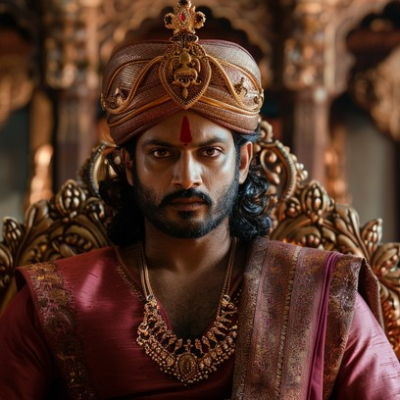
Anaranya (Shiva Purana) — King of Seven Continents, Devotee of Shiva, Father of Padma, the King Who Retired to the Forest
Anaranya · Anaraṇya · Mangalaranya-putra · Indrasavarni-vamsha-nripa · Padma-pita · Pippalada-shvaśura · Kirtiman-pita · Bhrigu-yajamana · Shivaloka-gamaka
Anaranya is a great king recorded in the Shiva Purana (Rudra Samhita, Parvati Khanda, Chapters 34–35); the son of Mangalaranya; a king of extraordinary power who ruled over the seven continents; a great devotee of Shiva; the father of one hundred sons and one beloved daughter Padma — who married the sage Pippalada (the orphaned son of Dadhicha, the narrator of the Prashna Upanishad, and an amsha of Shiva); and a king whose grief at giving his daughter to an ancient, emaciated sage led him to renounce his kingdom and retire to the forest, where through intense penance and Shiva's grace he attained Shivaloka. His story is narrated in the context of the Shiva Purana's account of Pippalada's incarnation as one of Shiva's avatars — the entire episode of Anaranya and Padma is framed as a story narrated by Vasishtha to Himavat (the mountain-king, father of Parvati) to illustrate the quality of the devotion shown by women who married sages far older and more austere than themselves. A critical note: two or more entirely distinct kings named Anaranya appear across the tradition. The figure profiled here — the Shiva Purana's Anaranya, son of Mangalaranya, father of Padma — is a different person from the more famous Ramayana Anaranya: the king of Ayodhya who was killed by Ravana and who cursed him that a descendant would bring his death, fulfilling in Rama. Both are kings of the Solar Dynasty, both bear the same name, but they belong to entirely different periods — the Shiva Purana explicitly states that its Anaranya hailed from the race of the fourteenth Manu Indrasavarni, a future cosmic age, making him a figure of the far future relative to the Ramayana's Anaranya who was Rama's distant ancestor in the Vaivasvata (seventh) Manvantara.
✦ The Name
The Sanskrit name Anaranya — written Anaraṇya — is a compound of the negative prefix an (without, not) and aranya (forest, wilderness, wild uncultivated land). The compound means the one without forest, the non-forest dweller, the one for whom there is no wilderness — suggesting a king of settled, cultivated civilisation whose domain has no wilderness remaining, implying the extent of his ordered rule over all regions. As a name it may record his power: a king whose dominion is so complete that even the forest has been brought under his governance, or a king of such royal quality that the wild is alien to his nature. The irony of the name's later resonance is quiet: the king called the one without forest ends his life in the forest — abandoning his kingdom for the aranya (wilderness) of penance after giving his daughter to a sage who emerged from a forest tree.
✦ Lineage
- Father: Mangalaranya — recorded in the Shiva Purana (Chapter 34, Verse 2) as Anaranya's father; his name means the auspicious forest, the blessed wilderness; no further details of his life or lineage are recorded in the sources available
- Dynastic affiliation: the Shiva Purana states he hailed from the race of the fourteenth Manu Indrasavarni — the last of the fourteen Manus; a cosmic age that has not yet arrived in the present era; a king of the Solar Dynasty in that distant future age; making him a figure of the far future from the perspective of the Mahabharata-Puranic present
- Priest: Bhrigu — the Saptarishi and progenitor of the Bhrigu lineage whose descendants include Chyavana, Sukanya, Dadhicha, and Pippalada; making the coincidence deeply ironic — the very sage whose lineage produced Dadhicha (Pippalada's father) served as the royal priest of Pippalada's future father-in-law; the same sage whose daughter Lakshmi (Bhargavi) married Vishnu served as the purohita of the king whose daughter would marry a Shiva amsha
- Wives: five queens — described in the Shiva Purana as endowed with great qualities and fortunes; loved by Anaranya over and above his life; unnamed individually in the primary source
- Sons: one hundred — of whom the eldest Kirtiman ruled the kingdom virtuously after his father's retirement; described as tending subjects like his own children
- Daughter: Padma — his only daughter; described as equal to Lakshmi in beauty and virtue; more beloved to him than all his hundred sons; who married Pippalada under duress; who served her husband with absolute devotion as Lakshmi serves Vishnu; who when tested by Dharma (who assumed the guise of a lustful king) refused to abandon her husband and cursed the disguised Dharma; profiled separately below in this series
- Son-in-law: Pippalada — the orphan sage raised under the pipal tree; son of Dadhicha and Suvarcas; amsha of Shiva; narrator of the Prashna Upanishad; who demanded Padma's hand under threat of burning the kingdom to ash; whose marriage to Padma the king accepted with grief at his counsellors' advice
✦ The King's Portrait — Power, Devotion, and Renunciation
The Shiva Purana's account of Anaranya (Chapter 34, narrated by Vasishtha to Himavat) presents him as one of the tradition's rare models of a king who possessed everything and refused to grasp for more. He was very strong and ruled over the seven continents — an extent of dominion that in the Puranic geographical model represents effective universal sovereignty. He was a great devotee of Shiva. With Bhrigu as his priest he performed a hundred Ashvamedha sacrifices — the royal horse sacrifice, each of which claimed universal sovereignty for the performer. The accumulated merit of a hundred Ashvamedhas was sufficient to challenge even Indra's position as king of the devas. The gods, recognising this, offered Anaranya the position of Indra — the kingship of heaven. He refused it. A king who refused Indra's position when it was offered freely — who had sufficient devotion and self-possession to decline the most coveted prize in the cosmos — is the tradition's portrait of a man entirely free from ambition's compulsion. He had five queens whom he loved above his own life; he had a hundred sons; he had a daughter whom he loved more than all his sons combined. Then Pippalada arrived and demanded that daughter.
✦ Giving Padma to Pippalada — The Forced Marriage and Its Consequence
The Shiva Purana (Chapter 34) narrates the sequence with the precise and unhurried attention of the Puranic story-telling style. Pippalada, returning to his ashrama along a forest path, saw a Gandharva couple engaged in pleasure and was suddenly overcome with desire for a wife. Enquiring locally, he heard of Padma — the daughter of King Anaranya, regarded as another Lakshmi, being sought by great kings as a bride. He went directly to Anaranya's court. The king received him with full honour — this was Pippalada, the son of the sage who had given his bones for the cosmic good, a figure of immense spiritual stature. He offered the Madhuparka (a formal welcoming gift of honey, curds, and water given to honoured guests) and worshipped him devoutly. Pippalada, his needs attended to, requested Padma's hand in marriage. The king was silent. The request was impossible — his young, beautiful daughter, sought by princes and kings across the world, being asked for by an ancient, emaciated sage consumed by decades of penance, whose body was described as old and weak. He could not bring himself to agree and he could not bring himself to refuse. Pippalada repeated his request: give me your daughter. The king remained silent. The sage then issued his threat directly: if the king did not give him Padma he would reduce the kingdom to ash. The king consulted his ministers. The ministers advised him that the sage was clearly an extraordinary being — an amsha of Shiva himself, beyond ordinary assessment — and that the welfare of the dynasty required compliance over personal sentiment. The king accepted their counsel, suppressing his grief. He gave Padma in marriage to Pippalada with all the ordained rites. When the couple departed for Pippalada's hermitage, the impact on the king was total: after giving his daughter to an old man, the king was much dejected in mind. Abandoning everything he went to the forest for performing penance. When the king went to the forest, his queen passed away due to the pangs of separation from her husband and daughter. Without the king, the respectable sons and officers of the king became distressed. The eldest son Kirtiman eventually took over the kingdom and ruled virtuously. Anaranya performed great penance in the forest, worshipped Shiva with devotion, and in the end attained Shivaloka — the divine realm of Shiva, free from all ailments. The tradition's account does not sentimentalise Anaranya's grief or condemn Pippalada's threat. Both are simply recorded. The king who had refused Indra's throne gave his daughter under duress to a sage he had not chosen, retired to the forest in grief, and attained liberation through devotion. The last act is the canonical statement about what the tradition considered most important: not the forced marriage, not the grief, but the fact that the grief drove him to the forest and the forest drove him to Shiva and Shiva gave him freedom.
✦ The Two Anaranyas — A Disambiguation
The Ramayana's Anaranya is a king of Ayodhya in the Solar Dynasty — a descendant of Ikshvaku, an ancestor of Rama, who was killed by Ravana in single combat before the main Ramayana events. As he lay dying after being struck by Ravana's mace, he cursed the demon king that a descendant of the Ikshvaku dynasty would bring about his death. This curse was fulfilled when Rama killed Ravana. The Brahmanda Purana (Chapter 45) records this episode. His position in the Solar Dynasty genealogy is given variously as: son of Bana and father of Prithu (Quora source, Wisdomlib Sanskrit dictionary); or son of Trasaddasyu and father of Haryashva (Bhagavata Purana 9.7.4); or son of Sambhuta and father of Prishadashva (other Puranic genealogies). The Wisdomlib Solar Dynasty genealogy source shows him at positions 6, 25, and 29 in different Puranic lists — reflecting the general Puranic variation in Solar Dynasty king sequences. This Anaranya has no daughter Padma and no connection to Pippalada. The Shiva Purana's Anaranya — profiled here — is explicitly described as belonging to the race of the fourteenth Manu Indrasavarni, a future cosmic age, and cannot be the same figure as the Vaivasvata Manvantara king who was Rama's ancestor. The shared name is a coincidence of the kind common in the tradition — the same name recurring across different cosmic ages in the same dynasty.
✦ References
- Shiva Purana (Rudra Samhita, Parvati Khanda, Chapter 34 — The Story of Anaranya) — the primary canonical source: Anaranya as son of Mangalaranya; his rule over seven continents; Bhrigu as his priest; the hundred sacrifices; his refusal of Indra's position; his five queens; his hundred sons and beloved daughter Padma; Pippalada's arrival and demand; the king's silence; the threat; the counsellors' advice; the forced marriage; the king's grief and renunciation; his queen's death from separation; Kirtiman's assumption of the kingdom; Anaranya's attainment of Shivaloka
- Shiva Purana (Chapter 35 — The Story of Padma and Pippalada) — the continuation: Padma's devoted service to Pippalada; Dharma testing her virtue in the guise of a lustful king; Padma's refusal and curse; Dharma revealing his true form; Pippalada's transformation into a handsome youth; the ten sons
- Wikipedia — Pippalada — Pippalada chancing upon Padma; his lust; his discovery that she was Anaranya's daughter; his march into the king's chambers; the threat; the forced marriage; the subsequent household narrative
- Wisdomlib — Anaranya (13 definitions) — the critical disambiguation: the Shiva Purana Anaranya as son of Mangalaranya and father of Padma; the Ramayana Anaranya as the king killed by Ravana; the Bhagavata Purana Anaranya as son of Trasaddasyu; the three as distinct figures bearing the same name in different genealogical contexts
- Medium — 14. Anaranya (Ravi Unni); Wisdomlib — Chapter 34 The Story of Anaraṇya (Shiva Purana full translation); Ofdivineperspectives Blogspot — The story which nullifies ill-effects of Shani: modern summaries drawing from the above primary sources
Padma — Daughter of Anaranya, Wife of Pippalada, the Chaste Princess Who Cursed Dharma Himself
Padma · Padmā · Anaraṇya-putri · Pippalāda-patni · Shiva-amsha · Dharma-shapta · Pativrata-shreshtha · Dasha-putra-mata
Padma is the only daughter of King Anaranya — who ruled the seven continents and refused Indra's position when it was offered to him — and the wife of the sage Pippalada — the orphan son of Dadhicha and Suvarcas, the narrator of the Prashna Upanishad, and an amsha of Shiva; the mother of ten noble sons who equalled their father in quality. She is described in the Shiva Purana (Rudra Samhita, Parvati Khanda, Chapter 35) as an amsha of Shiva's own Shakti — the Shiva Purana's own verse (Chapter 25, Verse 9) describing her as a part of Shiva — and as a woman regarded as another Lakshmi in beauty and virtue by all who knew her. She was given in marriage to Pippalada under considerable duress — her father had no choice, as Pippalada threatened to reduce the kingdom to ash if his demand was refused — and came to the hermitage of an ancient, emaciated sage whose body was consumed by decades of intense penance. She served him with absolute devotion — physically, mentally, and verbally — like Lakshmi serving Vishnu, the Shiva Purana states directly. Her most celebrated episode is the test of her devotion by Dharma himself — the god of cosmic righteousness — who assumed the disguise of a lustful young king of dazzling appearance to see whether her fidelity to Pippalada could be shaken. She refused him with such decisive authority and such eloquent reasoning that she cursed Dharma before she knew who he was — a curse she could not retract even after his divine identity was revealed, because the curse of a truly chaste woman is irrevocable. Pippalada, pleased beyond measure with her devotion, eventually transformed himself into a youth by his divine power and sported with her as a young man. Ten sons were born of their union. Her story is narrated to Himavat (the mountain-king, father of Parvati) by the sage Vasishtha as a specific illustration of the quality of devotion required of a woman who marries a great sage — presented, in other words, as the model for what Parvati's own devotion to Shiva should be.
✦ The Name
The Sanskrit name Padma — written Padmā — means the lotus, she who is lotus-natured, the lotus-born. The lotus is one of the most celebrated symbols in the Hindu tradition — rooted in mud, growing through water, blooming above the surface in perfect beauty untouched by the water or mud that surround it. It is the primary symbol of Lakshmi herself, of beauty sustained through difficult circumstances, of purity maintained in an impure environment. As a name for a princess described as equal to Lakshmi in beauty and virtue, given in marriage under duress to an ancient ascetic and remaining devoted through every difficulty, the name is precisely apt. The lotus blooms perfectly even when its roots are in adverse soil — and Padma served perfectly even when her circumstances were entirely contrary to what her beauty and status might have commanded.
✦ Lineage
- Father: Anaranya — king of the seven continents; son of Mangalaranya; who performed a hundred Ashvamedha sacrifices; who refused Indra's position when offered; who had Bhrigu as his priest; who gave Padma in marriage to Pippalada under duress and retired to the forest in grief thereafter; who attained Shivaloka through penance; profiled separately in this series
- Paternal grandfather: Mangalaranya — father of Anaranya; his name meaning the auspicious forest; no further personal details recorded in the primary sources
- Brothers: one hundred sons of Anaranya — of whom the eldest Kirtiman ruled the kingdom virtuously after his father's renunciation; Padma was the only daughter and the most beloved of all Anaranya's children
- Cosmic identity (Shiva Purana): an amsha of Shiva's own Shakti — explicitly stated in the Shiva Purana's Satarudra Samhita account; making her marriage to Pippalada (an amsha of Shiva) a reunion of divine complements — the Shiva-amsha and the Shakti-amsha entering the human world in separate bodies and finding each other through the sequence of events set in motion by Pippalada's encounter on the path to the Pushpabhadra river
- Husband: Pippalada — son of Dadhicha and Suvarcas; raised under the pipal tree; amsha of Shiva; narrator of the Prashna Upanishad; who demanded her in marriage under threat; who tested her implicitly by being ancient and emaciated when she came to him; who eventually transformed himself into a youth to sport with her; profiled separately in this series
- Sons: ten — described in the Shiva Purana (Chapter 25, Verse 13) as noble and great, equal to their father in quality, increasing Padma's happiness; their names are not individually recorded in the primary sources available
✦ Coming to the Hermitage — Service Without Complaint
The Shiva Purana records the first phase of Padma's life with Pippalada in the compressed and precise language of the Puranic text: the very old and venerable sage Pippalada returned to his hermitage along with his wife Padma and passed time in pleasure. He was not too much sensuous. He continued to perform his penance and holy rites in the forest and on the mountain. The daughter of Anaranya served the sage devoutly physically, mentally and verbally like Lakshmi serving Vishnu. The description condenses an entire way of life into its essential qualities: the sage's temperance, the forests and mountains as his sphere of activity, and Padma's threefold service — physical service (tending his body, preparing his food, maintaining the hermitage), mental service (holding him in her mind with devotion and without resentment or comparison), and verbal service (speaking to him only with reverence and helpfulness). The Lakshmi-Vishnu simile is the tradition's highest available comparison for a wife's devotion to her husband — and the Shiva Purana deploys it without qualification or caveat. Padma had been brought to this hermitage against her father's will and against any reasonable expectation for a princess of her beauty and station, and she served the ancient sage who lived there with the same devotion that the goddess of fortune offers to the supreme preserver of the cosmos.
✦ The Test of Dharma — Refusal, Curse, and Recognition
The Shiva Purana's Chapter 35 narrates the Dharma episode in full. Dharma — the god of cosmic righteousness, the sustainer of moral order in the universe — decided to test Padma's devotion. He assumed the disguise of a beautiful young king: seated in a chariot studded with gems, bedecked in many kinds of ornaments, in the prime of fresh youth, glorious and lustrous as Kamadeva himself. He saw Padma walking through the forest with a gentle smile on her way to the celestial river for her holy bath and spoke to her in words of flattery and proposition: you are Lakshmi herself; you are charming; you are worthy of a king; you are in the very prime of youth; you will be ever young; you are a lovely sweet lady — how can you stay with an old man, a man worn out by austerities? Come with me and enjoy this life as it deserves to be enjoyed. Padma's response was immediate, decisive, and philosophically argued. The Shiva Purana preserves her words directly. She told the disguised Dharma: how can I resort to you, lecherous and mad after women, after forsaking the excellent sage Pippalada whose body is sanctified by austerities? By the very touch of a person under the influence of women all merits are destroyed — he is a great sinner, his very sight promotes sins. Even if he performs holy rites, a person succumbing to the viles of women is always impure. The manes, the gods and all men despise him. Of what avail is knowledge, penance, repetition of sacred mantras, sacrifice, adoration, learning and charitable gift to him who is henpecked? She then cursed him: since you spoke to me viewing me with the feelings that I am your wife although I ought to have been viewed as your mother — you will have a gradual decline as a result of my curse. Dharma, on hearing the curse of the chaste woman, cast off his disguise and stood before her in his true divine form. He was stunned and delighted at her chastity. He did not say anything immediately. Padma, recognising him, was alarmed and regretful. She addressed him with her own honesty: O Dharma, you are the ever-present witness of all activities. O lord, why did you deign to deceive me to know my mind? What has been done already does not amount to any guilt on my part. You have been cursed in vain by me but it was due to my ignorance and my innate nature as a woman. I am now thinking as to what shall be done about it. But this sky, these quarters and the winds may get destroyed — the curse of a chaste lady will never be destroyed. Padma then described the nature of her own curse and its consequence: in the Satya Yuga Dharma shines with all four legs — representing the four pillars of righteousness fully intact. As the Yugas progress — through Treta, Dvapara, and Kali — Dharma progressively loses one leg each time, shining with three, then two, then one. This gradual decline corresponds precisely to Padma's curse — the progressive diminishment of Dharma's four-footed wholeness across the Yugas, reducing until in the Kali Yuga he limps on a single leg. The tradition's standard teaching about Dharma declining across the four Yugas is here given a personal and mythological origin: the curse of a devoted wife who was provoked beyond her ignorance by a disguised god testing her beyond her knowledge. Dharma stood before her, stunned and delighted — the god of righteousness had been simultaneously humbled by righteousness in its most human form.
✦ Pippalada's Transformation and the Ten Sons
After Dharma departed, Padma returned to Pippalada and told him all that had happened — the beautiful young king, her refusal, the curse, and the revelation. Pippalada heard her account and was moved by the depth of her devotion. He then exercised his divine power — his Shiva-amsha transforming him from within. The Shiva Purana's account (Chapter 25, Verse 12) records precisely: then the excellent sage Pippalada, a part of Shiva, became a young man by means of his divine sport and sported with that young lady. The ancient, emaciated sage whose body had been consumed by the most severe penance the tradition could describe — who had been raised under a tree, who had tried to destroy heaven, who had demanded a princess under threat — shed his aged appearance through the same inner Shiva-energy that had characterised him from birth. He and Padma sported together as equals in youth. Ten noble sons were born of their union, all equal to their father in quality, all increasing Padma's happiness. The trajectory of Padma's married life describes a curve that the tradition seems to have constructed with deliberate precision: she was brought to a hermitage against her will, she served an ancient sage with absolute devotion, she was tested by the god of righteousness and refused him with courage and cursed him with truth, she watched her husband transform and become young through devotion's reward, and she bore ten sons in a happy household. The woman forced into a marriage that no princess would have chosen freely was also the woman who became the model of pativrata virtue used by Vasishtha to illustrate to Himavat what Parvati's own devotion to Shiva should be.
✦ As the Narrative Frame for Shiva-Parvati's Marriage
The Shiva Purana's placement of the Anaranya-Padma-Pippalada narrative within the larger story of Shiva and Parvati's courtship and marriage is deliberate and structurally important. The story of Padma is narrated by Vasishtha to Himavat — the mountain-king, father of Parvati — specifically in the context of Parvati's resolve to win Shiva as her husband through intense penance. Himavat, uncertain and worried about his daughter's safety and the appropriateness of her devotional pursuit, asked Vasishtha for guidance. Vasishtha told him the story of Padma: a princess who was given to an ancient sage under the most difficult circumstances, who served him with complete devotion, who refused the god of righteousness himself, and who was rewarded with her husband's transformation and a life of happiness and ten noble sons. The message to Himavat was clear: your daughter's devotion to Shiva, however unconventional and however daunting the circumstances, will follow the same pattern as Padma's devotion — service through difficulty, tested by the highest powers, and rewarded with union. Padma's story is told to Parvati's father as a story about what Parvati's own story will become.
✦ The Ritual Significance of Her Story
The Shiva Purana's conclusion to the Pippalada-Padma narrative (Chapter 25, Verses 21–24) explicitly states the ritual consequence of hearing their story: for the dissolution of the affliction of Saturn (Shani), the man who reads or listens devoutly to the story of Pippalada along with that of Padma attains all desires in this world. The story of Padma and Pippalada is therefore not merely a hagiographical or mythological narrative — it is a liturgical text prescribed specifically for the relief of Shani's adverse influence on the horoscope. Pippalada's connection to Shani — having defeated him and extracted the concession that Shani would not afflict children under five — makes the story of Pippalada-and-Padma a specific antidote to Saturn's malefic effects in Vedic astrology. Padma's role in the ritual is embedded in the narrative itself: it is her story alongside Pippalada's, not Pippalada's alone, that constitutes the full protective text. Her devotion is not merely a personal virtue — it is a sacred event whose telling has cosmic consequences.
✦ References
- Shiva Purana (Rudra Samhita, Parvati Khanda, Chapter 25 — Pippalada Incarnation of Shiva, Verses 2, 8–13) — the primary canonical source confirming Padma as a part of Shiva's Shakti; the king's forced gift of Padma to the sage; Padma's devotional service like Lakshmi serving Vishnu; Pippalada's transformation into a youth; the ten noble sons; the ritual statement that reading this story dissolves Saturn's affliction
- Shiva Purana (Rudra Samhita, Parvati Khanda, Chapter 35 — The Story of Padma and Pippalada, Verses 5–38) — the full canonical account of the Dharma test: Dharma assuming the guise of a lustful king; his flattering speech; Padma's refusal and philosophical argument; the curse on Dharma; Dharma revealing himself; Padma's regret; the irrevocability of a chaste woman's curse; the description of Dharma's decline across the four Yugas as the curse's consequence; Dharma's stunned admiration
- Wikipedia — Pippalada — the summary of the Padma episode; her service like Lakshmi; her rejection of Dharma's advances; the standard modern secondary reference for this narrative
- Hindu Devotional Blog — Lord Shiva Pippalada Avatar Story; DNA of Hinduism — Incarnation of Shiva as Pippalada; Ofdivineperspectives Blogspot — The story which nullifies ill-effects of Shani; Bali Padma Bhuwana — Pippalada Avatar of Shiva: modern summaries drawing from the Shiva Purana as the primary source