
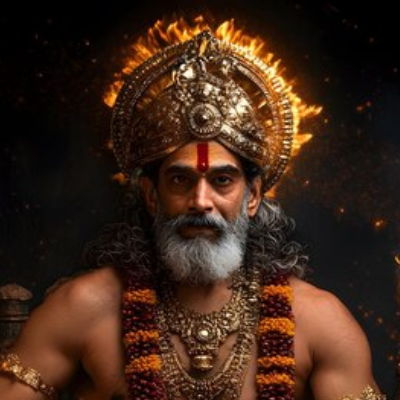
About
Kusha (Ancestor of Vishvamitra) — Mind-Born Son of Brahma, King, Father of Four Princes, Founder of the Kaushika Dynasty
Kusha · Kūśa · Kushika · Brahma-putra · Brahmana-rishi · Vaidarbhi-pati · Kushamba-pita · Kushanabha-pita · Asurtarajasa-pita · Vasu-pita · Kaushika-vamsha-sthapaka
Kusha — the ancestor of Vishvamitra, not to be confused with Kusha the son of Rama and Sita — is described in the Valmiki Ramayana's Bala Kanda (Chapters 32–34) as a notable ascetic born of Brahma; the husband of Vaidarbhi — a high-born woman of great beauty from the Vidarbha region; the father of four sons — Kushamba, Kushanabha, Asurtarajasa (also written Umuritarajasa, Amurtyaraja), and Vasu — each of whom founded a great city; and the great-grandfather of Vishvamitra through the chain Kusha → Kushanabha → Gadhi → Vishvamitra. He is the eponymous progenitor of the Kaushika lineage — the clan whose descendants include Gadhi, Vishvamitra, and Satyavati; and whose gotra-name Kaushika (of Kusha, descendant of Kusha) is used by millions of Brahmin households across India to the present day. He appears in the Valmiki Ramayana as a figure narrated in the past — Vishvamitra himself is the narrator and recounts his own ancestral lineage to Rama when they camp at Girivraja. Kusha is described as a brainchild of Brahma and a noted ascetic faithful to his vows and conversant with dharma. After giving his four sons the instruction to found four cities — thereby establishing ordered civilisation across their respective territories — Kusha journeyed to the sky and returned to Brahma's abode. He reappeared in spirit-form to Kushanabha during the Putrakameshti yajna to announce the birth of Gadhi — a divine appearance that confirmed his continued presence and interest in the lineage's continuation even after his return to the divine realm.
✦ The Name — Disambiguation
The name Kusha appears for at least three distinct figures in the tradition: the mind-born son of Brahma and ancestor of Vishvamitra profiled here; the sacred kusa grass used in all Vedic ritual; and Kusha the son of Rama and Sita who ruled Kushavati (one of the twins born to Sita at Valmiki's ashrama). All three share the same Sanskrit root — kus (to embrace, to pull towards oneself, to attract) or alternatively the grass-name itself — and the tradition's use of Kusha for both a son of Brahma and a son of Rama creates a potential for confusion that the Valmiki Ramayana itself is aware of — the text's narration of Kusha the Brahma-son's genealogy occurs as Vishvamitra tells Rama about his own ancestors, in a passage that explicitly identifies this Kusha as a different figure from any of Rama's descendants. The Alchetron source recording the Ramayana's exact passage states: there was a king named Kusha, not to be confused with Kusha son of Rama. The Kaushika lineage name derives from this ancestor Kusha — not from the other figures who share the name.
✦ Lineage
- Father: Brahma — the Creator; the first being of the present cosmic cycle; who generated Kusha as one of his mind-born descendants — whether directly or through an intervening generation the Valmiki Ramayana does not specify beyond calling Kusha a brainchild (manasa-suta) of Brahma
- Wife: Vaidarbhi — described in the Hari Prasad Shastri translation of the Valmiki Ramayana (Bala Kanda, Chapter 32) as a high-born woman of great beauty; the Grokipedia source clarifies her as a princess of Vidarbha; the Grokipedia entry on Kushanabha records that Kusha's wife was a Vidarbha princess; her personal name Vaidarbhi is a patronymic designation meaning woman of Vidarbha rather than a given personal name, and no other name is recorded for her in any primary source
- Sons:
- Kushamba — who founded the city of Kaushambi (present-day Kosam near Allahabad in Uttar Pradesh on the banks of the Yamuna); a major ancient city of the Vatsa kingdom that appears repeatedly in Buddhist and Jain texts as well as the Mahabharata
- Kushanabha — who founded the city of Mahodaya (identified with present-day Kannauj in Uttar Pradesh); who had a hundred daughters by the apsara Ghritachi; whose son Gadhi was the father of Vishvamitra; profiled separately below
- Asurtarajasa — also written Umuritarajasa and Amurtyaraja in different translations; who founded the city of Dharmaranya — possibly identified with Dharmakshetra near present-day Delhi
- Vasu — who founded the city of Girivraja, also called Vasumati (identified with present-day Rajgir in Bihar); the capital surrounded by five mountain peaks through which the river Magadhi/Shona flowed; the city that would later become famous as the capital of the Magadha kingdom and as a major Buddhist pilgrimage site
- Grandson: Gadhi — through Kushanabha; king of Kanyakubja; father of Vishvamitra and Satyavati
- Great-grandson: Vishvamitra — the great Brahmarishi; author of the Gayatri Mantra
✦ The Four Cities — Founding Civilisation
The Valmiki Ramayana records Kusha's instruction to his four sons with precision: desirous of teaching them the duties of a Kshatriya, he instructed them each to found a city. All four obeyed. The four cities — Kaushambi, Mahodaya, Dharmaranya, and Girivraja — together formed a civilisational network across the northern plains of the Indian subcontinent. Kaushambi on the Yamuna became one of the most important ancient cities of the Vatsa kingdom. Girivraja in the eastern hills became the Magadha capital that eventually produced Chandragupta Maurya's empire. Mahodaya became Kanyakubja, the famous city of the Kaushika lineage from which Gadhi and Vishvamitra ruled. The founding of four cities by one father's four sons is the tradition's statement about the civilisational function of the Kaushika lineage — they were city-builders, order-establishers, the creators of settled governance in the northern heartland. After this instruction to his sons Kusha returned to the divine realm. The Valmiki Ramayana's Bala Kanda (Sarga 34) records his reappearance during Kushanabha's Putrakameshti yajna in spirit-form: speaking from the sky to announce the birth of Gadhi — a divine voice telling his son that through Gadhi, Kushanabha would have everlasting renown. Then Kusha entered the sky and journeyed to the time-honoured abode of Brahma. The divine appearance was a transmission — confirming the lineage's continuation and blessing the birth that would eventually produce Vishvamitra.
✦ References
- Valmiki Ramayana (Bala Kanda, Chapters 32–34) — the primary canonical source: Vishvamitra narrating his own lineage to Rama; Kusha as a brainchild of Brahma; his wife Vaidarbhi of Vidarbha; the four sons; the instruction to found four cities; Kaushambi, Mahodaya, Dharmaranya, and Girivraja founded; Kushanabha's Putrakameshti yajna; Kusha appearing from the sky to announce Gadhi's birth; Kusha returning to Brahma's abode
- Wisdomlib — Vishvamitra tells of his ancestors (Valmiki Ramayana Bala Kanda Chapter 32) — the full primary text in translation; Kusha as the founder of the Kaushika dynasty
- Wikipedia — Vishvamitra; Alchetron — Vishvamitra; Grokipedia — Kushanabha; Indiaspiritual.wordpress.com — Story of Kushanabha: modern summaries drawing from the Valmiki Ramayana as the primary source