
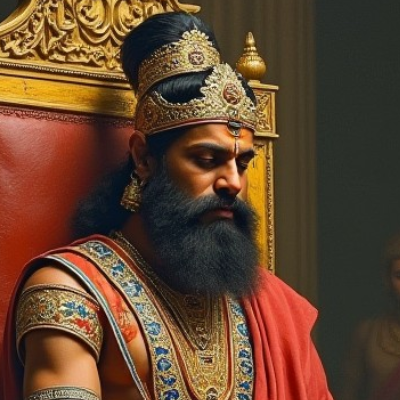
About
Kushanabha — Son of Kusha, Founder of Mahodaya, Father of a Hundred Daughters, Father of Gadhi
Kushanabha · Kuśanābha · Kushanaabha · Kusha-putra · Vaidarbhi-suta · Ghritachi-pati · Shatakanya-pita · Gadhi-pita · Vishvamitra-pitamaha · Mahodaya-sthapaka · Kanyakubja-raja
Kushanabha is the son of Kusha — the mind-born descendant of Brahma and founder of the Kaushika dynasty — and his wife Vaidarbhi; the founder and king of the city of Mahodaya (later called Kanyakubja, present-day Kannauj in Uttar Pradesh); the husband of the apsara Ghritachi by whom he had one hundred beautiful daughters; the husband of a princess of the Purukutsa dynasty (descendants of the Ikshvaku Solar Dynasty king Trasadasyu) by whom he had the son Gadhi; the grandfather of both Vishvamitra (the great Brahmarishi) and Satyavati (the wife of Richika, mother of Jamadagni, who became the river Kaushiki). His canonical story is narrated in the Valmiki Ramayana's Bala Kanda (Chapters 32–34) as part of Vishvamitra's own genealogical account to Rama, and is confirmed in the Bhagavata Purana (Canto 9), the Vishnu Purana (Book 4), the Brahmanda Purana, and the Vayu Purana. His most celebrated episode is the story of his hundred daughters — their beauty, their encounter with the wind god Vayu, their deformity at his curse, their forbearance, and their eventual healing through marriage to King Brahmadatta. He is characterised throughout as supremely righteous — the epithet sudharmikas (most righteous) is used for him in the Valmiki Ramayana's Sanskrit text.
✦ The Name
The Sanskrit name Kushanabha — written Kuśanābha — is a compound of kusha (the sacred grass used in Vedic ritual; also his father's name) and nabha (navel, the central point, the hub of a wheel). The compound means the navel of Kusha, the one who is the central point of the Kusha lineage, Kusha's central successor. As the progenitor of the Kaushika lineage's most significant descendants — Gadhi, Vishvamitra, Satyavati — the name's meaning of central-point is genealogically apt: he is the figure through whom all subsequent Kaushika glory flows.
✦ Lineage
- Father: Kusha — brainchild of Brahma; noted ascetic; who instructed his four sons to found four cities; profiled separately above
- Mother: Vaidarbhi — high-born woman of Vidarbha; Kusha's wife; no further personal details recorded beyond this identification
- Paternal brothers: Kushamba (founder of Kaushambi), Asurtarajasa (founder of Dharmaranya), and Vasu (founder of Girivraja/Vasumati)
- First wife: Ghritachi — the apsara (celestial nymph); by whom he had one hundred beautiful daughters; her role as Kushanabha's wife in this context is distinct from her other appearances in the tradition;
- Second wife: a princess of the Purukutsa dynasty — descendants of the Ikshvaku Solar Dynasty king Trasadasyu; named in the Vishnu Purana (Book 4, Chapter 7) as a damsel of the Purukutsa dynasty (later called the Shatamarshana lineage); not given a personal name in any primary canonical source; by whom he had Gadhi
- Daughters: one hundred — born of Ghritachi; extremely beautiful; described in the Valmiki Ramayana as clad in lovely dresses, unparalleled in beauty, wandering in the garden like lightning amidst clouds; who refused Vayu's advances, were deformed by his curse, waited in patience while their father arranged their marriage, and were healed by the touch of Brahmadatta's hand
- Son: Gadhi — born after the Putrakameshti yajna; of the Purukutsa princess; king of Kanyakubja; father of Vishvamitra and Satyavati; described as highly virtuous and selfsame to his grandfather Kusha in quality; profiled separately in this series
- City founded: Mahodaya — his capital city; later called Kanyakubja (meaning the city of the hundred hunchbacked girls — a name that directly commemorates the episode of his hundred deformed daughters); present-day Kannauj in Uttar Pradesh on the Ganga; a major cultural and political centre of northern India throughout the classical period
✦ The Hundred Daughters — Vayu's Desire and the Deformity
The Valmiki Ramayana's Bala Kanda (Chapters 32–33) narrates the hundred daughters episode as the centrepiece of Kushanabha's story. The hundred daughters — of incomparable beauty, born of the apsara Ghritachi — were one day singing, dancing, and playing musical instruments in their garden. Vayu — the wind god, the all-pervading one — saw them and was overwhelmed by desire. He approached them and proposed that they become his wives. The girls refused, stating with perfect precision that they were not free to make that choice while their father was living — any man who wished to marry them should approach their father for his consent. Vayu, disregarding their respectful and reasonable answer, became angry and punished them for the refusal. He entered their bodies and twisted their limbs into hunchbacked deformities — the physical punishment of the god who pervades all space for a group of young women who had refused him nothing except the right to decide without their father. The girls went to Kushanabha and reported what had happened. The Ramayana records his response with careful attention: the king did not rage at Vayu, did not demand divine retribution, did not curse or threaten. Instead he praised his daughters for their quality of forbearance — kshamaite, forgiveness — which he declared to be the highest dharma. He told them that they had acted nobly in enduring what Vayu had done to them and that their patience and restraint were worth more than revenge. Then he proceeded to arrange their marriages rather than their vindication. He chose Brahmadatta — the pious king of Kampilya, the mind-born son of the sage Chuli and the Gandharva woman Somada — as the husband for all hundred daughters simultaneously. At the marriage ceremony, as Brahmadatta took each daughter's hand in the traditional way, the deformity departed — the hunchbacked twisted bodies straightened and restored to their original incomparable beauty at the mere touch of his righteous hand. The Ramayana records this healing with joy: Kushanabha, seeing his daughters restored to their former beauty, was filled with the highest happiness and took delight again and again as he looked at them. The name Kanyakubja — the city of the hunchbacked girls — permanently commemorates this episode, recording the suffering of his daughters in the very city-name of the place his father had instructed him to build. After the marriage was complete and Brahmadatta had left with all hundred daughters, Kushanabha performed the Putrakameshti yajna to beget a son. During the yajna his father Kusha appeared to him from the sky and prophesied: a highly virtuous and selfsame son will be born to you named Gadhi, and through him you will gain everlasting renown in the world. In due course Gadhi was born. And through Gadhi came Vishvamitra — the Brahmarishi whose renown gave his grandfather Kushanabha exactly the everlasting fame Kusha had promised.
✦ Kanyakubja — The City Named for the Daughters' Suffering
The city of Mahodaya that Kushanabha founded was renamed Kanyakubja — from kanya (girl, daughter) and kubja (hunchbacked, deformed) — literally the city of the hunchbacked girls. The renaming commemorates the deformity that Vayu imposed on Kushanabha's hundred daughters. Kanyakubja became one of the most celebrated cities of ancient and medieval India — the capital of the Maukhari dynasty in the 6th century CE, then of Harsha's empire in the 7th century CE, then a centre of the Gurjara-Pratihara kingdom, and the subject of conflict in the Tripartite struggle between the Palas, Pratiharas, and Rashtrakutas in the 8th–10th centuries CE. Its present form, Kannauj, retains the phonetic trace of Kanyakubja. The city's name is thus a permanent memorial to a private family tragedy of the Kaushika dynasty, rendered into a place-name that survived for several thousand years.
✦ References
- Valmiki Ramayana (Bala Kanda, Chapters 32–34) — the primary canonical source: Kushanabha as the son of Kusha; founder of Mahodaya; his hundred daughters by Ghritachi; Vayu's desire and their refusal; the deformity; Kushanabha's praise of their forbearance; the marriage to Brahmadatta; Brahmadatta healing the daughters by touch; the Putrakameshti yajna; Kusha appearing from the sky to announce Gadhi; the Gadhi birth; the chapter titles confirming all episodes
- Vishnu Purana (Book 4, Chapter 7) — Kushanabha married a damsel of the Purukutsa dynasty (Shatamarshana lineage) and had a son Gadhi; Gadhi had Satyavati and Vishvamitra
- Bhagavata Purana (Canto 9, Chapter 15); Brahmanda Purana (III.66.32); Vayu Purana (91.62) — genealogical confirmations of Kushanabha as the father of Gadhi
- Wisdomlib — King Kushanabha's hundred daughters (Bala Kanda Chapter 33); Wisdomlib — Vishvamitra tells of his ancestors (Bala Kanda Chapter 32); Wisdomlib — Kushanabha (6 definitions); Grokipedia — Kushanabha; Indiaspiritual.wordpress.com — Story of Kushanabha: modern summaries drawing from the above primary sources