
About
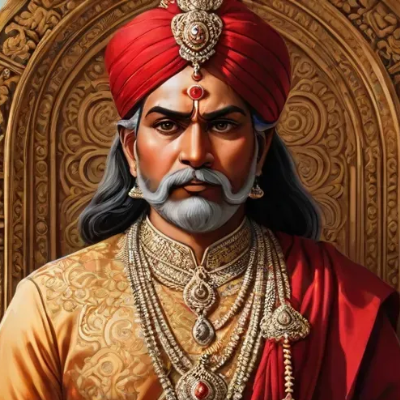
Trishanku — Exiled King of Ayodhya Who Ascended to Heaven in His Mortal Body
Satyavrata · Trishanku · Chandala-raja · Suryavamshi Nripa
Trishanku, born Satyavrata, was a king of the Ikshvaku dynasty of Ayodhya belonging to the Solar lineage, the Suryavamsha, and is placed in the Treta Yuga by the genealogical traditions of the Puranas and the Valmiki Ramayana. He is the son of King Trayyaruna and the father of Harishchandra, the celebrated king renowned for his absolute fidelity to truth. As a direct ancestor of Rama — the seventh avatar of Vishnu and the hero of the Ramayana — Trishanku occupies a foundational position in the Solar dynastic line. He is most celebrated, and most notorious, for his singular ambition to ascend bodily into the heavens without first dying, and for the extraordinary intervention of the sage Vishvamitra — born Kaushika, a royal warrior who became one of the most powerful sages of the tradition — which resulted in the creation of a separate celestial realm. His legend is recounted most fully in the Bala Kanda of the Valmiki Ramayana and is summarised in the ninth book of the Bhagavata Purana and in the Vishnu Purana.
✦ The Name
The king's birth name, Satyavrata, is a compound of satya, meaning truth, and vrata, meaning vow or observance, and thus signifies one who is bound by a vow of truth or devoted to truthfulness. The name carries an ironic weight in the tradition, given that the narrative arc of his life is defined by a series of transgressions rather than righteousness.
The name Trishanku is a compound of tri, meaning three, and shanku, which carries the sense of a stake, thorn, or point of sin and transgression — giving the combined meaning of one bearing three sins or three thorns of wrongdoing. This name was applied to him as a consequence of three specific moral and ritual transgressions committed during his youth and early life, and it supplanted his birth name entirely in the narrative tradition. The name has passed into common usage in Indian languages as a proverbial expression: a Trishanku state denotes a condition of suspension between two worlds, belonging fully to neither.
✦ Lineage
- Dynasty: Ikshvaku dynasty, Suryavamsha (Solar lineage), ruling from Ayodhya
- Father: King Trayyaruna, a king of Ayodhya in the Solar line, who banished his son Satyavrata from the kingdom on account of the abduction of a Brahmin's bride
- Son: King Harishchandra, celebrated throughout the Puranic and epic traditions as the paramount exemplar of truth-telling and endurance of suffering; he inherited the throne of Ayodhya after Trishanku's suspension in the heavens
- Grandson: Rohitasva (also called Rohita), son of Harishchandra, who appears in the Aitareya Brahmana and the Bhagavata Purana in connection with the Shunahshepa episode
- Descendant: Rama, the seventh avatar of Vishnu, born many generations later in the same Solar line through the lineage that passes from Harishchandra down through Sagara, Bhagiratha, Raghu, Dasharatha, and others
Note: The Valmiki Ramayana does not name Trishanku's wife in the Bala Kanda account. The name Satyavati as the wife of Trishanku does not appear in the primary Puranic or epic sources consulted, and is accordingly omitted from this profile.
✦ The Three Transgressions
The Valmiki Ramayana, in the Bala Kanda, records three acts that transformed the prince Satyavrata into the outcast Trishanku. The first was the forcible carrying away of a Brahmin's newly wed bride, an act of abduction that so enraged his father Trayyaruna that the king banished the prince from Ayodhya and disinherited him. The second transgression was the killing and consumption of the sacred cow belonging to the sage Vasishtha — the family preceptor of the Ikshvaku dynasty, son of the creator Brahma, and one of the seven great sages of the tradition. This occurred during a prolonged famine of twelve years. During this period, the exiled Satyavrata had placed himself in the service of the family of the sage Vishvamitra — originally a king named Kaushika who had undertaken severe austerities to transform himself into a Brahmarishi. Finding Vishvamitra's wife and children in desperate need, and unable to find game, Satyavrata slaughtered Vasishtha's Kamadhenu, the divine wish-fulfilling cow, and fed her flesh to Vishvamitra's dependants and consumed some himself. The act of killing a sacred cow and eating unsanctified meat constituted both a ritual sacrilege and a personal offence against Vasishtha. The third transgression was the accumulated enmity and disrespect he harboured toward Vasishtha for failing to intercede with his father on his behalf during the banishment. These three acts together — the abduction, the killing of the sacred cow, and the sustained disrespect toward his guru — earned him the name Trishanku.
✦ The Restoration and the Ambition
After the conclusion of the twelve-year famine, which the tradition attributes to the influence of Vishvamitra's austerities, Satyavrata's father Trayyaruna died. Vasishtha, acting as the royal preceptor, installed Satyavrata on the throne of Ayodhya. Thus, despite his disgrace and exile, Satyavrata came to rule the kingdom, henceforth bearing the name Trishanku as a permanent marker of his transgressions.
Once established as king, Trishanku conceived an extraordinary ambition: to perform a great sacrifice, a yajna, by the power of which he might ascend bodily into the realm of the gods — Svarga — without undergoing death. This desire for physical immortality in the celestial realm, bypassing the natural law by which mortals shed the body before attaining heaven, is presented in the Ramayana as the central drama of his life.
✦ The Refusal of Vasishtha and the Curse of His Sons
Trishanku first approached Vasishtha, the hereditary preceptor of the Ikshvaku dynasty, with his request to officiate at a sacrifice that would convey him to heaven in his mortal body. Vasishtha refused, declaring the enterprise impossible and contrary to the established order of existence. Undeterred, Trishanku then travelled to the hermitage of Vasishtha's hundred sons and made the same petition. The sons, regarding the request as an insult to their father and as the demand of a man already tainted by grave sins, cursed him: Trishanku was to become a Chandala, a member of the lowest and most ritually polluted social category. The curse took immediate effect, and Trishanku found himself physically transformed — his appearance darkened, his garments and ornaments those of an outcast, his body bearing the marks of degradation.
✦ The Alliance with Vishvamitra
In this degraded state, Trishanku sought out Vishvamitra, the sage who had once benefited from his service during the famine. Vishvamitra, moved by the king's plight and his memory of what Satyavrata had done for his family, and also animated by his long-standing rivalry with Vasishtha, agreed to sponsor the sacrifice. He declared that the merit of his own accumulated austerities would be sufficient to accomplish what Trishanku desired.
Vishvamitra assembled the sages of the region and invited them to participate in the great sacrifice. Most came, but the hundred sons of Vasishtha refused, mocking the notion that a Chandala could be the subject of a Vedic yajna and that a former Kshatriya — which Vishvamitra had been before his transformation into a sage — could officiate. Vishvamitra, incensed, cursed those sons who had refused: they were to be reborn for seven hundred cycles as eaters of dog-flesh in the lowest existences. The sacrifice then proceeded with those sages who had agreed to attend.
✦ The Ascent, the Rejection, and the Suspension
Through the power of the sacrifice and the concentrated spiritual force that Vishvamitra directed into its rites, Trishanku began to rise bodily from the earth, ascending visibly upward through the sky toward the heavens. He rose in his physical, mortal, and ritually polluted body — still bearing the form of a Chandala — toward the realm of Indra, the king of the gods.
Indra and the assembled gods refused him entry. Indra declared that Trishanku, having been cursed by his legitimate preceptors and bearing the marks of extreme sin, could not enter the celestial realm. The god cast him back down, and Trishanku fell headfirst through the sky, crying out to Vishvamitra in terror.
Vishvamitra, still engaged at the sacrificial altar, commanded him to stop — the Ramayana records his cry of arrest — and by the force of his will and his spiritual power he halted Trishanku's fall. The king remained suspended mid-air, inverted, held between the earth below and the heaven above, belonging to neither.
✦ The Counter-Creation: Trishanku's Heaven
Enraged at the gods' rejection, Vishvamitra resolved to create an entirely new cosmic order for Trishanku. He began fashioning, through the power of his austerities and the sacrificial fire, a new set of stars and a new southern firmament. He created new constellations and new celestial bodies, positioning them in the southern sky. He then began creating new gods to inhabit this new realm, and the tradition records that he even began to fashion a new Indra for the alternative heaven.
At this point the gods, alarmed that the fabric of the existing universe was being destabilised by Vishvamitra's parallel creation, intervened and negotiated a resolution. The compromise agreed upon was that Trishanku would remain permanently in his own created heaven, luminous and honoured, but suspended in his inverted position — head downward — for eternity. The stars and the southern firmament that Vishvamitra had created would remain as they were. Vishvamitra, satisfied that his word to the king had been honoured and that Trishanku had indeed reached a heaven, accepted the settlement and discontinued his counter-creation.
This episode gave rise to the phrase Trishanku's heaven, used in Sanskrit and in later Indian vernacular traditions to describe a condition of permanent suspension between two states — achieved and yet not achieved, elevated and yet inverted, present in a realm that is real but that belongs to neither the natural nor the fully divine order.
✦ Textual Variants and Inconsistencies
The Valmiki Ramayana, Bala Kanda, provides the most elaborate and narratively complete account of Trishanku, spanning several sargas and covering the three sins, the curse, the alliance with Vishvamitra, the ascent, the rejection by Indra, and the creation of the alternative heaven. This is the primary locus of the legend.
The Bhagavata Purana, in its ninth book, includes Trishanku in the Solar dynastic genealogy and names him as the son of Trayyaruna and the father of Harishchandra, but its treatment of his life story is substantially compressed compared to the Ramayana account. The genealogical details it supplies are consistent with those of the Valmiki Ramayana.
The Vishnu Purana likewise places Trishanku in the Solar lineage as son of Trayyaruna and father of Harishchandra. Its genealogical account is consistent with both the Ramayana and the Bhagavata Purana on these points.
The Devi Bhagavata Purana contains a version of the Vishvamitra and Trishanku episode that is broadly consistent with the Valmiki Ramayana account in its broad outlines, though with differences in emphasis and detail. The Markandeya Purana similarly situates Trishanku in the Solar lineage.
No primary Puranic source consulted names the wife of Trishanku. The attribution of the name Satyavati to Trishanku's queen, which appears in some secondary and popular accounts, is not confirmed in the primary texts and is accordingly not incorporated into this profile.
The Aitareya Brahmana, one of the earliest texts in the tradition, contains a version of the Shunahshepa episode in which Harishchandra — son of Trishanku — plays a prominent role. In this text, the king is named Harishchandra Traishankava, meaning son of Trishanku, confirming the father-son relationship attested in the later Puranas and the Ramayana. The Aitareya Brahmana's account of Harishchandra focuses on a different narrative than the Puranic version, but the genealogical link it supplies to Trishanku is consistent across traditions.
✦ Theological and Philosophical Significance
The Trishanku episode functions in the tradition as a sustained meditation on the limits of human ambition and the order of cosmic law. The desire to enter heaven in a physical mortal body is presented as a transgression of the boundary between the human and divine orders — a boundary that exists as a structural fact of the cosmos rather than merely a social or ritual convention. Even the most powerful sage's will, concentrated into the fires of sacrifice, cannot ultimately override this boundary; it can create a compromise, a liminal realm, but not a complete violation of the cosmic order.
Trishanku's condition — suspended, inverted, permanent — is the tradition's image for the outcome of ambition that strains past its proper limits. He is in a heaven, but upside down. He has been granted what he sought, but in a form that is simultaneously fulfilment and punishment. The narrative presents this not as divine cruelty but as the natural consequence of attempting to occupy a position for which the seeker is, by the logic of the tradition, constitutionally unfit.
The episode is also significant for what it reveals about the figure of Vishvamitra. His willingness to bend the cosmic order in favour of a man he had reason to feel gratitude toward, and his fury when the gods resist him, are presented as evidence of both the extraordinary potency of his tapas — ascetic spiritual power — and of the dangers inherent in wielding such power from a position of personal attachment and rivalry. The settlement reached is not a victory for Vishvamitra but a containment of a crisis he himself created.
✦ Connection to the Wider Genealogy
Trishanku stands as the twenty-eighth king in certain Puranic enumerations of the Solar dynasty descending from Ikshvaku, the son of Manu Vaivasvata, who is himself the son of the sun-god Vivasvat and the progenitor of the human race in the current cosmic cycle. The Solar dynasty passes from Ikshvaku through a long succession of kings to Trayyaruna, then to Trishanku, then to Harishchandra, and continues through Rohitasva, Sagara, and subsequent monarchs to Bhagiratha — who is credited with bringing the river Ganga from heaven to earth — and eventually to Raghu, Dasharatha, and Rama. Trishanku's suspension in his created heaven did not disrupt the dynastic succession; his son Harishchandra inherited and ruled Ayodhya, and the lineage continued unbroken through the generations that produced Rama.
✦ References
Primary Sources
- Valmiki Ramayana, Bala Kanda, Sargas 57–60: The principal and most detailed source for the Trishanku legend, narrating the three transgressions, the curse, the alliance with Vishvamitra, the ascent, the rejection by Indra, and the creation of the alternate heaven.
- Bhagavata Purana, Skandha 9, Chapter 7: Places Trishanku in the Solar dynastic genealogy as the son of Trayyaruna and the father of Harishchandra; provides a compressed account consistent with the Ramayana.
- Vishnu Purana, Book 4: Enumerates the Solar dynasty and situates Trishanku as the son of Trayyaruna and the father of Harishchandra, consistent with other Puranic accounts.
- Aitareya Brahmana: Names Harishchandra as Traishankava — son of Trishanku — in the context of the Shunahshepa episode, providing the earliest textual confirmation of the father-son relationship.
- Markandeya Purana: Includes Trishanku in the Solar dynastic genealogy in a manner consistent with the Vishnu Purana and Bhagavata Purana accounts.
- Devi Bhagavata Purana: Contains a version of the Vishvamitra–Trishanku episode broadly consistent with the Valmiki Ramayana in its outline.
Secondary and Reference Sources
- Vettam Mani, Puranic Encyclopaedia (1975): Provides a synthesised account of Trishanku drawn from multiple Puranic and epic sources, with genealogical data and cross-references to the Harishchandra narrative.
- A. A. Macdonell and A. B. Keith, Vedic Index of Names and Subjects (1912): Useful for the early attestation of the Traishankava epithet of Harishchandra in the Aitareya Brahmana and related Vedic literature.
- Robert P. Goldman (trans.), The Ramayana of Valmiki, Vol. 1: Balakanda (Princeton University Press, 1984): Critical translation and annotation of the Bala Kanda, providing scholarly context for the Trishanku episode and its place in the larger narrative of Vishvamitra's career.