
About
Kushamba — Son of Kusha and the Vidarbha Princess, Founder of Kaushambii, and First of the Four City-Building Brothers
Kushamba · Kushumba · Kushambu · Kusha-prathama-putra · Brahma-prapautra · Kaushambii-nirmata · Vishvamitra-purvajanin · Vaidarbhi-nandana
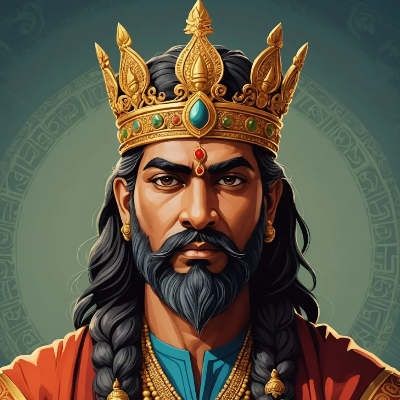
Kushamba is the first of the four sons of Kusha — the mind-born son of Brahma and a righteous kingly sage — and of the princess of Vidarbha, and the builder of the celebrated ancient city of Kaushambii whose name is derived directly from his own. He is the eldest brother among the four city-founding sons whose story is narrated by Vishvamitra to Rama and Lakshmana in the Valmiki Ramayana's Bala Kanda sarga 32 — the genealogical account of Vishvamitra's own ancestry that Vishvamitra delivers as they travel together toward Mithila for the Sita Svayamvara. The narrative context is precise: Vishvamitra is Kusha's great-grandson through the line of Kushanaabha-Gadhi, and his narration of his ancestors' history gives the Bala Kanda's genealogical section one of its most richly detailed passages. Kushamba appears in the Valmiki Ramayana at Bala Kanda sarga 32 verses 2-6 as the first-named of the four sons and as the builder of Kaushambii. He is described with the epithet mahaatetaah — "great-resplendent" — at verse 6, the only such individually distinctive epithet given to any of the four brothers in this passage. He is also identified across different sources as an ancestor in the line that eventually produced Vishvamitra through his brother Kushanaabha's descendant Gadhi — though the specific transmission through Kushamba himself versus through Kushanaabha is the primary genealogical question for the Vishvamitra connection.
✦ The Name
The name Kushamba is derived from his father Kusha's name — it is formed from Kusha with the suffix amba or through a compounding that encodes his identity as Kusha's son and heir. The Ramayana translators render the name variously as Kushamba, Kusumba, and Kushambu across different manuscript traditions. The city he built — Kaushambii — is derived from his name through the standard Sanskrit geographical naming convention of adding the ii long vowel to produce the place name from the founder's name, yielding "the city of Kushamba" or "Kushamba's city." Kaushambii — identified with the modern city of Kosam on the Yamuna river in Uttar Pradesh — was one of the most important cities of ancient India, serving as the capital of the Vatsa mahajanapada and as a significant Buddhist centre. The epithet Mahaatejah means "of great brilliance and radiance" — the specific quality the Valmiki Ramayana assigns to Kushamba individually among the four brothers.
✦ Lineage
- Father: Kusha — identified in the Valmiki Ramayana's Bala Kanda sarga 32 verse 1 as "the brainchild of Brahma" (brahma yoniH) — a mind-born son of Brahma — who was a highly righteous kingly sage of higher ascesis, faithful to his vows, and conversant with dharma. This is a different Kusha from Rama's son Kusha — the two figures share a name but are separated by multiple cosmic ages in the tradition's genealogical reckoning.
- Mother: The princess of Vidarbha — described in the Valmiki Ramayana's Bala Kanda sarga 32 as kulinaayaam — "one with noble birth" — and yuktaayaam — "an eligible wife." She is identified as Vaidarbhi — the Vidarbha princess — in the Sanskrit text. The Hari Prasad Shastri translation gives her name as Bhidharvi. She is the mother of all four brothers equally — the four being described as sadrisaan — "selfsame" or "identical in quality" — born of the same noble mother.
- Paternal grandfather: Brahma — the creator. Kusha as Brahma's mind-born son makes all four of Kusha's sons Brahma's grandsons.
- Brothers: Kushanaabha (who built Mahodaya and whose hundred daughters by Ghritachi married Brahmadatta — Kushanaabha's profile is given separately in this series through the Romasha-Ghritachi thread), Asuurtarajasa (who built Dharmaaranya — profiled separately below), and Vasu (who built Girivraja — profiled separately below).
- The primary sources do not give Kushamba's wife or children with specificity. His significance in the tradition is concentrated in the founding of Kaushambii and his position as the eldest of the four brothers rather than in an extended dynastic or personal biography.
✦ The Founding of Kaushambii
The Valmiki Ramayana's Bala Kanda narrates that after the four brothers were born, their father Kusha addressed them with the aspiration that they uphold the principles of the Kshatriyas and achieve righteousness abundantly — a specific paternal injunction connecting martial and dharmic responsibility simultaneously. On hearing their father's words the four brothers initiated the building of four cities. Kaushambii — Kushamba's city — was the first named, reflecting his position as the eldest among the four. The Valmiki Ramayana describes him at this verse as mahaatetaah — "great-resplendent" — the single most notable individual characterisation among the four brothers' naming in this passage. The city of Kaushambii is identified by modern scholarship with the archaeological site of Kosam on the Yamuna river in Uttar Pradesh's Allahabad district — an important ancient site whose excavations have revealed occupation layers going back to the early historical period of the first millennium BCE. The city became the capital of the Vatsa kingdom and later a significant centre of Buddhism — its name preserved in the ancient Pali and Sanskrit literary tradition as one of the sixteen great cities of ancient India.
✦ Source Character — the Vishvamitra Genealogical Narration
The entire passage of Bala Kanda sarga 32 in which Kushamba appears is narrated by Vishvamitra to Rama — making the account specifically a genealogical self-narration by the sage who is himself Kusha's great-grandson through Kushanaabha-Gadhi. The narrative context is the journey to Mithila: Vishvamitra is explaining to Rama why the territory through which they are travelling is called Vasumadhya — the land of Vasu — and in doing so he traces his own ancestry back through Gadhi-Kushanaabha-Kusha to Brahma. Kushamba appears in this account as the eldest of the four founding brothers whose city-building established the settlements of the region Vishvamitra's lineage inhabited. This narrative framing — the account of the founding brothers given by the sage who is their descendant to the prince he is mentoring — gives the genealogical passage a specific personal dimension: Vishvamitra is not merely recounting history but explaining the sacred landscape through which he and Rama are walking in terms of his own family's foundational acts.
✦ Textual Variants
The name appears as Kushamba, Kusumba, Kushambu, and Kushamba across different manuscript traditions and translations of the Valmiki Ramayana. The Valmiki Ramayana Critical Edition and the Bombay edition both give Kushambu or Kushamba as the primary form. The Hari Prasad Shastri translation names him Kushamba. The Gita Press translation gives Kushamba. All forms designate the same figure — the name variations are transliteration conventions rather than references to different individuals.
✦ References
- Valmiki Ramayana, Bala Kanda, sarga 32, verses 1–11: The primary and complete canonical source for Kushamba's biography — the narration by Vishvamitra to Rama of Kusha's four sons, the paternal injunction to uphold Kshatriya dharma, the founding of four cities, and Kushamba's building of Kaushambii as the first and most resplendent of the four. All subsequent references to Kushamba in the tradition derive from this passage.
- Vettam Mani, Puranic Encyclopaedia (1975): Entry on Kushamba confirming his position as Kusha's eldest son and founder of Kaushambii.
- Robert P. Goldman (translator), The Ramayana of Valmiki — Bala Kanda (1984): Critical translation with scholarly notes on the genealogical passage of sarga 32 and the historical identification of Kaushambii with Kosam on the Yamuna.