
About
Dhara — The Vasu of Earth, Son of Vasu and Dharma
Dhara · Drona (in the Bhagavata Purana's enumeration) · not to be confused with Drona the military preceptor of the Pandavas and Kauravas
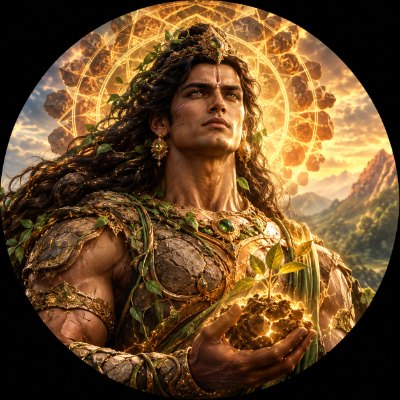
Dhara is one of the eight Vasus — the group of elemental divine beings associated with fire and light who form part of the thirty-three principal gods of the Vedic and Puranic tradition. He is the son of Vasu, daughter of Daksha Prajapati and his wife Asikni, and of Dharma, the personification of cosmic righteousness. Among the eight Vasus, Dhara is associated with the earth — his name meaning that which holds or sustains — and represents the elemental quality of support and foundation in the natural world. He is attested under the name Dhara in the Mahabharata, Harivamsa, Agni Purana, Padma Purana, and Vishnu Purana, and under the name Drona in the Bhagavata Purana's enumeration of the eight Vasus in Skandha 6. His wife is named Abhimati in the Bhagavata Purana and is identified with Manohara in the Puranic Encyclopaedia's account drawing on the Mahabharata tradition; through her he fathers children who are described as the presiding deities of the emotional states of joy, sorrow, and fear. He is additionally prominent in the Bhagavata Purana, Skandha 10, where the Vasu Drona and his wife Dhara — whose name in this context means a stream or current of water — are said to have petitioned Brahma for the boon of being reborn as the foster parents of the Supreme Lord himself, subsequently incarnating as Nanda and Yashoda, the foster parents of Krishna.
✦ The Name
The name Dhara derives from the Sanskrit root dhr, to hold, sustain, or support, through the nominal form meaning that which holds or bears — the earth, a holder, or one who sustains. In its application to this Vasu, the name designates him as the elemental divine being who embodies the sustaining quality of earth or ground. The Brihadaranyaka Upanishad's discussion of the eight Vasus associates this position with the earth itself as a cosmic element. The alternate name Drona, used in the Bhagavata Purana's Skandha 6 enumeration, derives from a different root associated with a bucket or container — something that holds or stores — and carries the sense of the Vasu who is a storehouse or container of vitality, a slightly different but complementary nuance to the earth-sustaining sense of Dhara. The two names are understood in the secondary tradition as designating the same Vasu under different Puranic naming conventions.
✦ Lineage
- Father: Dharma — the personification of cosmic righteousness, duty, and the sustaining moral order of the universe; one of the creations of Brahma; husband of ten daughters of Daksha and Asikni in Daksha's second birth, each wife producing a distinct class of divine offspring.
- Mother: Vasu — daughter of Daksha Prajapati and Asikni; one of the ten daughters of Daksha given to Dharma; the mother of all eight Vasus, whose collective name she shares.
- Brothers: The seven other Vasus — Apa, Dhruva, Soma, Anila, Anala, Pratyusha, and Prabhasa — born of the same parents. Their names vary across sources as described in the Vasu profile.
- Wife: Abhimati — named in the Bhagavata Purana, Skandha 6, Chapter 6, as the wife of the Vasu Drona (Dhara). The Puranic Encyclopaedia, drawing on the Mahabharata tradition, names the wife Manohara — meaning one who captivates the mind — through whom Dhara's five sons are born in that account.
- Children (Bhagavata Purana account): Harsha (joy), Shoka (sorrow), Bhaya (fear), and others described as presiding deities of the emotional states of living beings; born of Drona and Abhimati.
- Children (Mahabharata/Puranic Encyclopaedia account): Dravina and Hutahavyavaha, born of Dhara; the Agni Purana and Padma Purana through the wife Manohara add Shishira, Prana, and Ramana to this list.
✦ As Nanda and Yashoda — The Foster Parents of Krishna
The most celebrated narrative associated with the Vasu Dhara or Drona in the Bhagavata Purana tradition is his rebirth as Nanda, the cowherd chieftain of Gokula, and the rebirth of his wife Dhara as Yashoda, who became the foster mother of Krishna. The Bhagavata Purana, Skandha 10, Chapter 8, records that the Vasu Drona and his wife Dhara — overcome by the desire for the most intimate form of devotion, the parental love for the Supreme Lord — approached Brahma and obtained his blessing to be born as parents of Vishnu himself. This boon was fulfilled in the Dvapara Yuga when Krishna was born to Devaki and Vasudeva, and was immediately carried to the home of Nanda and Yashoda, where he was raised as their own child. The Harivamsa provides complementary background to this account. The relationship between the Vasu Drona/Dhara and his human incarnation as Nanda is one of the most theologically significant genealogical identifications in the Bhagavata Purana, as it provides the Vaishnava explanation for the extraordinary devotional relationship between Nanda and Yashoda and the divine Krishna: it was not accidental but the fulfilment of a celestial aspiration earned through devotion in a previous existence. The name of Dhara's wife in this context — also called Dhara, meaning a stream of water or that which flows — is distinct from the name Abhimati or Manohara given in the genealogical passages, and the Bhagavata Purana appears to be using Dhara both as the name of the Vasu and as the name of his wife in different narrative contexts.
✦ The Curse of Vasishtha and the Eight Vasus' Mortal Birth
Dhara is one of the eight Vasus who were cursed by the sage Vasishtha to take birth as mortals. The narrative, recorded in the Mahabharata, Adi Parva, describes how the eight Vasus were wandering with their wives when the wife of one of them — Prabhasa — caught sight of the divine cow Nandini at Vasishtha's hermitage and coveted it. At her insistence, her husband Prabhasa, aided by the other seven Vasus, stole the cow. When Vasishtha returned and perceived the theft through his divine vision, he cursed all eight to be born on earth as mortal men. The seven Vasus who participated only peripherally in the theft — including Dhara — were granted a brief mortal existence and were born as the first seven sons of Ganga and King Shantanu of the Kuru dynasty, being immediately drowned by Ganga at birth in fulfilment of a prior agreement with the Vasus that she would release them quickly from their mortal sojourn. The eighth Vasu, who committed the actual theft, was born as Bhishma and compelled to live a full mortal life. Dhara is thus one of the seven brief-mortal Vasus in this narrative, his mortal existence lasting only moments from birth to drowning, after which he returned to the celestial realms.
✦ Textual Variants and Inconsistencies
The principal inconsistencies concerning Dhara relate to his name and his children across sources. His name appears as Dhara in the Mahabharata, Harivamsa, Agni Purana, and Padma Purana, and as Drona in the Bhagavata Purana's Skandha 6 enumeration. His wife is named Abhimati in the Bhagavata Purana's Skandha 6 genealogical passage, but as Manohara in the account of the Mahabharata tradition as summarised in the Puranic Encyclopaedia. His children in the Bhagavata Purana's Skandha 6 are Harsha, Shoka, Bhaya and others — emotional deity-presiders — while in the Mahabharata tradition they are Dravina and Hutahavyavaha, names with sacrificial connotations. These differences likely reflect the two distinct thematic schemes of each source: the Bhagavata Purana's Skandha 6 presents the Vasus' offspring as presiding deities of natural and emotional phenomena, while the Mahabharata tradition records names with ritual associations. Additionally, a critical textual note: the Bhagavata Purana's Skandha 10 refers to the Vasu Drona's wife as Dhara, which is also the name of the Vasu himself in other sources, creating potential confusion that requires contextual resolution.
✦ Disambiguation
The Vasu Dhara treated in this profile must be distinguished from Drona the military preceptor — the son of the sage Bharadvaja and the teacher of archery to both the Pandavas and Kauravas, who is a prominent figure throughout the Mahabharata's Drona Parva and who meets his death on the battlefield of Kurukshetra. The two share the name Drona but are entirely distinct figures. Additionally, within the Bhagavata Purana, the name Drona denotes the Vasu in the Skandha 6 genealogy and the foster father of Krishna in Skandha 10; these are the same figure in different cosmic contexts.
✦ References
Primary Sources
- Mahabharata, Adi Parva, Chapter 66 — names Dhara among the eight Vasus and records his sons Dravina and Hutahavyavaha; also narrates the curse of Vasishtha and the mortal births of the Vasus.
- Bhagavata Purana, Skandha 6, Chapter 6, verse 11 — names the equivalent Vasu as Drona, his wife as Abhimati, and their children as Harsha, Shoka, Bhaya, and others.
- Bhagavata Purana, Skandha 10, Chapter 8 — records the story of the Vasu Drona and his wife Dhara petitioning Brahma for the boon of becoming the foster parents of Krishna, subsequently reborn as Nanda and Yashoda.
- Harivamsa, Book 1, Chapter 3 — names Dhara among the eight Vasus and records his sons.
- Agni Purana, Chapter 18 — names Dhara among the eight Vasus and records his sons Dravina and Havyavaha through Manohara, with additional sons Shishira, Prana, and Ramana.
- Padma Purana, Srishti Khanda, Chapter 6 — names Dhara among the eight Vasus and records his sons Dravina and Havyavaha.
Modern Reference Works
- Vettam Mani, Puranic Encyclopaedia (1975), entry on Ashtavasu — provides the most comprehensive secondary collation of the names and offspring of all eight Vasus across the Mahabharata, Vishnu Purana, Bhagavata Purana, and Harivamsa, and notes the identification of Drona with Dhara.
- Wisdom Library (wisdomlib.org), entries on Dhara (Vasu) and Drona (Vasu) — provides verse-level references to the Bhagavata Purana passages and the Puranic Encyclopaedia's collation.