
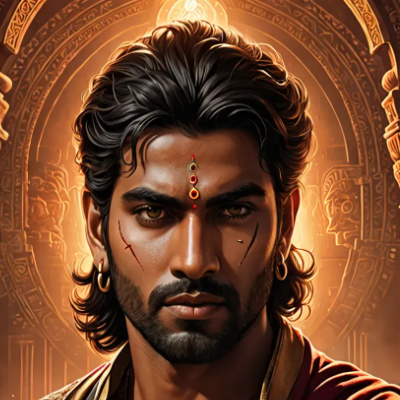
About
Pushparna — Son of Vatsara and Svarvithi, Prince of the Lineage of Dhruva
Pushparna · Vatsara-putra · Svarvithi-putra · Dhruva-vamshaja · Svayambhuva-vamshaja
Pushparna is a prince of the lineage of Dhruva, named in the Bhagavata Purana's fourth skandha as the first of the six sons of Vatsara — one of the sons of the celebrated boy-devotee Dhruva — and his wife Svarvithi. He appears in the genealogical continuation that the Bhagavata Purana traces through Dhruva's descendants after the main devotional narrative of Dhruva's austerities and ascent to the pole star. The Bhagavata Purana names Pushparna's two wives and his children through each of them, giving his entry in the genealogical register a modest degree of individual substance. He receives no narrative episode in any primary text consulted. The Vishnu Purana provides a parallel genealogical account of this portion of the lineage with some variation in detail.
✦ The Name
The name Pushparna is Sanskrit, a compound of pushpa meaning flower or blossom, and arna or related forms that may derive from the root r meaning to go or to move, giving the sense of one who moves among flowers or one who is adorned with flowers, or alternatively a compound encoding the abundance and beauty of flowering. Some readings connect the second element to the root arh meaning to be worthy or to deserve, giving the sense of one worthy of flowers or one deserving of floral honour — a name encoding the auspiciousness and beauty appropriate to a prince of the celebrated Dhruva lineage. The floral imagery in the name is consistent with the naming traditions of this portion of the primordial Solar lineage, where names frequently encode natural, astronomical, or auspicious qualities rather than martial ones.
✦ Lineage
- Father: Vatsara, one of the sons of Dhruva — the celebrated boy-devotee of Vishnu who was granted the eternal position of the pole star — and his wife. Vatsara's wife is named as Svarvithi in the Bhagavata Purana, and their six sons are Pushparna, Tigmaketu, Isha, Urja, Vasu, and Jaya.
- Mother: Svarvithi, the wife of Vatsara, named in the Bhagavata Purana as the mother of the six sons of Vatsara; her parentage is not specified in the primary sources consulted.
- Paternal grandfather: Dhruva, son of King Uttanapada and his wife Suniti, who at the age of five years undertook extraordinary austerities at Madhuvana on the Yamuna river, received the direct vision of Vishnu, and was granted the eternal position of the pole star — the Dhruva nakshatra — around which all stars, planets, and celestial beings revolve for the duration of the current cosmic age.
- Paternal great-grandfather: Uttanapada, king of the Solar dynasty, son of Manu Svayambhuva — the first Manu and primordial sovereign of humanity.
- Paternal great-great-grandfather: Svayambhuva Manu Prajapati, the first Manu, mind-born son of Brahma and primordial sovereign of humanity in the current cosmic age.
- Brothers: Tigmaketu, Isha, Urja, Vasu, and Jaya — the five other sons of Vatsara and Svarvithi named in the Bhagavata Purana's fourth skandha; none of these five receives individual narrative treatment in any primary source consulted.
- First wife: Dosha, named in the Bhagavata Purana as the first wife of Pushparna.
- Second wife: Prabha, named in the Bhagavata Purana as the second wife of Pushparna.
- Sons by Dosha: The Bhagavata Purana names three sons of Pushparna and Dosha — Pradosha, Nisakha, and Vyushta. These three sons are named in the genealogical register but receive no individual narrative treatment in any primary source consulted.
- Son by Prabha: The Bhagavata Purana names one son of Pushparna and Prabha — Prabhata. He is named in the genealogical register without further narrative detail.
✦ Position in the Genealogical Continuation
Pushparna appears in the Bhagavata Purana's fourth skandha as part of the systematic genealogical continuation of Dhruva's lineage through his son Vatsara. The text's naming of Pushparna's two wives — Dosha and Prabha — and the children born of each is notable in that it gives this figure slightly more genealogical definition than the purely name-only entries that characterise many figures in this portion of the primordial register. The names of the wives Dosha and Prabha carry their own meanings — Dosha meaning dusk or the period of early night, and Prabha meaning radiance or light — and the names of the sons born of each reflect these associations: Pradosha meaning the early part of night, Nisakha meaning companion of the night, and Vyushta meaning the dawn or the breaking of light, while Prabhata — born of Prabha — means morning or the time of radiant light. This constellation of names encoding the cycle of night and dawn within a single family gives this entry in the genealogical register an unusual internal coherence, suggesting that the Bhagavata Purana's redactors were working with an established and carefully constructed naming tradition for this branch of the Dhruva lineage.
✦ References
Primary Sources
- Bhagavata Purana, Skandha 4, Chapter 13: Names Pushparna as the first of the six sons of Vatsara and Svarvithi; identifies Dosha and Prabha as his two wives; names Pradosha, Nisakha, and Vyushta as the sons of Dosha and Prabhata as the son of Prabha; the sole detailed primary source for his genealogical placement and his family.
- Vishnu Purana, Book 1, sections on Dhruva's lineage: Provides a parallel genealogical account of the Dhruva lineage continuation; the details for this specific branch may vary from the Bhagavata Purana's account.
Modern Reference Works
- Vettam Mani, Puranic Encyclopaedia (Motilal Banarsidass, 1975), entry on Pushparna: Notes his identification as a son of Vatsara, records his two wives and his children as given in the Bhagavata Purana, and situates him within the genealogical continuation of the Dhruva lineage.
- Ganesh Vasudeo Tagare (trans.), Bhagavata Purana, Part 2 (Motilal Banarsidass, 1976): Critical translation of the fourth skandha including the genealogical continuation; the relevant chapter names Pushparna, his wives, and his sons within the register of Dhruva's descendants.