
About
Sahasrajit — Eldest Son of Yadu and Progenitor of the Haihaya Dynasty
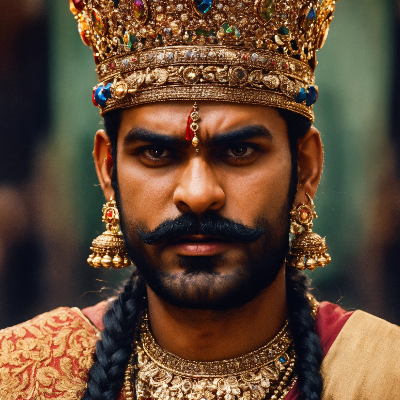
Sahasrajit · Sahasrajita
Sahasrajit is the eldest son of King Yadu, the legendary patriarch of the Yaduvamsha — the great Lunar Dynasty clan from which numerous celebrated kings, heroes, and ultimately the god Vishnu in his Krishna avatara descended. Sahasrajit is named consistently across several Puranic texts, including the Bhagavata Purana and the Agni Purana, as the firstborn among Yadu's sons. While his younger brother Kroshtu founded the branch of the Yadu lineage from which Krishna eventually descended, Sahasrajit's own line gave rise to the powerful Haihaya dynasty, one of the most dominant royal houses of ancient central India. His significance in the genealogical tradition is therefore less as a figure of personal narrative and more as the founding link of a major dynastic branch of the Yadava people.
✦ The Name
The name Sahasrajit is a compound of the Sanskrit sahasra, meaning one thousand, and jit, a form of the root ji, meaning to conquer or to win. The name therefore carries the meaning of one who conquers a thousand or victor over thousands, a designation befitting a prince of the Lunar Dynasty and the progenitor of a line of warrior kings. No specific etymology or explanation of the name is offered in the primary texts beyond its transparent Sanskrit composition.
✦ Lineage
- Father: Yadu — the eldest son of King Yayati of the Lunar Dynasty and his wife Devayani, daughter of the sage Shukracharya. Yadu is the founding patriarch of the Yaduvamsha, the vast dynastic confederation from which the Yadava clans descended. Despite being the eldest son of Yayati, Yadu was cursed by his father and excluded from inheriting the main throne of the Lunar Dynasty, leading his descendants to establish independent kingdoms.
- Brothers: Kroshtu (also rendered Kroshta or Kroshtha), Nala, and Ripu — the other sons of Yadu named in the Bhagavata Purana. Of these, Kroshtu is the most genealogically significant alongside Sahasrajit, as Kroshtu's line eventually produced Krishna.
- Son: Shatajit (also rendered Satajit or Shatajit) — Sahasrajit's son and the link between Sahasrajit and the Haihaya dynastic line.
- Grandsons through Shatajit: Three sons are named in the Bhagavata Purana and related texts — Haihaya, the founder and eponym of the Haihaya dynasty; Renuhaya (also rendered Venuhaya in some recensions); and Mahahaya (also referred to simply as Haya in certain texts).
✦ The Curse of Yayati and Dynastic Exclusion
Sahasrajit's dynastic position was shaped from the outset by the circumstances of his father Yadu's exclusion from the main Lunar Dynasty succession. Yayati, Yadu's father and the great king of the Lunar line, cursed Yadu for refusing to exchange his youth for his father's premature old age — a curse that disqualified Yadu and all his descendants from the principal throne of the Chandravamsha. This exclusion, recorded in the Mahabharata and the major Puranas, meant that Sahasrajit and his descendants were compelled to establish their own independent kingdoms rather than inherit the central sovereignty of the Lunar Dynasty. The Haihaya kings who descended from Sahasrajit through Shatajit and Haihaya accordingly built their power base in the Narmada river region of central India, independent of the main dynastic line.
✦ The Haihaya Dynasty and Its Branches
The line descending from Sahasrajit through Shatajit and Haihaya grew into one of the most powerful royal confederations of the Puranic age. The Haihaya dynasty eventually expanded and diversified into five distinct sub-clans: the Vitihotra, the Sharyata, the Bhoja, the Avanti, and the Tundikera. These five groups together constituted the broader Haihaya confederation and held sway over a wide territory in central India, with the city of Mahishmati on the banks of the Narmada River serving as the principal seat of Haihaya power.
The most celebrated figure to emerge from Sahasrajit's lineage was Kartavirya Arjuna, also known as Sahasrabahu — the thousand-armed king of Mahishmati who is described across the Puranas and the Mahabharata as one of the mightiest monarchs of his age. Kartavirya Arjuna was eventually killed by Parashurama, the avatara of Vishnu, in the epic cycle of conflict between Parashurama and the Kshatriya warrior class. This episode is among the most extensively narrated in the Puranas connected to the Haihaya lineage.
✦ Textual Variants and Inconsistencies
The name of Sahasrajit's son varies across recensions. The Bhagavata Purana gives the name as Shatajit, while other texts render it as Satajit or Shataajit — these are orthographic variants of the same name rather than distinct figures. The names of Shatajit's three sons also show minor variation across sources: Renuhaya appears as Venuhaya in some recensions, and Mahahaya is shortened to Haya in certain versions. The Bhagavata Purana, Agni Purana, and Vishnu Purana broadly agree on the core genealogical sequence from Yadu through Sahasrajit to the Haihaya line, though the level of detail provided for intermediate generations varies between texts.
✦ Connection to the Wider Genealogy
Sahasrajit stands at the head of one of the two principal branches of the Yadu lineage, the other being that of his brother Kroshtu. Through his son Shatajit and grandson Haihaya, he is the direct patrilineal ancestor of the entire Haihaya confederation — including the Vitihotra, Sharyata, Bhoja, Avanti, and Tundikera clans — and of the celebrated warrior-king Kartavirya Arjuna. His own patrilineal ancestry runs upward through Yadu to Yayati, to Nahusha, and further back through the Lunar Dynasty to its divine origins. He thus occupies a critical node in the Puranic genealogical scheme, connecting the founding patriarch Yadu to one of the most historically and narratively prominent dynastic lines of the Yadava people.
✦ References
- Bhagavata Purana, Ninth Skandha, Chapter 23 — the principal Puranic source naming Sahasrajit as the eldest son of Yadu, identifying his son Shatajit, and naming Haihaya, Renuhaya, and Mahahaya as Shatajit's three sons.
- Agni Purana — corroborates the genealogical sequence from Yadu through Sahasrajit to the Haihaya line.
- Vishnu Purana — provides the broader Yadu dynastic genealogy and the account of Yayati's curse, establishing the context for the Yadava branches including Sahasrajit's line.
- Mahabharata, Adi Parva — records the lineage of Yadu and his sons within the broader Lunar Dynasty genealogy, and contains accounts of Yayati's curse and its dynastic consequences.
- Puranic Encyclopaedia by Vettam Mani — provides a consolidated reference entry on Sahasrajit and his descendants within the Yadu lineage.
- Wisdomlib, Puranic Encyclopaedia online — secondary reference compiling Puranic genealogical data on the Yadu lineage including the Sahasrajit branch.