
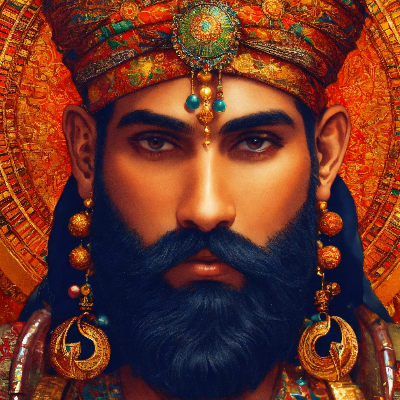
About
Ripu — Son of Yadu, Prince of the Lunar Yaduvansha
Ripu · Raghu (Vishnu Purana variant for the fourth son of Yadu)
Ripu was a son of King Yadu, the eldest son of Emperor Yayati of the lunar Chandravamsha, and accordingly a prince of the Yadava lineage. He is named in the genealogical lists of the Bhagavata Purana as the fourth son of Yadu. Beyond this listing, the Bhagavata Purana records no descendants, episodes, or further details for Ripu. The Vishnu Purana, covering the same genealogical register, names the fourth son of Yadu as Raghu rather than Ripu — a different name in the same position, constituting a textual discrepancy between two major primary sources. No other Mahapurana examined records any progeny, narrative, or genealogical extension for the figure named Ripu as a son of Yadu. The Puranic tradition contains other figures named Ripu — most notably a son of Srishti who is the father of Chakshusha Manu — who are entirely distinct from the son of Yadu and must not be confused with him. The primary source for Ripu as a son of Yadu is the Bhagavata Purana (Canto 9, Chapter 23, verses 20–21).
✦ The Name
The Sanskrit word ripu is a common noun meaning enemy, foe, or adversary. The Wiktionary Sanskrit entry traces the word to a Proto-Indo-European root meaning to adhere or smear, noting that the meanings of deceitful, treacherous, and enemy developed figuratively from an earlier cluster of meanings centering on stain or fault. Classical dictionaries confirm that ripu means enemy or foe and is used throughout Sanskrit literature including the Rig Veda, the Mahabharata, and the Manu Smriti. In the Rig Veda the word carries the sense of deceitful or treacherous, while in later Puranic and epic usage it functions as the straightforward noun for an adversary. The compound shadrip or shadripu, the six enemies of the mind — desire, anger, greed, ego, attachment, and jealousy — is one of the word's best-known later applications. No primary text provides any specific etymology or explanation for why this name was given to the son of Yadu, nor does any source explain any connection between the name's meaning and the character or circumstances of this prince.
✦ Lineage
- Paternal grandfather: Yayati, emperor of the lunar dynasty and son of Nahusha, who had two wives — Devayani, daughter of the sage Shukracharya, and Sharmishtha, daughter of Vrishaparva, king of the Daityas. Yadu was born of Devayani.
- Father: Yadu, the eldest son of Yayati, who refused to exchange his youth for his father's old age and was cursed that none of his descendants would rule as sovereign heirs of the Yayati imperial line. Yadu's progeny established the separate lineage called the Yaduvansha.
- Brothers: The Bhagavata Purana (9.23.20–21) lists four sons of Yadu: Sahasrajit, Kroshta, Nala, and Ripu, placing Ripu fourth. Sahasrajit was the eldest, from whom the Haihaya confederacy descended through his son Shatajit and grandson Haihaya. Kroshta was the second son, from whom all major Yadava clans of the Mahabharata period descended, including the Vrishnis, Satvatas, and Andhakas, and through them Vasudeva, Krishna, and Balarama. Nala was the third son, for whom no descendants are recorded in any primary text.
- Descendants: The Bhagavata Purana records no descendants for Ripu as the son of Yadu. No Mahapurana examined develops any line from this Ripu.
✦ What the Primary Sources Record
The Bhagavata Purana (Canto 9, Chapter 23, verses 20–21) in the Vedabase translation gives the four sons of Yadu as Sahasrajit, Kroshta, Nala, and Ripu. After recording this list, the text turns immediately to the descendants of Sahasrajit and then to those of Kroshta; it says nothing further about Nala or Ripu. The Vishnu Purana (Book IV, Chapter XI) in the Wilson translation gives the four sons of Yadu as Sahasrajit, Kroshti, Nala, and Raghu — using Raghu in the fourth position rather than Ripu. The Vishnu Purana likewise records nothing about the descendants of the fourth son. The Harivamsha Purana (Adi Parva, Chapter 33) records five sons of Yadu — Sahasrada, Payoda, Kroshta, Neela, and Anjika — and does not include a name corresponding obviously to Ripu anywhere in this list. No primary text examined assigns any narrative, kingdom, wife, children, or further genealogical development to Ripu as a son of Yadu.
✦ The Distinct Ripu of the Dhruva Lineage
The Puranic tradition contains a much more developed figure named Ripu who is entirely distinct from the son of Yadu. This second Ripu is a descendant of Dhruva, the celebrated devotee of Vishnu: according to the Vishnu Purana (Book III, Chapter I) and the Saurapurana's genealogical section, Dhruva had a son named Srishti, and Srishti by his wife Chaya had five sons — Ripu, Ripunjaya, Vipra, Vrishala, and Vrikatejas. This Ripu, son of Srishti, had a son named Chakshusha by his wife Vrihati, and Chakshusha Manu became the Manu of the sixth Manvantara. The Religion Fandom wiki and the en-academic encyclopedia both record this lineage explicitly. The Wilson footnote to the Vishnu Purana (Book III, Chapter I) also identifies Chakshusha as the son of Ripu by Vrihati and the Manu of the sixth Manvantara, a figure from an entirely separate branch of the Puranic genealogy with no connection to the Yadava line. These two Ripus — son of Yadu and son of Srishti — must be kept distinct; the Pitarau baby name page erroneously states "Ripu was a son of Yadu and Babhru," which is a confusion, as Babhru is not Yadu's wife but a later Yadava figure.
✦ Textual Variants and Inconsistencies
Ripu versus Raghu: The most important variant for this figure is the divergence between the Bhagavata Purana's Ripu and the Vishnu Purana's Raghu as names for the fourth son of Yadu. These are not phonetically close names — Ripu and Raghu — and the divergence cannot plausibly be attributed to scribal confusion between similar-looking Devanagari letters. They represent two genuinely different names in two different Mahapuranas for the same genealogical position. The user's supplied notes claim that the Agni and Garuda Puranas use Raghu for the same figure due to a scribal confusion between the Sanskrit letters for pa and gha. No such statement is made in the primary texts examined; the Wilson footnote to Vishnu Purana Book IV, Chapter XI records Purana-level variants for other names in the list but does not state that the Agni Purana or Garuda Purana calls the fourth son Raghu specifically because of scribal error. This claim in the user's notes is unsupported by the examined sources and should be treated with caution.
The fourth son and fifth son positions: The Harivamsha's five-son list gives Anjika in the fifth position. The user's supplied notes suggest that scholars map Ripu to the position of Anjika in the Harivamsha tradition. No primary text states this equivalence. Anjika occupies the fifth position in a five-son list; Ripu occupies the fourth position in a four-son list. The correspondence is plausible if Payoda (the Harivamsha's second son, absent from the Bhagavata Purana) is treated as an addition that shifts later sons one position, but this remains a scholarly inference not stated in any primary text examined, and should not be presented as an established identification.
The mother of Yadu's sons: The user's supplied notes state that Ripu's mother was one of the five Naga princesses daughters of King Dhumravarna whom Yadu married. This detail about Yadu's wives — daughters of the Naga king Dhumravarna — is attested in the Harivamsha Purana and elsewhere in the Puranic tradition. However, no text examined specifies which of the five wives was the mother of Ripu in particular. The assignment of one of the five Naga wives to Ripu specifically is not confirmed by any primary source.
✦ Connection to the Wider Genealogy
Ripu is a member of the founding generation of the Yaduvansha. Through his father Yadu he is descended from Yayati and through Yayati from the earlier lunar line reaching back through Nahusha, Ayu, Pururava, and ultimately to Soma, the moon god. As a brother of Sahasrajit he is a generation senior to the Haihaya kings of Mahishmati, including Kartavirya Arjuna and the Talajangha confederacy. As a brother of Kroshtu he belongs to the same founding generation as the progenitor of every major Yadava clan of the Mahabharata period, including the Vrishnis, the Andhakas, the Satvatas, the Kukuras, and through them Vasudeva, Krishna, and Balarama. No descendant line is recorded for Ripu himself in the primary sources. The Puranic tradition records no kingdom, no marriage, no son, and no episode associated with him as a son of Yadu. His sole textual function in the primary sources is to complete the list of Yadu's sons.
✦ References
Primary Sources
- Bhagavata Purana, Canto 9, Chapter 23, verses 20–21 (Vedabase) — The principal source for Ripu as a son of Yadu: names the four sons of Yadu as Sahasrajit, Kroshta, Nala, and Ripu; records no descendants or narrative for Ripu.
- Vishnu Purana, Book IV, Chapter XI (Wilson translation, Sacred Texts Archive; Wisdomlib edition) — Names the four sons of Yadu as Sahasrajit, Kroshti, Nala, and Raghu; records nothing about the fourth son beyond the name. The Wilson footnote records variant names across other Puranas for positions in this list but does not specifically address the Ripu / Raghu divergence.
- Harivamsha Purana, Adi Parva, Chapter 33 (Wisdomlib, Dutt translation) — Records five sons of Yadu as Sahasrada, Payoda, Kroshta, Neela, and Anjika; Ripu does not appear in this list by name. No descendants are recorded for Anjika.
- Vishnu Purana, Book III, Chapter I (Wilson translation, Sacred Texts Archive) — Identifies the Ripu who is the son of Srishti and grandson of Dhruva, entirely distinct from the son of Yadu; his son Chakshusha by Vrihati became the Manu of the sixth Manvantara.
- Saurapurana, Vamsanucarita section (Wisdomlib, Shodhganga critical study) — Names Ripu among the five sons of Srishti and Chaya in the Dhruva lineage, again confirming the distinct Ripu of the non-Yadava line.
Secondary and Reference Sources
- Wisdomlib — "Ripu: 27 definitions" (wisdomlib.org/definition/ripu) — Compiles the Sanskrit lexical definition of ripu as foe or enemy across Ayurvedic, Shaiva, Jain, and astronomical contexts; confirms the common-noun status of the word and its Vedic and Puranic usage.
- Wiktionary — Sanskrit entry for ripu (en.wiktionary.org) — Provides the Proto-Indo-European etymology and traces the semantic development from stain to deceitful to enemy.
- Vedabase — Bhagavata Purana 9.23 (vedabase.io) — Provides the full verse text of the four-son list confirming Ripu as the name given in this Purana for the fourth son of Yadu.
- Religion Fandom wiki — "Chakshusha" (religion.fandom.com) — Records Chakshusha as the Manu of the sixth Manvantara and identifies his father as Ripu son of Srishti by Vrihati, establishing the distinct non-Yadava Ripu clearly.
- Wikipedia — "Yadu dynasty" (en.wikipedia.org/wiki/Yadu_dynasty) — Confirms the four-son tradition including Ripu and the variant five-son list of the Harivamsha.