
About
Shatajit — Son of Sahasrajit and Progenitor of the Haihaya Line
Shatajit · Satajit · Shataajit
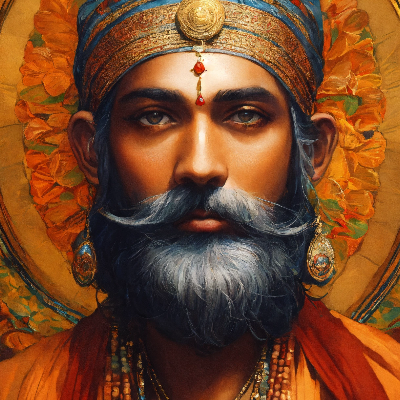
Shatajit is a king of the Yadu lineage, the son of Sahasrajit and the grandson of Yadu — the legendary patriarch of the Yaduvamsha and eldest son of King Yayati of the Lunar Dynasty. Shatajit's primary significance in the Puranic genealogical tradition lies not in any personal narrative but in his role as the direct progenitor of three sons — Haihaya, Renuhaya, and Mahahaya — through whom the Haihaya dynasty, one of the most powerful royal confederations of ancient central India, was established and expanded. He is named in the Bhagavata Purana and related genealogical texts as the critical generational link between Sahasrajit and the Haihaya dynastic line.
✦ The Name
The name Shatajit is a Sanskrit compound of shata, meaning one hundred, and jit, from the root ji, meaning to conquer or to win. The name therefore signifies one who conquers a hundred or victor over hundreds. It follows the same naming convention as his father Sahasrajit — victor over thousands — suggesting a deliberate dynastic pattern in the naming of this line. The variant spellings Satajit and Shataajit found across different recensions and transliterations represent the same name without substantive difference in meaning.
✦ Lineage
- Grandfather: Yadu — the eldest son of King Yayati of the Lunar Dynasty and his wife Devayani, daughter of the sage Shukracharya. Yadu is the founding patriarch of the Yaduvamsha. Though the eldest son of Yayati, Yadu was cursed by his father and excluded from inheriting the principal throne of the Lunar Dynasty, leading his descendants to establish independent kingdoms.
- Father: Sahasrajit — the eldest son of Yadu and the progenitor of the branch of the Yadu lineage that produced the Haihaya dynasty. His name means victor over thousands, and he is consistently identified in the Bhagavata Purana and Agni Purana as the firstborn among Yadu's sons.
- Son: Haihaya — the eponymous founder of the Haihaya dynasty, one of the most powerful Kshatriya royal houses of central India in the Puranic age. The Haihaya clan eventually diversified into five sub-clans and held dominion over a wide territory centred on the city of Mahishmati on the Narmada River.
- Son: Renuhaya — also rendered Venuhaya in certain recensions of the Puranas. Named alongside Haihaya and Mahahaya as one of Shatajit's three sons in the Bhagavata Purana. The primary texts do not elaborate a distinct narrative for this figure beyond his genealogical placement.
- Son: Mahahaya — also referred to as Haya in shorter recensions of the genealogy. Named as the third of Shatajit's sons. As with Renuhaya, the primary texts do not preserve a separate narrative for this figure.
✦ Textual Variants and Inconsistencies
The name of Shatajit's son Renuhaya appears as Venuhaya in some Puranic recensions, a variation that reflects differences between manuscript traditions rather than distinct genealogical claims. Similarly, Mahahaya is shortened to Haya in certain versions of the genealogy. The Bhagavata Purana, Agni Purana, and Vishnu Purana broadly agree on the sequence from Sahasrajit through Shatajit to the three sons, though the level of detail provided for each son varies. No primary text assigns Shatajit a personal narrative, battle account, or administrative record; his presence in the tradition is exclusively genealogical.
✦ Connection to the Wider Genealogy
Shatajit occupies a pivotal position in the Yadava genealogical tree as the figure through whom the Haihaya dynastic branch was formally established. His patrilineal ancestry runs upward through Sahasrajit to Yadu, and thence through Yayati and Nahusha to the divine origins of the Lunar Dynasty. Through his son Haihaya, Shatajit is the direct ancestor of the five Haihaya sub-clans — the Vitihotra, Sharyata, Bhoja, Avanti, and Tundikera — and through the Haihaya line he is a remote patrilineal ancestor of Kartavirya Arjuna, the celebrated thousand-armed king of Mahishmati who figures prominently in the Puranic narratives of Parashurama's conflict with the Kshatriya order.
✦ References
- Bhagavata Purana, Ninth Skandha, Chapter 23 — the principal source naming Shatajit as the son of Sahasrajit and identifying his three sons Haihaya, Renuhaya, and Mahahaya.
- Agni Purana — corroborates the genealogical sequence through Shatajit to the Haihaya line.
- Vishnu Purana — provides the broader Yadu dynastic genealogy within which Shatajit's placement is established.
- Puranic Encyclopaedia by Vettam Mani — provides a consolidated genealogical reference for the Sahasrajit branch of the Yadu lineage including Shatajit's position.
- Wisdomlib, Puranic Encyclopaedia online — secondary reference compiling Puranic genealogical data relevant to the Shatajit entry.