
About
Haihaya — Yadava King and Eponymous Founder of the Haihaya Dynasty
Haihaya · Haihaya Raja
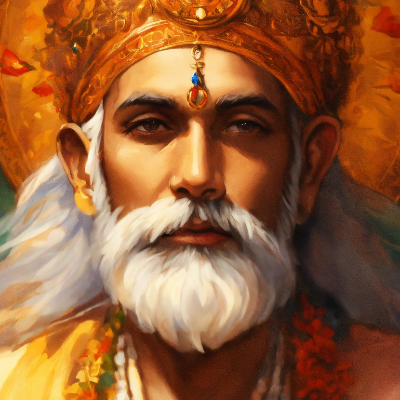
Haihaya is a king of the Yadu lineage and the eponymous founder of the Haihaya dynasty, one of the most powerful Kshatriya royal confederations of the Puranic age. He is the son of Shatajit, grandson of Sahasrajit, and great-grandson of Yadu — the legendary patriarch of the Yaduvamsha and eldest son of King Yayati of the Lunar Dynasty. The dynasty that bears his name grew into a formidable power centred on the city of Mahishmati on the banks of the Narmada River in central India, and eventually diversified into five distinct sub-clans. The most celebrated descendant of his line was Kartavirya Arjuna, the thousand-armed king of Mahishmati whose exploits and eventual defeat at the hands of Parashurama form one of the major narrative cycles of the Puranas. Haihaya is named in the Bhagavata Purana, the Vishnu Purana, and related genealogical texts as the founding figure of this branch of the Yadava people.
✦ The Name
The name Haihaya is of disputed and uncertain Sanskrit etymology. One traditional derivation connects it to haya, meaning horse, with the compound suggesting association with or lordship over horses — an attribute of prestige and martial power in the Vedic and Puranic world. Another interpretation links the name to the region or territory over which the clan held dominion. The name functions primarily as a dynastic and clan designation in the texts; the Haihaya people as a group take their identity directly from this eponymous ancestor. No extended etymological discussion of the name is preserved in the principal primary sources.
✦ Lineage
- Great-grandfather: Yadu — the eldest son of King Yayati of the Lunar Dynasty and his wife Devayani, daughter of the sage Shukracharya. Yadu is the founding patriarch of the Yaduvamsha. Though the eldest of Yayati's sons, Yadu was cursed by his father and excluded from inheriting the principal Lunar Dynasty throne, leading his descendants to establish independent kingdoms across the subcontinent.
- Grandfather: Sahasrajit — the eldest son of Yadu, whose name means victor over thousands. Sahasrajit is the progenitor of the branch of the Yadu lineage that produced the Haihaya dynasty and is consistently identified in the Bhagavata Purana as the firstborn among Yadu's sons.
- Father: Shatajit — son of Sahasrajit, whose name means victor over hundreds. The primary texts preserve no personal narrative for Shatajit beyond his genealogical role as the father of Haihaya, Renuhaya, and Mahahaya.
- Brothers: Renuhaya (also rendered Venuhaya in some recensions) and Mahahaya (also rendered Haya in shorter genealogical lists) — the other two sons of Shatajit named in the Bhagavata Purana. The primary texts do not preserve distinct narratives for either brother.
- Descendants: Through Haihaya's line the dynasty expanded across several generations, eventually producing the five sub-clans of the Haihaya confederation — the Vitihotra, the Sharyata, the Bhoja, the Avanti, and the Tundikera — and culminating in the celebrated warrior-king Kartavirya Arjuna of Mahishmati.
✦ The Haihaya Dynasty and Its Five Branches
The dynasty founded by Haihaya grew over successive generations into one of the dominant royal powers of central India in the Puranic age. The Puranas record that the Haihaya line eventually subdivided into five major branches or sub-clans: the Vitihotra, the Sharyata, the Bhoja, the Avanti, and the Tundikera. Each of these groups constituted a distinct clan within the broader Haihaya confederation, and together they held sway over a wide territory in the Narmada river region. The city of Mahishmati on the Narmada served as the principal royal capital of the Haihaya kings and is consistently associated with the dynasty across the Puranic texts.
The most famous king to emerge from Haihaya's line was Kartavirya Arjuna, also known by the epithet Sahasrabahu — the thousand-armed one — who ruled from Mahishmati and is described across the Puranas and the Mahabharata as one of the mightiest monarchs of his era. The texts credit him with extraordinary martial prowess and dominion over vast territories. His eventual defeat and death at the hands of Parashurama, the avatara of Vishnu born into the brahmin lineage of Bhrigu, forms one of the major narrative cycles connected to the Haihaya dynasty and marks the effective end of Haihaya supremacy in the Puranic historical scheme.
✦ Textual Variants and Inconsistencies
The primary texts are consistent in naming Haihaya as the son of Shatajit and the eponymous ancestor of the Haihaya dynasty. However, the intermediate genealogical steps between Haihaya himself and the later kings of the dynasty — including Kartavirya Arjuna — are recorded with varying degrees of detail and occasional differences in names across the Bhagavata Purana, Vishnu Purana, Agni Purana, and Mahabharata. The five sub-clans of the Haihaya confederation are named consistently across the major Puranas, though the precise genealogical relationship between Haihaya and each of the five founding figures of those sub-clans is not uniformly elaborated. No personal narrative episode involving Haihaya himself — as distinct from his descendants — is preserved in the principal primary sources; his profile in the tradition is predominantly genealogical and dynastic rather than biographical.
✦ Connection to the Wider Genealogy
Haihaya stands at a critical node in the Yadava genealogical tree, connecting the founding patriarchs of the Yadu lineage to one of the most historically prominent dynastic branches of the Yadava people. His patrilineal ancestry runs upward through Shatajit and Sahasrajit to Yadu, and thence through Yayati and Nahusha to the divine origins of the Lunar Dynasty. Downward through his descendants, he is the remote patrilineal ancestor of Kartavirya Arjuna and of all five branches of the Haihaya confederation. His line thus represents one of the two major branches of the Yadu lineage in the Puranic scheme, the other being the branch of Yadu's son Kroshtu from which Krishna eventually descended.
✦ References
- Bhagavata Purana, Ninth Skandha, Chapter 23 — the principal Puranic source naming Haihaya as the son of Shatajit and establishing the genealogical sequence from Yadu through Sahasrajit and Shatajit to the Haihaya dynastic line.
- Vishnu Purana — provides the broader Yadu dynastic genealogy and records the Haihaya branch including the five sub-clans of the confederation.
- Agni Purana — corroborates the genealogical placement of Haihaya within the Sahasrajit branch of the Yadu lineage.
- Mahabharata, Adi Parva and Shanti Parva — references the Haihaya dynasty and its most celebrated king Kartavirya Arjuna in the context of Parashurama's conflict with the Kshatriya order.
- Puranic Encyclopaedia by Vettam Mani — provides a consolidated reference entry on Haihaya and the dynasty bearing his name.
- Wisdomlib, Puranic Encyclopaedia online — secondary reference compiling Puranic genealogical and dynastic data relevant to the Haihaya entry.