
About
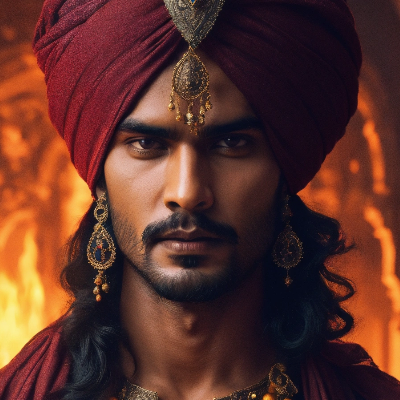
Kartavirya Arjuna — Haihaya Chakravartin, Sahasrabahu, and Adversary of Parashurama
Kartavirya Arjuna · Sahasrabahu · Sahasrarjuna · Sahasrabahu Arjuna
Kartavirya Arjuna, widely known by his epithet Sahasrabahu — the thousand-armed one — is the most celebrated king of the Haihaya dynasty and one of the most formidable warrior-kings of the Puranic age. He is the son of King Kritavirya of the Haihaya line, a dynasty that traces its patrilineal origin through Haihaya, Shatajit, and Sahasrajit to Yadu, the eldest son of King Yayati of the Lunar Dynasty. Kartavirya Arjuna ruled from the city of Mahishmati on the banks of the Narmada River and is described across the Mahabharata, the Bhagavata Purana, the Vishnu Purana, the Brahmanda Purana, and several other Puranic texts as a Chakravartin — a universal emperor of extraordinary power. He is identified in certain Puranic accounts as a partial incarnation of the Sudarshana Chakra, the divine discus-weapon of the god Vishnu. His narrative arc moves from devoted discipleship under the sage Dattatreya and righteous universal sovereignty to arrogance and transgression, culminating in his defeat and death at the hands of Parashurama, the avatara of Vishnu born of the Bhrigu sage Jamadagni — an event that triggered one of the most dramatic cycles of Kshatriya annihilation in the Puranic tradition.
✦ The Name
The name Kartavirya Arjuna is a compound designation combining a patronymic and a personal name. Kartavirya identifies him as the son of Kritavirya, following a standard Sanskrit patronymic formation. Arjuna, from the root meaning bright, clear, or shining white, is one of the most distinguished personal names in the Kshatriya tradition and is shared with the celebrated Pandava hero of the Mahabharata, though the two are entirely distinct figures. His most widely used epithet, Sahasrabahu, is a Sanskrit compound of sahasra — one thousand — and bahu — arm — meaning the thousand-armed one, a direct reference to the miraculous boon that defined his martial identity. He is also referred to as Sahasrarjuna in contracted form across several texts.
✦ Lineage
- Remote patrilineal ancestor: Yadu — the eldest son of King Yayati of the Lunar Dynasty and his wife Devayani, daughter of the sage Shukracharya. Yadu is the founding patriarch of the Yaduvamsha. Though the eldest of Yayati's sons, Yadu was cursed by his father and excluded from inheriting the principal Lunar Dynasty throne, leading his descendants to establish independent kingdoms.
- Remote patrilineal ancestor: Sahasrajit — the eldest son of Yadu, progenitor of the branch of the Yadu lineage that produced the Haihaya dynasty.
- Remote patrilineal ancestor: Shatajit — son of Sahasrajit, father of Haihaya, Renuhaya, and Mahahaya, and the direct patrilineal link between Sahasrajit and the Haihaya dynastic line.
- Remote patrilineal ancestor: Haihaya — son of Shatajit and eponymous founder of the Haihaya dynasty. The clan and the dynasty bear his name, and through his descendants the line eventually produced the five sub-clans of the Haihaya confederation.
- Father: Kritavirya — a king of the Haihaya dynasty and the immediate father of Kartavirya Arjuna. The texts record that Kritavirya performed extended austerities to obtain a son, and that Kartavirya Arjuna was the fruit of those penances. The name Kartavirya is the patronymic derived from Kritavirya.
- Sons: The Puranas name several sons of Kartavirya Arjuna, of whom Shurasena and Shura are among those mentioned as survivors after Parashurama's assault. The Brahmanda Purana and related texts note that some of his sons escaped destruction and continued the Haihaya line, though the dynasty never recovered its former supremacy.
✦ Divine Identity and the Boons of Dattatreya
Certain Puranic accounts, notably those in the Brahmanda Purana and texts drawing on the same tradition, identify Kartavirya Arjuna as a partial avatara or incarnation of the Sudarshana Chakra — the divine discus-weapon of the god Vishnu. This identification positions him within a cosmic framework as both an instrument and an eventual target of Vishnu's salvific purpose, since he was destined to be slain by Parashurama, himself an avatara of Vishnu. The tension between his divine origin and his arrogant transgression is a deliberate theological construction in the Puranic narrative.
Kartavirya Arjuna is consistently described in the Puranas as a devoted disciple of the sage Dattatreya — a figure revered as the combined incarnation of the divine triad of Brahma, Vishnu, and Shiva, and one of the most celebrated of the Avadhuta sages. Through prolonged and earnest devotion to Dattatreya, Kartavirya Arjuna received a series of extraordinary boons. He was granted the power to manifest one thousand arms in battle, which gave rise to his most enduring epithet. He received a boon of invincibility against gods, demons, and human warriors alike, with the sole exception of a being of surpassing divine power. He was granted yogic capabilities over natural forces, including the ability to summon rain and to arrest the flow of rivers — an ability he is specifically described as exercising upon the Narmada. He also received a divine chariot said to be capable of travelling anywhere without obstruction. These boons together made him effectively peerless among the rulers and warriors of his age.
✦ The Capture of Mahishmati
Among the martial achievements attributed to Kartavirya Arjuna in the Puranic texts is the capture of Mahishmati, the city on the Narmada that became the celebrated capital of the Haihaya kingdom. The texts record that Mahishmati was at the time held by the Karkotaka Nagas — a lineage of serpent-beings — and that Kartavirya Arjuna wrested it from them and established it as his royal seat. Mahishmati under his rule became one of the great cities of the Puranic world, associated with his long and prosperous reign as a Chakravartin.
✦ The Defeat and Imprisonment of Ravana
One of the most celebrated episodes associated with Kartavirya Arjuna in the Puranic and epic tradition is his encounter with Ravana, the demon-king of Lanka who is the principal antagonist of the Ramayana. The texts record that while Kartavirya Arjuna was sporting in the waters of the Narmada River — some accounts specify that he used his thousand arms to arrest the river's current and create a vast pool for his recreation — Ravana was performing worship on the riverbank and his ritual was disturbed. The two came into conflict, and Kartavirya Arjuna, using the overwhelming force of his boon-granted arms, captured Ravana and imprisoned him at Mahishmati, treating him as a captive of no great consequence. Ravana was held there until the sage Pulastya — the grandfather of Ravana and one of the seven primordial sages — intervened and petitioned Kartavirya Arjuna for his grandson's release. Kartavirya Arjuna, out of respect for the great sage, released Ravana. This episode is recorded in the Valmiki Ramayana's Uttara Kanda, the Vishnu Purana, and several other Puranic texts, and it establishes Kartavirya Arjuna's power as surpassing even that of the formidable Ravana.
✦ The Theft of Kamadhenu and the Conflict with Parashurama
The central and defining episode of Kartavirya Arjuna's narrative in the Puranas is his conflict with Parashurama, which the texts present as the inevitable consequence of his descent from righteousness into arrogance. The episode begins when Kartavirya Arjuna and his army visited the forest hermitage of the sage Jamadagni, a great ascetic of the Bhrigu lineage and the father of Parashurama. Jamadagni possessed the divine cow Kamadhenu — a wish-fulfilling bovine of celestial origin — and was able through her power to provide hospitality to the entire royal retinue with miraculous abundance. Kartavirya Arjuna, overwhelmed by desire for the cow and unwilling to accept that a brahmin sage should possess so great a treasure, seized Kamadhenu by force against Jamadagni's will and had her carried away to his capital.
Parashurama — the son of Jamadagni, born as an avatara of Vishnu and armed with a divine axe given to him by Shiva — returned to the hermitage to find his father bereft and set out to confront the king. The battle that followed is described across the Mahabharata, the Bhagavata Purana, and numerous other texts as a demonstration of Parashurama's supreme divine power. Despite Kartavirya Arjuna's boon of invincibility and the formidable force of his thousand arms, Parashurama — being himself a divine incarnation of surpassing power — stood as the one being capable of defeating him. Parashurama destroyed the king's vast army, severed all thousand of his arms, and finally killed him. The Bhagavata Purana presents this outcome as cosmically foreordained, since Kartavirya Arjuna's boon excluded defeat only by ordinary beings and Parashurama's divine status placed him beyond that category.
The aftermath of Kartavirya Arjuna's death escalated the conflict dramatically. His sons, in revenge for their father's killing, attacked and murdered the sage Jamadagni at his hermitage while Parashurama was absent. This act of vengeance against an unarmed and defenceless brahmin sage provoked Parashurama to a vow of total retribution. He undertook to rid the earth of the Kshatriya warrior class twenty-one times over — an extraordinary campaign of annihilation that forms one of the darkest and most consequential cycles in the Puranic historical tradition.
✦ Textual Variants and Inconsistencies
The core narrative of Kartavirya Arjuna — his boons from Dattatreya, his defeat of Ravana, the theft of Kamadhenu, and his death at Parashurama's hands — is broadly consistent across the major Puranas and the Mahabharata. However, specific details vary between texts. The duration of his reign, given in some sources as eighty-five thousand years, belongs to the mythological time-scale of the Puranic age and is not uniformly stated across all texts. The precise genealogical steps between Haihaya and Kritavirya — that is, the number and names of the intermediate generations separating the dynastic founder from Kartavirya Arjuna's father — are given with varying levels of detail in the Bhagavata Purana, Vishnu Purana, and Brahmanda Purana, and do not always agree exactly. The identification of Kartavirya Arjuna as an incarnation of the Sudarshana Chakra is specific to certain Puranic traditions and is not a universally stated element of his characterisation across all texts.
✦ Theological Significance
Kartavirya Arjuna's narrative carries a clear theological structure that recurs across several Puranic cycles. He exemplifies the pattern of the great king or warrior who begins in righteousness and devotion, achieves extraordinary power through that devotion, and then falls into arrogance and transgression as a result of the very power he has obtained. His theft of the sage's divine cow is a violation of the dharmic boundary between Kshatriya and brahmin that the Puranas treat as a crime of the gravest order. His defeat by Parashurama is presented not merely as a military event but as a cosmic correction — the restoration of dharmic order through divine intervention. The subsequent vow of Parashurama to annihilate the Kshatriya class is grounded in the transgression of Kartavirya Arjuna's sons, making Kartavirya Arjuna the indirect cause of one of the most sweeping upheavals in the Puranic world-age.
✦ Connection to the Wider Genealogy
Kartavirya Arjuna is the most celebrated descendant of Haihaya and the culminating figure of the Sahasrajit branch of the Yadu lineage. His patrilineal ancestry runs upward through Kritavirya and the intervening Haihaya kings to Haihaya, Shatajit, Sahasrajit, and Yadu, and thence through Yayati and Nahusha to the divine origins of the Lunar Dynasty. He is thus a remote patrilineal cousin — through the respective branches of Sahasrajit and Kroshtu — of the entire Krishna lineage of the Yadava people, though the two branches had long since diverged into entirely separate royal houses by his era. Through his surviving sons the Haihaya line continued in diminished form after Parashurama's campaign, though the dynasty never regained the universal sovereignty it had held under Kartavirya Arjuna.
✦ References
- Mahabharata, Vana Parva and Shanti Parva — records the story of Kartavirya Arjuna's conflict with Parashurama, his defeat of Ravana, and the consequences of his sons' killing of Jamadagni.
- Bhagavata Purana, Ninth Skandha — provides the genealogical placement of Kartavirya Arjuna within the Haihaya line and narrates the principal episodes of his reign, his theft of Kamadhenu, and his death at Parashurama's hands.
- Vishnu Purana — records the Haihaya dynastic genealogy and the narrative of Kartavirya Arjuna's conflict with Parashurama and his earlier defeat of Ravana.
- Brahmanda Purana — provides additional detail on Kartavirya Arjuna's divine identity as an incarnation of the Sudarshana Chakra and on his boons from Dattatreya.
- Valmiki Ramayana, Uttara Kanda — records the episode of Kartavirya Arjuna's capture and imprisonment of Ravana on the banks of the Narmada and his subsequent release of Ravana at the petition of the sage Pulastya.
- Agni Purana — corroborates the genealogical sequence of the Haihaya line culminating in Kartavirya Arjuna.
- Puranic Encyclopaedia by Vettam Mani — provides a consolidated reference entry on Kartavirya Arjuna covering his genealogy, boons, major episodes, and significance.
- Wisdomlib, Puranic Encyclopaedia online — secondary reference compiling Puranic and epic data relevant to the Kartavirya Arjuna entry.