
About
Jayadhvaja — Haihaya Survivor, King of Avanti, and Progenitor of the Talajangha Line
Jayadhvaja
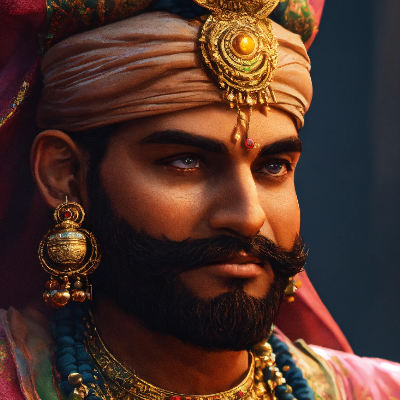
Jayadhvaja is a king of the Haihaya dynasty, the son of Kartavirya Arjuna — the celebrated thousand-armed Chakravartin of Mahishmati — and the most prominent of the small number of Haihaya princes who survived the retributive campaign of Parashurama following his father's defeat and death. He assumed kingship over the Haihaya territories in the aftermath of that catastrophe and ruled from the Avanti region of central India. He is the father of Talajangha, whose own numerous descendants came to be known collectively as the Talajangha Kshatriyas — a powerful martial lineage that subsequently waged extensive conflicts with the Ikshvaku dynasty of Ayodhya. Jayadhvaja is recorded in the Bhagavata Purana, the Matsya Purana, the Narasimha Purana, the Saurapurana, and related texts. Beyond his genealogical and dynastic significance, he is noted in certain Puranic traditions for his exceptional personal devotion to the god Vishnu and for a narrative concerning his virtuous conduct in a previous life that accounts for his distinguished rebirth as a Haihaya prince.
✦ The Name
The name Jayadhvaja is a Sanskrit compound of jaya, meaning victory or conquest, and dhvaja, meaning banner, flag, or standard. The compound therefore signifies one whose banner is victory or he of the victorious standard — a name with strong royal and martial connotations, befitting a Kshatriya prince of the Haihaya line. It carries an ironic resonance within the narrative context, as Jayadhvaja bore a name proclaiming triumph even as his inheritance was shaped by the catastrophic defeat and death of his father at Parashurama's hands.
✦ Lineage
- Remote patrilineal ancestor: Yadu — the eldest son of King Yayati of the Lunar Dynasty and his wife Devayani, daughter of the sage Shukracharya. Yadu is the founding patriarch of the Yaduvamsha. Though the eldest of Yayati's sons, Yadu was cursed by his father and excluded from inheriting the principal throne of the Lunar Dynasty, leading his descendants to establish independent kingdoms.
- Remote patrilineal ancestor: Sahasrajit — the eldest son of Yadu, progenitor of the branch of the Yadu lineage that produced the Haihaya dynasty.
- Remote patrilineal ancestor: Shatajit — son of Sahasrajit and father of Haihaya, Renuhaya, and Mahahaya.
- Remote patrilineal ancestor: Haihaya — son of Shatajit and eponymous founder of the Haihaya dynasty, from whom the entire dynastic confederation takes its name.
- Remote patrilineal ancestor: Dharmanetra — son of Haihaya and early Haihaya king whose name means one guided by righteousness.
- Remote patrilineal ancestor: Karta — also rendered Kunti or Kuni in different recensions. Son of Dharmanetra and an early Haihaya king of the dynasty's formative period.
- Remote patrilineal ancestor: Sahanja — also rendered Sohanji, Sahajit, or Sahatjit. Son of Karta and father of Mahishmant.
- Remote patrilineal ancestor: Mahishmant — son of Sahanja and the Haihaya king credited with founding Mahishmati on the Narmada River, the great capital of the Haihaya confederation.
- Remote patrilineal ancestor: Bhadrasrenaka — also known as Bhadrasena. Son of Mahishmant and the first Haihaya king associated with major military projection beyond the Narmada valley, including the conquest of Kasi.
- Remote patrilineal ancestor: Durdama — son of Bhadrasrenaka, whose name means indomitable. He ruled during the period of continued Haihaya conflict with the kingdom of Kasi.
- Remote patrilineal ancestor: Kanaka — son of Durdama and father of Dhanaka. The primary texts preserve no personal narrative for Kanaka beyond his genealogical placement.
- Remote patrilineal ancestor: Dhanaka — son of Kanaka and grandfather of Kartavirya Arjuna. Notable as the father of four sons all bearing the Krita prefix — Kritavirya, Kritagni, Kritavarman, and Kritaujas — a generation of particular dynastic distinction.
- Remote patrilineal ancestor: Kritavirya — the eldest son of Dhanaka, father of Kartavirya Arjuna, and the king whose name provided the patronymic by which his famous son is universally known. Kritavirya obtained his son through prolonged penance and the grace of the sage Dattatreya.
- Father: Kartavirya Arjuna — also known as Sahasrabahu, the thousand-armed one. The most celebrated king of the Haihaya dynasty, regarded as a Chakravartin and identified in certain texts as a partial incarnation of the Sudarshana Chakra of Vishnu. He ruled from Mahishmati, defeated Ravana on the Narmada, and was eventually slain by Parashurama following his forcible seizure of the divine cow Kamadhenu from the hermitage of the sage Jamadagni.
- Brothers who survived Parashurama's campaign: Shurasena, Vrishabha, Madhu, and Urjita — named in certain Puranic accounts as the other sons of Kartavirya Arjuna who escaped destruction alongside Jayadhvaja. The primary texts do not preserve extended narratives for these brothers individually.
- Son: Talajangha — the son and successor of Jayadhvaja, whose numerous descendants became known collectively as the Talajangha Kshatriyas. This lineage subsequently became embroiled in prolonged conflict with the Ikshvaku dynasty of Ayodhya, particularly during the reigns of the Ayodhya kings Bahu and Sagara.
✦ Survival of Parashurama's Campaign
The context of Jayadhvaja's accession to power is inseparable from the catastrophic events that preceded it. Kartavirya Arjuna's sons, in revenge for their father's slaying by Parashurama, attacked and killed the sage Jamadagni — Parashurama's father — at his hermitage while Parashurama was absent. This act of murderous vengeance against an unarmed brahmin sage provoked Parashurama to a vow of total retribution against the Kshatriya class, which he is said to have carried out twenty-one times across the earth. The Haihaya royal family, as the dynasty most directly implicated in the original chain of events, bore the full weight of this campaign. Of the vast number of sons attributed to Kartavirya Arjuna — the texts give varying figures, with some traditions citing a thousand sons and others a smaller number — only five are recorded as having survived: Jayadhvaja, Shurasena, Vrishabha, Madhu, and Urjita. Jayadhvaja, as the most prominent among these survivors, assumed the principal royal succession.
✦ Reign and Devotion to Vishnu
Jayadhvaja ruled from the Avanti region of central India, maintaining Haihaya sovereignty over that territory in the aftermath of the dynasty's catastrophic losses. The Saurapurana distinguishes Jayadhvaja from his brothers in terms of personal religious orientation, recording that while his brothers directed their worship primarily toward Mahadeva — the god Shiva — Jayadhvaja was of exceptional intelligence and became deeply devoted to Narayana, the god Vishnu. This distinction is significant within the broader Puranic framework, as it aligns Jayadhvaja with the Vaishnava tradition despite his dynasty's close associations with Shaiva worship, and it connects him to the narrative of his previous life preserved in the Narasimha Purana.
✦ The Previous Life Narrative
The Narasimha Purana preserves a narrative concerning the origin of Jayadhvaja's distinguished spiritual status in terms of his conduct in a previous birth. According to this account, in his prior life Jayadhvaja had been a humble servant employed in the maintenance of a Vishnu temple. His daily service consisted of sweeping and plastering the floors of the temple — tasks of a lowly and unprestigious character — which he performed with consistent selflessness and devotion without seeking recognition or reward. This humble and sincere seva, sustained as an act of pure devotion to Vishnu, accumulated sufficient spiritual merit to earn him divine grace and the boon of rebirth as a powerful and righteous king. The narrative follows a well-established Puranic pattern in which extraordinary royal or spiritual status in one life is traced to acts of humble but sincere devotion performed in a previous existence, emphasising the doctrine that devotional service to the divine carries transformative consequences across lifetimes regardless of the social station in which it is performed.
✦ The Talajangha Legacy
The most significant dynastic consequence of Jayadhvaja's reign was the founding of the Talajangha lineage through his son Talajangha. The descendants of Talajangha came to be known collectively as the Talajangha Kshatriyas — a powerful martial confederation that maintained Haihaya dynastic identity and ambition in the generations following Parashurama's decimation of the original Haihaya royal family. The Talajangha Kshatriyas are recorded in the Puranas as eventually waging extensive campaigns against the Ikshvaku dynasty of Ayodhya, the great Solar Dynasty royal line to which the god Vishnu's Rama avatara would eventually be born. These conflicts are associated in the texts with the Ayodhya kings Bahu and his son Sagara — the latter being the celebrated monarch in whose story the descent of the river Ganga to the earth is embedded. The Talajangha wars thus connect the Haihaya dynastic tradition to one of the most important narrative threads of the Solar Dynasty in the Puranic historical scheme.
✦ Textual Variants and Inconsistencies
The number of Kartavirya Arjuna's sons who survived Parashurama's campaign is not uniformly stated across all Puranic texts. Certain traditions give only five surviving sons — naming Jayadhvaja, Shurasena, Vrishabha, Madhu, and Urjita — while others suggest a larger number of survivors without naming them individually. The identification of Jayadhvaja as the principal heir and the most prominent survivor is, however, consistent across the sources that address this transition. The Saurapurana's account of Jayadhvaja's Vaishnava devotion as contrasted with his brothers' Shaiva orientation is a detail specific to that text and is not elaborated in all sources that mention him. The previous life narrative from the Narasimha Purana represents a tradition specific to that Purana's devotional framework and should be understood as belonging to that text's particular theological concerns rather than as a universally attested biographical detail.
✦ Connection to the Wider Genealogy
Jayadhvaja stands as the fourteenth generation of the Haihaya dynastic line counting from Yadu, depending on the recension. His patrilineal ancestry runs upward through the full sequence of Haihaya kings — Kartavirya Arjuna, Kritavirya, Dhanaka, Kanaka, Durdama, Bhadrasrenaka, Mahishmant, Sahanja, Karta, Dharmanetra, Haihaya, Shatajit, and Sahasrajit — to Yadu, and thence through Yayati and Nahusha to the divine origins of the Lunar Dynasty. Downward, his line passes through Talajangha to the Talajangha Kshatriya confederation, connecting the post-Parashurama Haihaya tradition to the later dynastic conflicts of the Puranic world. Jayadhvaja thus functions as the critical hinge figure between the glorious but catastrophically ended first phase of Haihaya imperial power under Kartavirya Arjuna and the dynasty's continued, if diminished, presence in subsequent Puranic history.
✦ References
- Bhagavata Purana, Ninth Skandha — records Jayadhvaja as a surviving son of Kartavirya Arjuna and the progenitor of the Talajangha line within the broader Haihaya genealogical framework.
- Matsya Purana — names the five surviving sons of Kartavirya Arjuna including Jayadhvaja and records his succession to the Haihaya throne.
- Narasimha Purana — preserves the narrative of Jayadhvaja's previous life as a humble temple servant whose devoted service to Vishnu secured his distinguished rebirth.
- Saurapurana — records Jayadhvaja's exceptional devotion to Narayana as distinguished from his brothers' worship of Mahadeva.
- Vishnu Purana — provides the broader Haihaya dynastic framework and records the transition from Kartavirya Arjuna's line to the Talajangha succession through Jayadhvaja.
- Puranic Encyclopaedia by Vettam Mani — provides a consolidated reference entry on Jayadhvaja covering his survival, reign, devotion, and the founding of the Talajangha lineage.
- Wisdomlib — secondary reference compiling Puranic data on Jayadhvaja and his position within the post-Parashurama Haihaya tradition.