
About
Talajangha — Haihaya King and Progenitor of the Talajangha Confederacy
Talajangha · Talajanghaka · Talajanghavamsha (the lineage bearing his name)
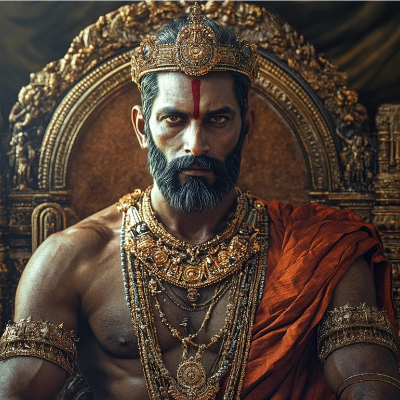
Talajangha was a king of the Haihaya branch of the Yadava lineage, belonging to the Chandravamsha, the lunar dynasty. He was the son of Jayadhvaja and the grandson of Kartavirya Arjuna, the celebrated thousand-armed emperor of Mahishmati. His principal significance in the tradition is twofold: as an individual king he led a successful military campaign against Ayodhya that drove the Ikshvaku king Bahu into exile, and as a progenitor his hundred sons collectively gave their name to the great Haihaya confederacy, so that all five constituent clans of the Haihayas came to be known as the Talajanghas. He appears principally in the Harivamsha Purana, the Vishnu Purana, the Brahmanda Purana, the Brahma Purana, the Bhagavata Purana, and the Balakanda of the Valmiki Ramayana.
✦ The Name
The name Talajangha is a Sanskrit compound formed from tala, meaning the palm tree or its trunk, and jangha, meaning the lower leg or shank, that portion of the limb from the knee to the ankle. The compound therefore carries the sense of one whose legs resemble the trunk of a palm tree, a common Sanskrit idiom of physical stature and strength applied to powerful warriors and kings. The name subsequently passed from the individual to the collective, becoming the designating term for all hundred of his sons and, by extension, for the entire five-clan Haihaya confederacy. In some Puranic passages the word Talajangha functions as a proper name for the king himself; in others it functions as a collective noun for his descendants and their clans.
✦ Lineage
- Paternal great-great-grandfather: Yadu, the eldest son of king Yayati of the lunar dynasty and the eponymous ancestor of the entire Yadava race. Through Yadu's line descended Sahasrajit, then Haihaya, and then through several generations the Haihaya kings.
- Paternal grandfather: Kartavirya Arjuna, also known as Sahasrabahu, the legendary thousand-armed king of Mahishmati on the Narmada river. He was the most celebrated ruler of the Haihaya lineage, venerated as a Chakravartin and Samrat, and was ultimately slain by the sage Parashurama in retribution for the killing of the sage Jamadagni.
- Father: Jayadhvaja, son of Kartavirya Arjuna who succeeded his father on the Haihaya throne. The Brahmanda Purana identifies Jayadhvaja as the fifth son of Kartavirya Arjuna, whereas the summary accounts in the Harivamsha and Vishnu Purana simply name him as the son who succeeded Kartavirya Arjuna without specifying his birth order among the siblings. This is a textual discrepancy noted below.
- Sons: One hundred sons, collectively designated the Talajanghas in all major sources. The eldest and most prominent was Vitihotra, who became the dominant figure in the next generation and gave his name to the Vitihotra clan, which later became the most powerful of the five Haihaya ganas. The Harivamsha names the following among his sons: Vitihotra, Sujata, Bhoja, Avanti, and the powerful Toundika, along with numerous others.
✦ The Talajangha Confederacy
Because Talajangha fathered a hundred sons and their respective lines grew into powerful ruling clans, the collective name Talajangha came to designate the entire five-clan Haihaya confederacy. The Vishnu Purana names all five Haihaya clans together as the Talajanghas. The five constituent ganas, as given in the Vishnu Purana, are the Vitihotra, Sharyata, Bhoja, Avanti, and Tundikera. The Harivamsha gives a partially different list in the same context, naming Vitihotra, Sujata, Bhoja, Avanti, and Toundika as the principal sons and their clans. The substitution of Sujata for Sharyata is a textual variant between these two sources; the Wisdomlib compilation of the Brahmanda Purana presents yet another version in which the five ganas are listed as Vitihotra, Bhoja, Avantya, Tundikera, and Talajangha proper. These differences in the clan-list are noted as a point of inconsistency across the primary sources.
The Haihayas under the Talajangha name were native to the Malwa region of western Madhya Pradesh. Their capital was Mahishmati, situated on the banks of the Narmada. In the later period of their history, the territory of the Vitihotra clan in particular expanded northward into the mid-Gangetic valley. The Puranas record that in time the whole Avanti region developed into two separate realms divided by the Vindhya mountains, with principal cities at Mahishmati in the south and Ujjayini in the north.
✦ The Defeat of King Bahu and the Occupation of Ayodhya
The Harivamsha, the Brahma Purana, and several other Puranas record that the Haihaya and Talajangha forces, supported by allied peoples including the Shakas, Yavanas, Kambojas, Pahlavas, and Paradas, waged war against Bahu, a king of the Ikshvaku solar dynasty ruling from Ayodhya. The Brahma Purana describes Bahu as a king who had become too devoted to pleasure, so that the defences of his kingdom fell into neglect, giving his enemies the opportunity to attack. The coordinated assault by this confederation drove Bahu from his throne and out of his kingdom entirely. Bahu, together with his wife Yadavi, took refuge in the forest and eventually in the hermitage of the sage Aurva.
The Wikipedia article on Sagara notes a detail, also found in some Puranic accounts, that Yadavi was herself the sister of Talajangha, which would make the conflict one between close kinsmen as well as rival dynasties. This detail is not uniformly present across all textual versions of the episode. Bahu died in the hermitage. His wife Yadavi was with child when her co-wife administered poison to her, which arrested the pregnancy for seven years. When Bahu died, the sage Aurva intervened to preserve Yadavi and her unborn child. The child, born carrying the poison into the world, was named Sagara — a compound of sa (with) and gara (poison) — by Aurva. Sagara was raised and trained entirely at the sage's hermitage.
✦ The Defeat of the Talajanghas by Sagara
The Harivamsha records plainly that Sagara, having received a fiery weapon from the sage Aurva, went on to destroy all the Haihayas and Talajanghas, conquered the world, and suppressed the religious practices of the Shakas, Pahlavas, and Paradas. The Brahma Purana gives the same account, specifying that Sagara obtained the Agneyastra from the sage and with great strength slew all the Haihayas and Talajanghas. The Bhagavata Purana also attests to the destruction of the Haihaya forces.
The Harivamsha further records that after the military defeat of the Talajangha confederacy and their allied peoples, Sagara ordered the surviving foreign allies — the Shakas, Yavanas, Paradas, Pahlavas, and Kambojas — to have their head-hair altered in prescribed ways as a mark of their degraded status among the Kshatriya orders. The Wikipedia article on Sagara also records, drawing on later Puranic elaboration, that the sage Vasishtha, the kulaguru of the Ikshvaku dynasty, counselled Sagara to show restraint and not exterminate the survivors entirely, resulting in their ritual degradation rather than total annihilation. With the collapse of the Haihaya-Talajangha power, Sagara reclaimed Ayodhya and was crowned king of the Kosala kingdom.
✦ Mention in the Ramayana
The Balakanda of the Valmiki Ramayana, at verse 70.28, mentions the Shashabindus alongside the Haihayas and the Talajanghas. The Shashabindus are identified in the Puranic tradition as descendants of Shashabindu, a Chakravartin and son of Chitraratha, himself a great-great-grandson of Kroshtu. This passage in the Ramayana confirms that the name Talajangha was current as a recognised lineage-designation in the epic tradition as well as in the Puranic corpus, though the Ramayana does not independently narrate the episode of the conflict with Bahu or the defeat by Sagara.
✦ Textual Variants and Inconsistencies
Several points of inconsistency across the primary sources merit attention.
Jayadhvaja's birth order: The user-supplied summary describes Jayadhvaja as the eldest surviving son of Kartavirya Arjuna. The Brahmanda Purana, however, explicitly identifies Jayadhvaja as the fifth son of Kartavirya Arjuna. The Harivamsha and Vishnu Purana accounts simply name Jayadhvaja as a son who succeeded Kartavirya Arjuna without specifying birth order. The claim of him being the eldest is not supported by the Brahmanda Purana, and no primary text examined explicitly calls him the eldest surviving son.
The five clan names: The Vishnu Purana gives the five Haihaya clans as Vitihotra, Sharyata, Bhoja, Avanti, and Tundikera. The Harivamsha substitutes Sujata for Sharyata. The Brahmanda Purana variant lists include Talajangha itself as the fifth clan name in place of Sharyata or Sujata. These are genuine discrepancies between the primary texts and should not be harmonised artificially.
Talajangha as individual versus collective: In some passages of the Harivamsha and the Vishnu Purana, Talajangha clearly designates the individual king, the son of Jayadhvaja. In others, particularly when listing the five ganas, the same word denotes the collective lineage of his hundred sons. The Brahmanda Purana in at least one version uses Talajangha as the name of the fifth clan itself, distinct from the other four. This double usage — as proper name and as collective lineage-name — is inherent to the Puranic treatment of the figure.
The role of Vasishtha versus Aurva: The Harivamsha account focuses on Aurva as the sage who trained Sagara and gave him weapons. The Grokipedia summary of Sagara, drawing on later Puranic elaboration, assigns a counselling role to Vasishtha as well, directing that the defeated enemies be degraded rather than exterminated. The primary Harivamsha text emphasises Aurva; the role of Vasishtha in this episode belongs to later Puranic layers and is not uniformly present across all recensions.
✦ Connection to the Wider Genealogy
Talajangha stands at a pivotal node in the Yadava genealogy. Through his grandfather Kartavirya Arjuna and his great-great-grandfather Haihaya, he is a descendant of Yadu, the eldest son of King Yayati, who is himself a descendant of Pururava and the sage Atri's line through the lunar dynasty. Talajangha's eldest son Vitihotra became the dominant figure of the next generation: the Puranas name Ananta as the son of Vitihotra and Durjaya Amitrakarshana as the son of Ananta, extending the line further. The Vitihotra clan eventually became so dominant within the confederation that the Haihayas as a whole came to be known as the Vitihotras in later Puranic usage. The final Vitihotra ruler of Ujjayini, Ripunjaya, was assassinated by his minister Pulika, who installed his own son Pradyota on the throne, ending the direct Haihaya-Talajangha royal succession in Avanti. On the opposing side of the Ayodhya conflict, Sagara — the son of Bahu — went on to become an ancestor of Bhagiratha, who brought the river Ganga down from the heavens to purify the ashes of Sagara's sixty thousand sons, and an ancestor further down the line of the solar dynasty king Rama of Ayodhya.
✦ References
Primary Sources
- Harivamsha Purana, Adi Parva, Chapter 33 (M.N. Dutt translation, Wisdomlib) — The principal genealogical source for Talajangha: names him as son of Jayadhvaja, son of Kartavirya Arjuna, and records that his sons bore the Talajangha name, listing Vitihotra, Sujata, Bhoja, Avanti, and Toundika as the main clans.
- Harivamsha Purana, Adi Parva, Chapter 13 (M.N. Dutt translation, Wisdomlib) — Records the attack on King Bahu by the Haihaya and Talajangha forces in alliance with the Shakas, Yavanas, Kambojas, Paradas, and Pahlavas, and the subsequent destruction of the Haihayas and Talajanghas by Sagara.
- Vishnu Purana, Book IV, Chapter 11 — Names all five Haihaya clans collectively as the Talajanghas, giving the clan list as Vitihotra, Sharyata, Bhoja, Avanti, and Tundikera; also records Vitihotra as the great-grandson of Kartavirya Arjuna and eldest son of Talajangha.
- Brahmanda Purana, Chapter 88 — Identifies Jayadhvaja as the fifth son of Kartavirya Arjuna and the father of Talajangha; names Vitihotra as the eldest of Talajangha's sons and records a great battle between Vitihotra and Parashurama; presents a variant clan list.
- Brahma Purana (Wisdomlib text) — Describes the assault on King Bahu by the Haihaya and Talajangha kings aided by the Shakas, Yavanas, Paradas, Kambojas, and Pahlavas, and Sagara's subsequent reconquest.
- Bhagavata Purana, Canto 9, Chapter 8 (verses 5–6) — References the Haihaya forces in the context of the Sagara narrative; describes the Haihayas in negative terms.
- Valmiki Ramayana, Balakanda, verse 70.28 — Names the Talajanghas alongside the Haihayas and the Shashabindus, confirming the name as a recognised lineage-designation in the epic tradition.
Secondary and Reference Sources
- Wisdomlib — "Talajangha: 11 definitions" (wisdomlib.org/definition/talajangha) — Compiles definitions and attestations of Talajangha from across the Puranas including the Brahmanda and Vishnu Puranas; provides the Brahmanda Purana reference to Jayadhvaja as the fifth son.
- Wisdomlib — "Talajangha: Significance and symbolism" (wisdomlib.org/concept/talajangha) — Describes Talajangha as son of Jayadhvaja and progenitor of a lineage of hundred sons; confirms dual usage of the name as individual and collective.
- Wikipedia — "Haihaya kingdom" (en.wikipedia.org/wiki/Haihaya_kingdom) — Summarises the five Haihaya clans, the role of Talajangha in the lineage, and the later history of the Vitihotra rulers; notes the Matsya Purana account of the final Vitihotra king Ripunjaya.
- Wikipedia — "Yadava" (en.wikipedia.org/wiki/Yadava) — Confirms that the five Haihaya clans called themselves Talajanghas; records Vitihotra as great-grandson of Kartavirya Arjuna and eldest son of Talajangha; notes the Ramayana Balakanda reference.
- Wikipedia — "Sagara (Hinduism)" (en.wikipedia.org/wiki/Sagara_(Hinduism)) — Provides the narrative of Bahu's defeat, the birth of Sagara at Aurva's hermitage, and the detail that Yadavi was the sister of Talajangha.
- Wisdomlib — Harivamsha Purana, Chapter 13 page (wisdomlib.org) — Provides the specific passage in which Haihaya and Talajangha forces attack Bahu and Sagara subsequently destroys them with a fiery weapon from Aurva.