
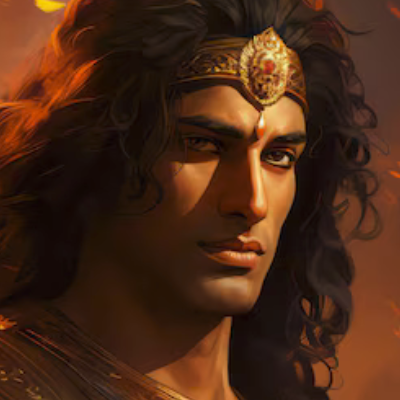
About
Asamanjas — Son of Sagara and Keshini, the Expelled Prince, Father of Anshuman, the Hidden Yogi
Asamanjas · Asamañjasa · Asamanja · Sagara-putra · Keshini-suta · Ambujakshi-pati · Anshuman-pita · Dilipa-pitamaha · Bhagiratha-prapitamaha · Rama-purvajanma · Ikshvaku-vamsha-nripa
Asamanjas — also written Asamanjasa — is the son of King Sagara of Ayodhya and his elder wife Keshini (daughter of the King of Vidarbha); the husband of Ambujakshi; the father of the virtuous prince Anshuman who recovered the Ashvamedha horse from Patala; and the ancestor of Dilipa, Bhagiratha, Raghu, Aja, Dasharatha, and Rama. He is described in the Valmiki Ramayana (Bala Kanda, Chapter 38) as a prince of notoriously evil conduct — Asamanjasa used to seize hold of children and throw them into the river Sarayu. When he saw them drowning, he rejoiced. This evil doer grew up to oppress the good. For this conduct the citizens of King Sagara's capital exiled the prince. However the Bhagavata Purana presents a radically different understanding of the same events — in which Asamanjas was secretly a great yogi who revived all the drowned children after he was exiled, and whose behaviour was the deliberate expression of an evil spirit he was purging from himself through an extreme act of controlled transgression. Both traditions are recorded below. He is one of the tradition's most paradoxical figures — the prince who was both the dynasty's worst member and its essential link, the cruel expelled son through whose own virtuous son the Sagara dynasty ultimately produced Rama.
✦ The Name
The Sanskrit name Asamanjas — written Asamañjasa — means confusion, dilemma, incongruity, that which is not proper or fitting. From the negative prefix a and samañjasa (proper, fitting, appropriate, coherent). The name itself records the tradition's assessment of his nature — the one who is inappropriate, the incongruous one, the figure who does not fit the role assigned to him. The InBrindavan source specifically notes this etymology: the word Asamanjas refers to the mental state of the central character — confusion, delusion, or dilemma. The name was given to him at birth — either as a prophecy of his problematic nature or as a description of the confusion his very existence would create in the dynasty's narrative.
✦ Lineage
- Father: Sagara — king of Ayodhya; son of Bahu and Yadavi; raised by Aurva; who reconquered Ayodhya; who performed the Ashvamedha; profiled separately in this series
- Mother: Keshini — daughter of the King of Vidarbha; elder and chief queen of Sagara; who chose one dynasty-perpetuating son at the boon-giving; profiled separately in this series
- Half-brothers: the sixty thousand sons of Sagara born of Sumati through the gourd; who were burned to ash by Kapila in Patala; profiled separately below
- Wife: Ambujakshi — confirmed in the Wikipedia Asamanja article; her parentage is not recorded in any primary canonical source
- Son: Anshuman — described as brave, virtuous, and amiable; a favourite of all the people; who succeeded Sagara as king; who recovered the Ashvamedha horse; who received Kapila's prophecy about the Ganga; profiled separately below
- Descendants through Anshuman: Anshuman → Dilipa → Bhagiratha → Kakutstha → Raghu → Aja → Dasharatha → Rama
✦ The Two Traditions — Madman or Hidden Yogi
The Valmiki Ramayana records Asamanjas's behaviour without ambiguity or sympathy: the elder son of King Sagara, namely Asamanja, always used to grab and hurl children into the waters of River Sarayu, and on seeing the drowning children he used to enjoy with laughter. His father Sagara, disgusted and grief-stricken, accepted the citizens' demand and expelled him from the kingdom. The Ramayana records no hidden virtue and no revival of the children. Asamanjas simply left and the narrative moved to his son Anshuman.The Bhagavata Purana and the InBrindavan retelling preserve a completely different tradition. In this version: it was the evil spirit within him that was forcing him to indulge in sinful acts. And Asamanjas knew that the only way he could exorcise it out of his life forever was by giving it free rein. So he allows the evil spirit to appease its hunger and anger after which he uses his yogic powers to bring the dead children back to life. Quora Before he departed into exile, Asamanjas revived all the drowned children. The devas, wondering at this strange behaviour, went to the sage Kapila to ask what would happen to Sagara's other sixty thousand sons who had been corrupted by Asamanjas's influence. Kapila told them the sixty thousand would be destroyed. After his exile, several years later they get the news that Asamanjas attained Moksha after performing penance in the forest. QuoraThe two traditions are incompatible but both are canonical — the Valmiki Ramayana's account is the simpler and older, the Bhagavata Purana's is the more theologically elaborate. Both agree on the central facts: Asamanjas was expelled, his son Anshuman was admirable, and the sixty thousand half-brothers were eventually destroyed.
✦ Participation in the Haihaya War (Glorious Hinduism source)
The Glorious Hinduism source records an episode not found in the Valmiki Ramayana — that Asamanjas participated in the great war between Sagara's forces (allied with Parashurama) against the Haihayas and their allies: on one side were the seventeen Akshauhinis of the Haihayas, the hundred sons of Kartavirya Arjuna, and all their unrighteous Kshatriya allies. On the other side was Parashurama, the armies of Vishvamitra, Vishvamitra's hundred sons, Sagara and his 60,000 sons, Asamanjas, and some righteous others. This places Asamanjas in a positive military role — fighting on the side of dharma alongside Parashurama — before the river-throwing episode that caused his expulsion. Whether this tradition belongs to a Puranic source that predates or supplements the Ramayana's account is not specified.
✦ References
- Valmiki Ramayana (Bala Kanda, Chapter 38) — the primary canonical source: Asamanjas seizing children and throwing them into the Sarayu; his enjoyment at their drowning; the citizens' demand for his expulsion; Sagara's exile of him; the contrast with the virtuous Anshuman
- Bhagavata Purana — the alternative tradition: Asamanjas as a hidden yogi purging an evil spirit; his revival of the drowned children; his attainment of moksha through forest penance after exile
- Vishnu Purana (Book 4, Chapter 4) — the genealogical confirmation of the Sagara → Asamanjas → Anshuman chain
- Wikipedia — Asamanja; InBrindavan.com — The Story of Asamanjas; Glorious Hinduism — Sagara: modern summaries drawing from the above primary sources