
About
The Sixty Thousand Sons of Sagara — The Princes Who Dug the Earth, Burned in Patala, and Named the Ocean
Sagaraputras · Sagara-putra · Shashti-sahasra · Shat-sahasra · Sumati-suta · Sagara-tanaya · Kapila-bhakshita · Patala-gamaka · Bhagiratha-tarpita · Sagara-namahetu
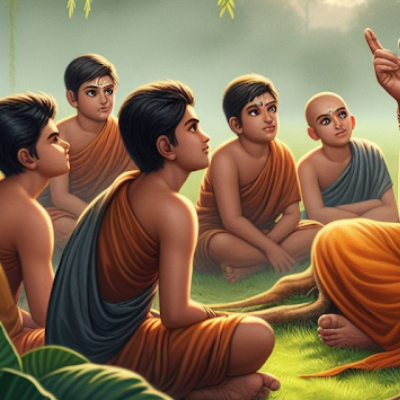
The sixty thousand sons of Sagara — known collectively as the Sagaraputras or Shat-sahasra (the sixty thousand) — are the sons of King Sagara of Ayodhya and his second wife Sumati (daughter of Arishtanemi and sister of Garuda); born from a round and long egg which is like a single gourd, and on breaking it up sixty thousand sons issued forth from that cucumber. The childminders brought those siblings up in vessels filled with ghee and after a protracted time all of them attained youthfulness. They are the tradition's supreme example of collective destruction — sixty thousand princes simultaneously burned to ash by a single sage's wrathful gaze — and equally the supreme example of collective liberation, when the waters of the descending Ganga, brought to earth by their great-great-nephew Bhagiratha generations later, touched their ashes and liberated every one of them. They did not have individual names recorded in any primary canonical source — they are the tradition's greatest named-but-unnamed collective, a mass of sixty thousand individuals who are everywhere referred to as a single entity. They gave the ocean its name — the tradition records that their frantic digging of the earth to reach Patala created the great depression that the ocean fills, making them collectively the shapers of the world's most significant geographical feature.
✦ Their Birth — From a Gourd
Sumati gave birth to a fissiparous mass which divided out into sixty thousand babies. This army of children was taken care of by nurses. Years rolled by and the sixty thousand grew into strong, handsome princes. The Mahabharata's version (Vana Parva) describes the birth differently: from her womb a Tumbi (a small pot of hollowed gourd) full of seeds was obtained. King Sagara took out the seeds and put each one individually in a pot full of ghee. These grew into embryos and sixty thousand sons were born. The Glorious Hinduism source records yet another variant: Sumati gave birth to a lump of flesh; Aurva stopped Sagara from throwing it away; Aurva instructed him to cut it into sixty thousand pieces and place each in a jar of ghee; sixty thousand sons were born. All versions agree: the sixty thousand came from a single mass, grew in ghee, and became strong and handsome princes.
✦ Their Conduct — Corrupted by Asamanjas
The Glorious Hinduism source records an important detail about their moral deterioration: Sagara's sixty thousand other sons always followed their older brother Asamanjas. They started becoming of bad conduct like Asamanjas. The devas were worried about this and went to Kapila Muni. They said, "O great one, what will become of this world if the sixty thousand sons of Sagara follow the evil ways of Asamanjas. Please do something about this." "In short time, the sixty thousand sons of Sagara will all perish," Kapila replied. The Vishnu Purana records the same divine consultation: the devas approached Kapila saying, "O lord, what will become of the world, if these sons of Sagara are permitted to go on in the evil ways which they have learned from Asamanjas! Do thou, then, assume a visible form, for the protection of the afflicted universe." "Be satisfied," replied the sage, "in a brief time the sons of Sagara shall be all destroyed."
✦ The Search in Patala — The Digging and the Burning
When Indra stole Sagara's Ashvamedha horse and hid it in Patala near the hermitage of the sage Kapila, Sagara sent his sixty thousand sons to search for it. They dug downwards each for a league, coming to Patala and beholding the horse wandering freely about, and at no great distance from him they saw the Rishi Kapila sitting, with his head declined in meditation. They found the horse wandering near sage Kapila's ashram, who was engrossed in meditation. Seeing the horse near the ashram of the sage, they mistook the sage to be responsible for the theft of the horse. They began attacking him with a view to kill him. Disturbed by the commotion, sage Kapila opened his eyes; within a few moments all the sixty thousand of Sagara's sons were reduced to ashes. The Valmiki Ramayana (Bala Kanda, Chapter 41) is more precise about the mechanism of the burning: when the noise became disturbing, the maharishi fired all these sixty thousand people through his third eye. Mahabharata Online Other sources state simply that his wrathful gaze burned them — the power accumulated through his meditation, discharged in a single moment of disturbance. The result in every version is the same: sixty thousand princes reduced to sixty thousand piles of ash in Patala, without funeral rites performed, without water oblation offered, without the rites that would allow their souls to move toward liberation.
✦ The Three-Generation Quest for Liberation — Anshuman, Dilipa, Bhagiratha
When Anshuman found the ash heaps in Patala and wanted to offer water oblation, he found no water. Garuda told him: River Ganga is the elder daughter of Himavanta. You have to offer water-oblation to the departed paternal-uncles in her waters. World-purifier River Ganga will drift them to heaven. Kapila confirmed: thy grandson shall bring down the river of heaven on the earth; and when her waters shall wash the bones and ashes of thy grandfather's sons, they shall be raised to Svarga. Anshuman tried and failed. Dilipa tried and failed. Bhagiratha performed the most extreme tapas of the entire Solar Dynasty tradition — standing on one toe with arms raised, subsisting on minimal sustenance for thousands of years — until both Brahma (who agreed to send the Ganga) and Shiva (who agreed to receive her force in his matted locks before releasing her gently) were satisfied. The Ganga descended. She flowed to Patala. She touched the ashes of the sixty thousand. Every one was liberated — raised to Svarga in the waters of the river whose descent had required three generations of royal penance to accomplish.
✦ The Ocean Named for Their Digging
The ocean's Sanskrit name Sagara records their story permanently in the world's geographical vocabulary. Their digging — each prince excavating a league of earth in search of the stolen horse — created the vast underground space that the ocean now occupies. The Wikipedia Sagara article confirms: the ocean is also called Sagara after him because his sixty thousand sons dug through its floor. The tradition's most consequential act of collective physical labour — sixty thousand princes digging the earth in search of a horse — produced the world's most significant geographical feature. The sixty thousand who were burned to ash in their search left the world permanently changed by their digging.
✦ References
- Valmiki Ramayana (Bala Kanda, Chapters 38–44) — the primary canonical source: the gourd birth; the ghee pots; the sixty thousand growing to manhood; the Ashvamedha; Indra stealing the horse; the search; the digging; Kapila's hermitage; the burning; Anshuman finding the ash heaps; Garuda's guidance; Kapila's prophecy; Bhagiratha's eventual success and the liberation of the sixty thousand in the Ganga's waters
- Vishnu Purana (Book 4, Chapter 4) — the devas consulting Kapila about the sixty thousand's wickedness; Kapila's prophecy of their destruction; the burning; Anshuman's journey; the Ganga requirement
- Bhagavata Purana (Canto 9, Chapters 8–9) — the parallel Puranic account of the sixty thousand's birth, conduct, destruction, and eventual liberation
- Mahabharata (Vana Parva — the Sagara narrative) — the seeds-in-ghee version of the birth; the Ashvamedha; the burning; the three-generation quest
- Wikipedia — Sagara (Hinduism); Glorious Hinduism — Sagara; Sagar World Blog — King Sagara and His 60,000 Sons; VedaBoys — How did King Sagara have 60,000 sons; Vishnu Purana Sacred Texts — Book 4 Chapter 4: modern summaries drawing from the above primary sources