
About
Dosha — Wife of Pushparna, Personification of Night
Dosha · Doshaa
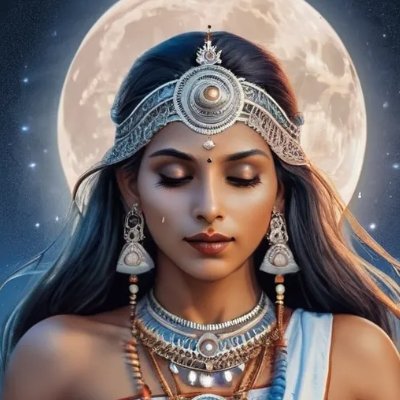
Dosha is one of the two wives of Pushparna, a king of the early cosmic lineage descending from Dhruva, the Pole Star, through Vatsara. She is recorded in the Bhagavata Purana (Canto 4, Chapter 13) and the Vishnu Purana (Book I, Chapter 13) as the mother of three sons — Pradosha, Nishitha, and Vyushta — who personify respectively the dusk, the midnight, and the pre-dawn hours of the nocturnal cycle. Her co-wife Prabha, whose name means radiance or daylight, is the mother of three sons representing the three daytime divisions: Pratah (morning), Madhyandina (midday), and Sayam (evening). Together the two wives and their six sons constitute a closed cosmological allegory exhausting the complete cycle of day and night within a single genealogical household. Dosha's name in Sanskrit carries the primary meanings of night, darkness, and fault or blemish, and she embodies the dark half of the daily cycle in direct contrast to Prabha. Unlike the daytime branch of the household, Dosha's line carries the genealogy forward: through her youngest son Vyushta and his son Sarvatejas, she is the great-grandmother of Chakshusha Manu, the lord of the sixth Manvantara, the sixth great cosmic epoch of the present universe.
✦ The Name
The name Dosha derives from the Sanskrit root dus, carrying meanings of night, darkness, the evening hours, and also fault or deficiency. In classical Sanskrit usage dosha denotes both the night itself and the evening period specifically, making the name cosmologically precise for a figure whose sons name the three divisions of the nocturnal cycle. The name stands in deliberate structural opposition to that of her co-wife Prabha, meaning radiance and light, the two names together mapping the complete arc of the daily cycle onto the two branches of Pushparna's household. Within the Puranic genealogical tradition the name is not merely descriptive but functional: Dosha as a figure is the night, and her sons are its named and measurable divisions.
✦ Lineage
- Husband: Pushparna — son of Vatsara and grandson of Dhruva, the Pole Star; the figure through whom the Dhruva lineage passes into the household that personifies the divisions of time; husband also of Prabha, who personifies daylight
- Co-wife: Prabha — the first wife of Pushparna, personifying the bright daylight hours; her name means radiance or light in Sanskrit; mother of three sons representing the three daytime divisions: Pratah (morning), Madhyandina (midday), and Sayam (evening)
- Son: Pradosha — personifying dusk and the initial portion of the night, the first of the three nocturnal divisions
- Son: Nishitha (also Nisitha) — personifying dead midnight, the second of the three nocturnal divisions
- Son: Vyushta — personifying the final hours of the night immediately preceding daybreak, the third of the three nocturnal divisions; the figure through whom Dosha's line carries the genealogy forward; husband of Pushkarini and father of Sarvatejas
- Daughter-in-law: Pushkarini — wife of Vyushta and mother of Sarvatejas
- Grandson: Sarvatejas — son of Vyushta and Pushkarini; father of Chakshusha Manu
- Great-grandson: Chakshusha Manu — son of Sarvatejas; the lord and progenitor of the sixth Manvantara, the sixth great cosmic epoch of the present universal cycle
✦ Cosmological Significance of the Household
The household of Pushparna with its two wives and six sons constitutes one of the most systematically allegorical genealogical units in the Puranic tradition. The Bhagavata Purana and the Vishnu Purana deploy this household to accomplish a transition within the cosmic genealogy from abstract celestial figures — Dhruva the Pole Star and his descendants — toward the structured measurement of time as it is experienced in the manifest world. Dosha's three sons name the three nocturnal periods that complement the three sandhyas of daylight named by Prabha's sons. Pradosha names the dusk and early night; Nishitha names the dead of midnight; and Vyushta names the closing darkness before dawn returns. Together with Prabha's sons Pratah, Madhyandina, and Sayam, the six sons account for the full twenty-four-hour cycle without remainder.
Within this paired structure, Dosha's branch carries a distinction that Prabha's does not: the genealogical line continues forward through it. Prabha's three sons are a terminal allegorical branch, naming the daytime periods without generating further descent in the primary sources. Dosha's youngest son Vyushta, by contrast, fathers Sarvatejas through his wife Pushkarini, and Sarvatejas in turn fathers Chakshusha Manu, the presiding lord of the sixth Manvantara. The line from Dosha through Vyushta thus bridges the cosmological allegory of time-personification and the historical cosmic order of the Manvantaras, making Dosha the ancestral figure through whom the Dhruva lineage connects to the sixth cosmic epoch.
✦ Connection to the Wider Genealogy
Dosha's place in the wider genealogical structure runs as follows. Her husband Pushparna is the son of Vatsara, who is himself a son of Dhruva. Dhruva was a prince of the early lineage who, through prolonged austerity in childhood, attained from Vishnu the position of the immovable Pole Star, around which all celestial bodies revolve. The Bhagavata Purana traces Dhruva's descendants through several generations before arriving at Pushparna and the household that personifies time. Through Dosha's son Vyushta, his son Sarvatejas, and Sarvatejas's son Chakshusha Manu, the descent from Dhruva extends forward to the lord of the sixth Manvantara, one of the fourteen successive cosmic epochs that together constitute the present universal cycle. Dosha herself stands within this structure as the personification of the night at the precise genealogical moment where the Dhruva lineage articulates the nature of measured time, and as the ancestral link through which that lineage passes onward into the order of the Manvantaras.
✦ References
- Bhagavata Purana, Canto 4, Chapter 13, verse 14: Primary source for Dosha as wife of Pushparna and mother of Pradosha, Nishitha, and Vyushta; records the descent from Vyushta through Sarvatejas to Chakshusha Manu; situates the complete household of Pushparna within the Dhruva genealogy as the moment at which the lineage personifies the divisions of the nocturnal cycle.
- Vishnu Purana, Book I, Chapter 13: Parallel genealogical register recording the household of Pushparna and both wives Prabha and Dosha with their respective sons; confirms the structure attested in the Bhagavata Purana and situates it within the early cosmic lineages compiled by the sage Parashara.
- Vettam Mani, Puranic Encyclopaedia. Motilal Banarsidass, 1975: Consulted for cross-referencing of the Dhruva lineage and the descent through Vyushta and Sarvatejas to Chakshusha Manu across the major Puranas.