
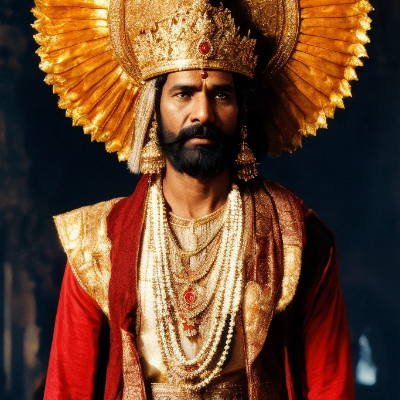
About
Vyushta — Personification of the Last Watch of Night, Son of Pushparna and Dosha
Vyushta · Vyushtha · Vyusha · Vyushti
Vyushta is recorded in the Bhagavata Purana's fourth Skandha as the third and youngest of three sons born to Pushparna and his wife Dosha within the allegorical genealogy of Dhruva's lineage. His name derives from the Sanskrit root vyush or vyusha, meaning the breaking of dawn or the brightening before sunrise — the last watch of the night when darkness begins to give way. He personifies this final division of the nocturnal cycle in the Bhagavata's cosmological genealogy, completing the scheme of three night-watches alongside his brothers Pradosha (dusk) and Nishitha (midnight). Among the three brothers, Vyushta is the only one who plays any further role in the genealogical sequence: through his son Sarvatejas and that figure's son Chakshusa Manu, the lineage continues forward to the sixth Manu of the present cosmic cycle. Vyushta is thus simultaneously a personification of the pre-dawn hour and the genealogical link through which the Dhruva line descends to Chakshusa Manu and ultimately to King Anga and the birth of Prithu.
✦ The Name
The Sanskrit name Vyushta — also rendered Vyushtha and occasionally as Vyusha — is derived from the verbal root vyush meaning to become bright or to dawn, related to the root ush which underlies both Usha (the goddess of dawn) and the Latin word aurora. In the context of the Bhagavata Purana's allegorical genealogy, Vyushta designates the period before sunrise — the brightening of the sky before dawn properly arrives, the last portion of the night. The Vishnu Purana's Wilson footnote translates the three sons of Dosha as the beginning, middle, and end of night, placing Vyushta as the end of night — the moment when night yields to the coming day. The name Vyushti, a related form, means the dawning or the shining forth, and appears in Vedic literature in connection with the cosmic cycle.
✦ Lineage
- Father: Pushparna — eldest of six sons of Vatsara and Svarvithi; married two wives, Prabha and Dosha; father of six sons in total, three by each wife.
- Mother: Dosha — second wife of Pushparna; her name means night or darkness; mother of the three sons who personify the three divisions of night.
- Paternal grandfather: Vatsara — second son of Dhruva by his wife Bhrami, daughter of Shishumara; became king when his elder brother Utkala renounced royal life for austerity; husband of Svarvithi, who bore him six sons.
- Paternal great-grandfather: Dhruva — son of Uttanapada and Suniti; grandson of Svayambhuva Manu; the royal ascetic elevated by Vishnu to the imperishable station of the Pole Star.
- Elder brothers: Pradosha — personification of dusk; and Nishitha — personification of midnight; both sons of Pushparna and Dosha.
- Half-brothers (by Prabha): Pratah (dawn), Madhyadina (noon), and Saya (evening) — the three sons of Pushparna by his other wife Prabha, personifying the three divisions of the day.
- Wife: Pushkarini — named in the Bhagavata Purana as the wife of Vyushta; her lineage is not specified in the available sources.
- Son: Sarvatejas — son of Vyushta and Pushkarini; through him the genealogical line descends to Chakshusa Manu.
✦ Vyushta's Role in the Genealogical Continuity
Among the three sons of Pushparna and Dosha, Vyushta alone is given a wife and a son in the Bhagavata Purana's account. His son Sarvatejas married a woman named Akuti and fathered from her Chakshusa, who became the sixth Manu of the present cosmic cycle — Chakshusa Manu. From Chakshusa Manu descended twelve sons, of whom the youngest, Ulmuka, had six sons. The eldest of these was Anga, who married Sunitha, the daughter of Mrityu, and fathered upon her the wicked king Vena. From Vena's arm, churned by the sages, was born the great sovereign Prithu — regarded in the Bhagavata Purana and Vishnu Purana as a partial manifestation of Vishnu and the first consecrated ruler of the earth, who gave the planet its name Prithivi. Vyushta is therefore, in the Bhagavata's genealogical scheme, the ancestral link that connects the allegorical world of time-personifications to the concrete royal lineage culminating in Prithu and the origin of ordered kingship.
✦ Textual Variants
The name of Vyushta's son varies between sources: the Bhagavata Purana names him Sarvatejas, while the Vishnu Purana's parallel genealogy — which follows an entirely different line through Slishti, Ripu, and Chakshusa without any intermediate personifications of time — names the Manu's father as Chakshusa without any Sarvatejas. These belong to distinct genealogical traditions for the same figures, as noted by Wilson. The Wisdomlib Puranic Encyclopaedia entry on Nishitha names the younger brother as Vyusha rather than Vyushta, a minor transliteration difference. The Wikipedia article on Vena renders the name as Vyushtha with an aspirated final consonant. All these represent the same Sanskrit figure.
✦ References
Primary Sources
- Bhagavata Purana, Skandha 4, Chapter 13: The sole primary source for Vyushta's parentage, wife Pushkarini, and son Sarvatejas, within the allegorical Dhruva genealogy.
- Vishnu Purana, Book I, Chapter XIII, footnote 1 (Wilson translation): Records the Bhagavata's account and identifies Vyushta as the end of night among the three sons of Dosha; notes that through Vyushta's son the line reaches Chakshusa Manu.
Secondary Sources
- Wikipedia, article on Vena (Hindu king): Provides the most complete summary of the Bhagavata genealogy, confirming Dosha as mother of Vyushtha and tracing the line through Sarvatejas to Chakshusa Manu and King Anga.
- Wisdomlib.org, entry on Nishitha: Notes Vyusha (Vyushta) as brother of Nishitha and Pradosha.
- Wisdomlib.org, entry on Pradosha: Confirms Vyushta as the third son of Pushparna within the Bhagavata Skandha 4 genealogy.
- Wisdomlib.org, entry on Vatsara: Confirms the genealogical chain from Dhruva through Vatsara to Pushparna.