
About
Prasenajit I — King of Ayodhya, Father of Renuka, Maternal Grandfather of Parashurama
Prasenajit · Prasena-jit · Ranashva · Seinya Jeet · Suryavanshi-nripa · Renuka-pita · Jamadagni-shvaashura · Parashurama-nana
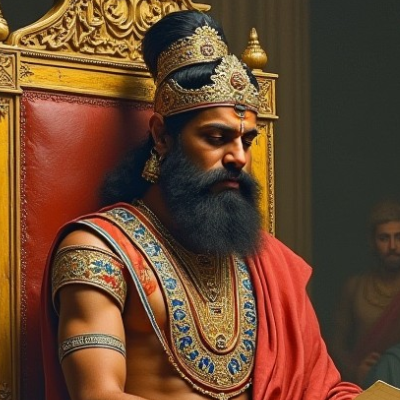
Prasenajit I is a king of the Solar Dynasty, the Surya Vansha, who ruled from the capital of Ayodhya as part of the Ikshvaku lineage. The distinguishing numeral and the qualifier Vedic Solar king separate him from the historical sixth-century BCE King Prasenajit of Kosala, a figure from an entirely different period who was a contemporary of Gautama Buddha and who bears no genealogical connection to this Puranic king of the same name. He is the son of King Haryashva I — a monarch whose quiet and stable reign is characterised in the Vayu Purana and Brahma Purana as a period of favourable natural conditions and prosperity in the Kosala kingdom — and the father of King Yuvanashva II, through whom the Solar line reaches its most celebrated miraculous episode: the accidental drinking of a consecrated ritual liquid by Yuvanashva II that resulted in the king himself gestating and giving birth to the world-conquering emperor Mandhata. Beyond his place in the patrilineal succession, Prasenajit I occupies a position of exceptional cross-dynastic theological significance as the father of Renuka — the princess of the Solar line whom he gave in marriage to the brahmin sage Jamadagni of the Bhrigu lineage, and who became the mother of Parashurama, the sixth avatar of Vishnu. This convergence of the Solar Dynasty's Kshatriya lineage with the Bhrigu tradition's brahminical austerity in the person of Parashurama — who derived his warrior capacity from his mother's royal Solar inheritance and his sacred knowledge from his father's brahmin lineage — gives Prasenajit I a genealogical significance that extends far beyond the dynastic king-lists of Ayodhya. His position in the succession is confirmed in the Vishnu Purana, the Bhagavata Purana, the Brahmanda Purana, the Harivamsa, the Brahma Purana, the Agni Purana, and the Mahabharata.
✦ The Name
The name Prasenajit is a Sanskrit compound of prasena, meaning an army or a large military force, and jit, meaning conqueror or victor. The compound therefore carries the meaning conqueror of armies or one who defeats great forces — a standard royal martial designation proclaiming military prowess. It is one of the tradition's more widely distributed royal names, borne by at least four distinct figures across the Hindu and Buddhist textual traditions: the Solar dynasty king who is the subject of this profile; a king of Shravasti recorded in the Bhagavata Purana as the son of Vishvasahvan and the father of Takshaka; a figure referenced as a distant relation of Satrajit in the Dakshinatya Patha of the Mahabharata's Sabha Parva; and the celebrated king of Shravasti who was a contemporary of Gautama Buddha and a prominent figure across Buddhist narrative literature from India through Southeast Asia and East Asia. None of these four figures is to be confused with the others. The Agni Purana gives the alternative name Ranashva for the Solar dynasty Prasenajit, a compound of rana, meaning battle, and ashva, meaning horse — denoting a warrior on horseback or one of the battle horse, a similarly generic royal martial epithet. The Ikshvaku dynasty tradition also records the variant Seinya Jeet for this figure alongside the Agni Purana's Ranashva. The honorific designations Renuka-pita, meaning father of Renuka, and Jamadagni-shvaashura, meaning father-in-law of Jamadagni, and Parashurama-nana, meaning maternal grandfather of Parashurama, function as relational epithets that identify him primarily through his familial connections to the Bhrigu-Bhargava lineage.
✦ Lineage
- Founding patriarch: Ikshvaku — eldest son of Vaivasvata Manu, the seventh Manu and progenitor of the current human race, founder of the royal house of Ayodhya, and patriarch of the Solar Dynasty from whom all Ikshvaku kings descend.
- Great-grandfather: Kuvalayashva, known by the earned epithet Dhundhumara, meaning slayer of Dhundhu — the king of Ayodhya who led his twenty-one thousand sons at the request of the sage Utanka to destroy the fire-breathing demon Dhundhu, buried beneath a sand sea; all but three of his sons were incinerated by the demon's fiery breath during the battle, after which Kuvalayashva, grief-stricken and spiritually detached, retired from rule.
- Grandfather: Dridhashva — eldest of the three sons of Kuvalayashva who survived the Dhundhu battle, who inherited the throne of Ayodhya and devoted his reign to rebuilding the kingdom's military strength and administrative order following the catastrophic losses of his father's campaign.
- Father: Haryashva I — king of Ayodhya, son of Dridhashva, whose reign is characterised in the Vayu Purana and Brahma Purana as a period of optimal rainfall, abundant harvests, and an absence of untimely deaths among his subjects; distinguished from two other Ikshvaku kings of the same name who appear at later points in the Solar Dynasty succession.
- Wife: Queen Gauri — celebrated in the tradition for her absolute devotion. The Harivamsa records a tragic episode in which she was transformed into the sacred river known as Bahuda following a curse arising from a ritual misunderstanding with her husband.
- Son and successor: Yuvanashva II — king of Ayodhya, son of Prasenajit I, whose reign is most celebrated for the extraordinary circumstances of Mandhata's birth: Yuvanashva II, having no sons, commissioned a great ritual sacrifice performed by attending sages to secure an heir; during the night he drank the consecrated ritual liquid that had been prepared for his wives, with the result that he himself became pregnant and eventually gave birth to Mandhata through his own side.
- Daughter: Renuka, also known by the name Konkana — princess of the Solar Dynasty, given by Prasenajit I in marriage to the brahmin sage Jamadagni of the Bhrigu lineage; mother of Parashurama, the sixth avatar of Vishnu; venerated across South and western India as a goddess under the names Yellamma, Ekvira, and Manchalamma among others.
- Son-in-law: Jamadagni — one of the seven primordial sages, the Saptarishis, of the Bhrigu lineage; renowned for his extraordinary austerities and his possession of the divine wish-fulfilling cow Kamadhenu; father of Parashurama.
- Grandson through daughter: Parashurama — the sixth avatar of Vishnu, son of Renuka and Jamadagni, born of the convergence of the Solar Dynasty's Kshatriya martial inheritance through his mother and the Bhrigu lineage's brahminical learning and austerity through his father; renowned in the tradition as the warrior-sage who waged a systematic campaign against the corrupted Kshatriya class, clearing the earth of its degenerate rulers twenty-one times.
- Grandson through son: Mandhata — son of Yuvanashva II, one of the most celebrated world-conquering emperors in the entire Puranic Solar Dynasty tradition, whose miraculous birth from his father's abdomen and subsequent campaigns of universal dominion are among the most extensively narrated episodes in the Puranic accounts of the Ikshvaku house.
✦ Jamadagni's Visit and the Marriage of Renuka
The Brahmanda Purana, the Bhagavata Purana, and the Mahabharata all record or corroborate the episode of Jamadagni's arrival at Prasenajit's court and his marriage to Renuka. The Puranic Encyclopaedia of Vettam Mani and the Dharmawiki account drawing on primary Puranic sources give the fullest narrative detail: Jamadagni, having completed his Vedic studies, undertook a pilgrimage to sacred sites and in the course of his travels arrived at the palace of King Prasenajit. The king, perceiving the sage's luminous and serene bearing, received him with honour and urged him to accept royal hospitality. During his stay at the palace, Jamadagni came to know Princess Renuka, and having developed a deep regard for her, approached the king to request her hand in marriage. Prasenajit consented immediately and without reservation, giving his daughter to the brahmin sage in an act of unconditional kanya-dana — the gift of a daughter — that the tradition treats as a mark of the king's high recognition of Jamadagni's extraordinary spiritual worth. For a Kshatriya king to give his daughter without negotiation or objection to a brahmin sage was a significant act of dharmic generosity within the social framework of the tradition, acknowledging the sage's quality as the highest possible recipient of such a gift. After the marriage, Jamadagni took Renuka to the banks of the Narmada river where they established a hermitage and began their shared life of austerity and sacred practice.
✦ The Second Episode — Jamadagni's Abandonment and Prasenajit's Intervention
The Brahmanda Purana at Chapter 58 records a second episode involving Prasenajit that is not present in the mainstream retellings of the Jamadagni-Renuka narrative and that reveals a more complex dimension of his biography than the simple initial marriage arrangement. On some occasion — the specific cause is not elaborated in the available passages — Jamadagni abandoned Renuka and sent her away from the hermitage. Renuka returned to her father's palace. Prasenajit, finding himself in possession of a great brahmin sage's abandoned wife and recognising the considerable danger that this situation posed — the risk of a brahminical or divine curse directed at his house for the breakdown of a marriage he had arranged, involving a Saptarishi of Jamadagni's stature — did not maintain the separation. Instead he gave his daughter back to Jamadagni a second time. The Brahmanda Purana's language, as summarised in the secondary tradition, specifies that Prasenajit acted while fearing a curse, giving his motivation a precise content: his second act of giving Renuka was shaped at least in part by the recognition that a rupture in this particular marriage carried consequences too grave to sustain. This episode places Prasenajit in an active role in the Jamadagni-Renuka narrative on two separate occasions — first as the willing and immediate giver of the original kanya-dana, and second as the protective and pragmatic father who restored the marriage rather than shelter his daughter from the sage's household.
✦ The Curse of Gauri and the River Bahuda
The Harivamsa records a tragic episode associated with Prasenajit's wife, Queen Gauri. The episode involves a curse pronounced by Prasenajit himself arising from a ritual misunderstanding between the king and his queen. The nature of the ritual transgression and the specific circumstances of the misunderstanding are presented in the Harivamsa's account as the cause of Gauri's transformation into the sacred river known as Bahuda. The river Bahuda, whose name is connected to the Sanskrit meaning of one who gives abundantly or the generous one, is thereby associated in the tradition with the former queen of Ayodhya. The episode adds a dimension of personal tragedy to Prasenajit's biography that stands apart from his genealogical function in the king-list, presenting him as a king whose household was marked by the irreversible consequences of a ritual error involving his wife.
✦ Reign Character and Spiritual Merit
The Puranic sources characterise Prasenajit I as a deeply religious, just, and benevolent king who placed particular emphasis on the protection of brahmin hermitages and the sages who dwelt in them within his kingdom's territory. The Mahabharata's Anushasana Parva cites him among the exemplary Solar Dynasty kings who earned great spiritual merit through the donation of lands and villages to scholarly brahmins, recording that this practice of dana — charitable gifting — secured him a permanent station in the higher celestial realms. The Harivamsa and Brahma Purana add detail on his domestic life and his political relationships with neighbouring kingdoms, presenting him as a monarch whose reign was characterised by stability and a genuine cultivation of dharmic governance rather than military expansion. The Ikshvaku dynasty tradition places his reign in a period synchronised with the Chandravamsha king Thamsu, which in the tradition's chronological reckoning corresponds to the transition between the Dvapara and Treta Yugas — a placement consistent with Parashurama's own traditional dating as a figure of the Treta Yuga who coexisted briefly with Rama.
✦ Theological and Genealogical Significance
Prasenajit I's deepest significance in the tradition is concentrated in the genealogical consequence of his giving Renuka to Jamadagni. His act of kanya-dana was the specific event that introduced the Solar Dynasty's Kshatriya energy into the Bhrigu lineage's brahminical tradition. The offspring of that convergence — Parashurama — derived from his mother Renuka, and through her from Prasenajit and the Solar line, the martial inheritance and royal physical power that made him capable of confronting and defeating the greatest Kshatriya warriors of his era. From his father Jamadagni and the Bhrigu tradition he derived the sacred knowledge, the divine weapons, and the brahminical authority that made his campaign against the corrupted Kshatriya class cosmically sanctioned. This dual identity — warrior and brahmin, royal and ascetic, destructive and purifying — which is the theological foundation of Parashurama's unique position as the avatar who cleared the earth of degenerate rulers, is grounded in the specific genealogical act of Prasenajit I giving his daughter across the varna boundary between Kshatriya royalty and brahmin austerity. Prasenajit I as the Solar dynasty king whose daughter carried the royal martial inheritance into the Bhrigu tradition is therefore not merely a genealogical link in the Ayodhya king-list but a figure of genuine theological consequence in the broader Puranic narrative of cosmic order, its corruption, and its restoration.
✦ Disambiguation from Other Prasenajits
Four distinct figures named Prasenajit appear in the Sanskrit and Buddhist textual traditions, and their disambiguation is essential in any genealogical reference context. The first is the Solar Dynasty king who is the subject of this profile — the Ikshvaku king of Ayodhya, father of Renuka, father-in-law of Jamadagni, and maternal grandfather of Parashurama. The second is a king of Shravasti recorded in the Bhagavata Purana at Canto 9 as the son of Vishvasahvan and the father of Takshaka — a later Solar Dynasty king of Ayodhya in the line of Rama's successors, entirely separate from Prasenajit I of this profile. The third is a figure referenced in the Dakshinatya Patha of the Mahabharata's Sabha Parva as a distant relation of Satrajit. The fourth, and most widely known across the pan-Asian literary tradition, is the historical king of Shravasti who was a contemporary of Gautama Buddha and a prominent figure in Buddhist narrative literature from India through Southeast Asia and East Asia — a figure from the sixth century BCE whose identity, period, and narrative context have nothing in common with the Puranic Solar Dynasty king of this profile beyond the shared name.
✦ References
Primary Sources
- Brahmanda Purana, Chapter 58: The primary narrative source for both of Prasenajit's biographical episodes — the original giving of Renuka in marriage to Jamadagni and the second episode in which Jamadagni abandoned Renuka and Prasenajit, fearing a curse, gave her back to the sage; the most important canonical source for Prasenajit I's active biographical presence beyond the genealogical king-list.
- Vishnu Purana, Book 4, Chapter 2: Records the direct patrilineal succession of Haryashva, Prasenajit, and Yuvanashva within the Ikshvaku Solar Dynasty king-list, confirming Prasenajit I's position between his father and his son.
- Bhagavata Purana, Canto 9, Chapter 6, verse 24; Canto 9, Chapter 15: Corroborates the genealogical placement of Prasenajit I between Haryashva I and Yuvanashva II, and contextualises his role as Renuka's father within the broader account of the Jamadagni family narrative.
- Harivamsa — Solar Dynasty genealogical chapters: Details Prasenajit's domestic life including the episode of Queen Gauri's transformation into the river Bahuda following a curse arising from a ritual misunderstanding, and provides background on his daughter Renuka's marriage into the Bhrigu clan.
- Brahma Purana — Solar Dynasty genealogical chapters: Corroborates the succession and provides additional detail on Prasenajit I's political relationships with neighbouring kingdoms and his reign's character.
- Agni Purana: Gives the alternative name Ranashva for Prasenajit I, providing the basis for the variant name tradition recorded in the Ikshvaku dynasty sources.
- Mahabharata, Anushasana Parva: Cites Prasenajit I among exemplary Solar Dynasty kings who earned great spiritual merit through the donation of lands and villages to brahmin scholars, recording his place among the dharmic rulers of the tradition's moral exemplar lists.
Secondary and Reference Sources
- Vettam Mani, Puranic Encyclopaedia (1975): Identifies the four distinct figures bearing the name Prasenajit across the Sanskrit and Buddhist traditions, gives the primary source references for the Suryavanshi Prasenajit who was Renuka's father, and records the immediate and unconditional nature of his consent to the marriage with Jamadagni.
- Wisdomlib — definition and disambiguation entry for Prasenajit: Aggregates cross-references to all four figures bearing this name across the Puranic and epic corpus and confirms the Brahmanda Purana chapter 58 as the primary source for the second episode of Renuka's return; essential for disambiguation across the tradition's multiple Prasenajits.
- Monier-Williams Sanskrit-English Dictionary: Entry on Prasenajit — gives the full range of textual references across the Mahabharata, Ramayana, Harivamsa, Puranas, and Buddhist texts, confirming the name's wide distribution and the multiple figures it designates.
- F. E. Pargiter, Ancient Indian Historical Tradition (1922): Provides systematic comparison of Solar Dynasty king-lists across the major Puranas, confirming the consistent placement of Prasenajit I between Haryashva I and Yuvanashva II in the Ikshvaku succession.