
About
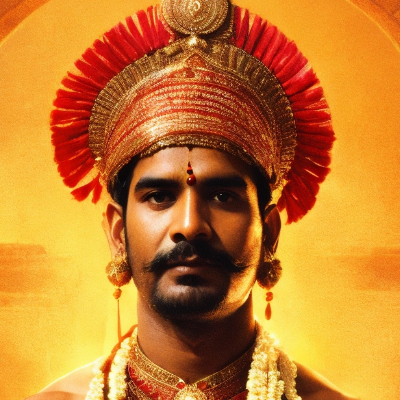
Bhurishravas — Prince of Bahlika and Maharathi Commander of the Kaurava Army
Bhurishrava · Bhurisravas · Bhoorishravas · Bhoorisravas · Saumadatti
Bhurishravas was a prince of the Bahlika kingdom and one of the most distinguished warriors to fight on the Kaurava side in the Kurukshetra War. He was the son of King Somadatta of Bahlika and the grandson of King Bahlika, who was the elder brother of Shantanu, the celebrated king of Hastinapur. Through this lineage, Bhurishravas stood as a great-grandnephew of Bhishma — the grandsire and supreme patriarch of the Kuru house — and as a collateral member of the broader Kuru royal family. He is remembered above all for his prolonged and ferocious rivalry with Satyaki, a Yadava hero of the Pandava army, a generational enmity whose origins preceded both men's births and whose resolution, during the afternoon of the fourteenth day of battle, constituted one of the most morally complex episodes in the entire Mahabharata. Bhurishravas appears primarily in the Bhishma Parva and the Drona Parva of the Mahabharata, with supplementary references scattered through the Udyoga Parva and later Parvas, as well as in secondary encyclopaedic compilations of Puranic and Itihasa lore.
✦ The Name
The name Bhurishravas is a compound Sanskrit formation. Bhuri means abundant, great, or exceedingly many, while shravas derives from the root shru — to hear — and denotes fame, renown, or glory that is heard of and proclaimed. The compound therefore signifies one of abundant or far-reaching fame, or one whose glory is widely proclaimed. The patronymic Saumadatti, meaning son of Somadatta, is also applied to him in the text. Multiple variant spellings of his name circulate across modern translations and reference works — including Bhurisravas, Bhoorishravas, and Bhurishrava — all representing the same Sanskrit original.
✦ Lineage
- Great-grandfather: Pratipa — King of Hastinapur and a scion of the Kuru lunar dynasty; father of Devapi, Bahlika, and Shantanu.
- Grandfather: Bahlika (also spelled Vahlika) — the eldest son of Pratipa and elder brother of Shantanu. Bahlika voluntarily renounced his claim to the Hastinapur throne in order to rule the kingdom of Bahlika (associated with the Bactrian or north-western region). He was the oldest warrior to take the field at Kurukshetra and fought on the Kaurava side. He was slain on the fourteenth day of battle by Bhima.
- Father: Somadatta — King of Bahlika, son of Bahlika, and a capable warrior in his own right. Somadatta fought at Kurukshetra alongside his father and son. He is closely associated with the backstory of the feud with the Vrishni Yadava clan.
- Brothers: Bhuri and Shala — named in the Mahabharata as brothers of Bhurishravas and sons of Somadatta, also participants in the Kurukshetra War on the Kaurava side. The text further mentions seven additional brothers, unnamed in most recensions.
- Sons: Pratipa and Parjanya — both young warriors who entered the Kurukshetra War and were slain by Abhimanyu, the son of Arjuna, during the course of the battle.
- Daughter: Kumbhaka — recorded in some recensions. According to this account, she later married Satyajit, a son of Drupada, the king of Panchala.
✦ The Generational Feud with the Vrishni Clan
The enmity between Bhurishravas and Satyaki — which reached its climax on the fourteenth day of the Kurukshetra War — was not of their own making. Its origins lay in a prior generation and in a contest over a woman of great consequence.
When the princess Devaki — who would later become the mother of Krishna, the Supreme deity of the Vaishnava tradition — was of marriageable age, princes from across the land competed for her hand. Among those who came to participate was Somadatta, father of Bhurishravas. Also present was Sini, a warrior of the Vrishni Yadava clan and the grandfather of the man who would become Satyaki. Sini came not on his own behalf but on behalf of the Yadava prince Vasudeva. The two men — Somadatta and Sini — clashed in direct combat over the matter. Sini prevailed decisively, and in the course of the victory he seized Somadatta by the hair and humiliated him by kicking him in the presence of all the assembled kings before sparing his life.
This public humiliation was unbearable to Somadatta. Unable to obtain redress by his own strength, he turned to austerity and performed a severe penance addressed to the god Shiva. His petition was specific: he requested that Shiva grant him a son of such prowess that the son would be able to avenge the insult Sini had inflicted upon him. Shiva granted this boon, and from that divine favour Bhurishravas was born. The Mahabharata thus establishes Bhurishravas as a figure whose very existence was shaped by the imperative of ancestral vengeance — a man born, in a real sense, for a specific act of reprisal.
✦ Role at Kurukshetra: Designation and Early Days
At the outset of the Kurukshetra War, Bhurishravas was formally designated as one of the eleven Maharathis — supreme chariot-warriors — of the Kaurava army. This rank acknowledged his exceptional martial ability and placed him among the highest tier of warriors on either side of the conflict. He fought alongside his father Somadatta and his grandfather Bahlika, three generations of the Bahlika royal house arrayed together under the Kaurava standard.
The Bhishma Parva records a significant early engagement between Bhurishravas and Satyaki. During this phase of the battle, Bhurishravas — described as an enhancer of the fame of the Kurus — engaged and overwhelmed the Yadava formations. In the course of this fighting, he executed all ten sons of Satyaki simultaneously. The killing of these ten young warriors in a single engagement was an act of extraordinary martial violence and served as a direct echo of the original ancestral grievance: just as Sini had humiliated Somadatta before all kings, so Bhurishravas now destroyed the progeny of Sini's lineage in one devastating stroke. The grief and rage this act kindled in Satyaki would drive him through the remainder of the war.
✦ The Fourteenth Day: The Combat with Satyaki and Death of Bhurishravas
The fourteenth day of the Kurukshetra War was among the most prolonged and violent of the entire conflict. Fighting continued past nightfall and the day encompassed some of the most morally charged events in the epic. Bhurishravas was stationed within the formation commanded by Dronacharya — Drona being the supreme commander of the Kaurava forces at this stage — in an effort to prevent Arjuna from reaching and killing Jayadratha, the king of Sindhu, who bore responsibility for the death of Arjuna's son Abhimanyu.
Satyaki — a warrior king of the Vrishni Yadavas and a disciple of Arjuna himself — had already fought his way through Drona's entire formation in the course of the day, following the path Arjuna had cut. By the time Bhurishravas engaged him directly, Satyaki was physically spent, having battled continuously through one of the greatest formations ever arrayed in the Kuru plain. Their duel began with bows and arrows and escalated as both warriors' weapons were destroyed. The combat descended into hand-to-hand fighting, in which Bhurishravas held every advantage over the exhausted Satyaki. He overwhelmed his opponent completely, dragged him across the battlefield by his hair, and struck him with his feet — a mirror-image reversal of what Sini had once done to Somadatta. Satyaki fell into a swoon and lay motionless on the ground. Bhurishravas raised his sword to deliver the killing blow.
It was at this moment that Krishna, who was serving as Arjuna's charioteer, drew Arjuna's attention to Satyaki's peril. Acting on Krishna's direction, Arjuna loosed an arrow from a distance — without formally challenging Bhurishravas and without entering into direct engagement with him — and the arrow severed Bhurishravas's right arm cleanly. Bhurishravas cried out, condemning the act as a violation of the warrior's code. His charge was pointed: Arjuna had not announced himself, had not issued a formal challenge, and had struck at a warrior who was engaged with a different opponent. The epic presents Bhurishravas's condemnation at length and with evident gravity, and warriors on both sides of the battlefield acknowledged the force of his protest. Arjuna defended his action on the grounds that Bhurishravas had himself been about to strike a defenceless and unconscious man — an act equally contrary to dharma.
His sword arm gone and his cause in that engagement lost, Bhurishravas made a decision that the tradition presents as his most defining act. He cast aside his remaining weapons, sat upon the battlefield, and entered into a state of yogic meditation — withdrawing himself from the war and preparing to depart the mortal world through conscious spiritual practice. The warriors around him, both Pandava and Kaurava, are described as regarding this act with awe and recognition. He had surrendered the field not in despair but in a deliberate turn toward the spiritual.
Satyaki, however, recovered from his swoon. Still burning with rage — for the ten sons Bhurishravas had killed, for the humiliation he had endured, and for his own near-death — he rose and struck off the meditating Bhurishravas's head with a single sword stroke. The reaction from the assembled armies was immediate and near-universal condemnation. A man in meditation, a man who had laid down his arms and was preparing for a peaceful death, had been killed in cold blood. The epic does not soften this judgement. Yet it equally notes that Bhurishravas himself, moments earlier, had been preparing to execute an unconscious and defenceless opponent. Both acts belonged to the same degraded moral order — the slow unravelling of dharmic restraint that the Kurukshetra War accelerated on both sides.
The tradition records that at the moment of his death, Bhurishravas attained immediate ascent to the celestial realms, his spiritual merit — accumulated over a lifetime of dharmic conduct — uncompromised by the manner in which his life was ended.
✦ Posthumous Significance: The Death of Satyaki
The killing of Bhurishravas while he sat in meditation cast a long shadow over Satyaki's reputation within the tradition. Years after the war, during the internecine conflict among the Yadavas that culminated in the Mausala Parva, Kritavarma — a warrior who had fought on the Kaurava side — publicly reproached Satyaki for the killing of the meditating Bhurishravas, calling it an act of cowardice and dishonour. The confrontation escalated and contributed directly to the catastrophic final quarrel among the Vrishni Yadavas in which Satyaki himself perished. The death of Bhurishravas thus became, narratively, one of the threads woven into the eventual destruction of the entire Yadava lineage.
✦ Moral and Theological Significance
The arc of Bhurishravas's life and death is among the Mahabharata's most sustained meditations on karma, dharma, and the corrupting logic of ancestral vengeance. His birth was the direct product of a boon granted to enable revenge — he was conceived, in a theological sense, as an instrument of karmic reprisal. The manner in which that reprisal was exacted, and the manner in which his own death mirrored the very act he had committed against Satyaki's sons and the humiliation he had visited upon Satyaki himself, constitutes a precise dramatic irony that the text's narrative structure makes impossible to overlook.
Secondary commentary on the Mahabharata has observed that Bhurishravas represents the binding power of accumulated karmic action: the attempt to destroy the defenceless Satyaki resulted, within moments, in his own destruction in a comparable state. Yet the text simultaneously complicates any purely punitive reading by crediting Bhurishravas with genuine righteousness in other dimensions of his character. He is named among those who openly opposed the loaded dice game by which Duryodhana entrapped the Pandavas — the original moral catastrophe that made the war inevitable. A man who fought for the Kaurava cause while personally dissenting from the means by which that cause had been advanced stands as a figure of genuine moral complexity, not a simple villain.
His final act of laying down his weapons and entering yogic meditation on the battlefield is understood within the tradition as an act of spiritual clarity. Whatever failures marked the arc of the feud, at the moment of his death Bhurishravas chose transcendence over retaliation — and the tradition records this choice as the reason for his immediate ascent to the celestial realms.
✦ Connection to the Wider Genealogy
Bhurishravas stood at a significant node in the extended Kuru genealogy. His great-grandfather Pratipa was the father of three sons: Devapi, the eldest, who retired from worldly life due to illness and became a hermit; Bahlika, the second, who departed Hastinapur to rule the north-western kingdom that bore his name; and Shantanu, the youngest, who became king of Hastinapur and whose line produced both the Pandavas and the Kauravas. Bhurishravas was thus a collateral kinsman of both the Pandava and Kaurava princes, related to Bhishma — born Devavrata, son of Shantanu — through the lateral branch descending from Bahlika. He was, in generational terms, of the same approximate generation as the principal heroes of both armies, fighting as a great-grandnephew of Bhishma on the same field where that patriarch himself commanded.
The Bahlika line — Pratipa, Bahlika, Somadatta, Bhurishravas — ended its principal male lineage at Kurukshetra, where all three generations fought and fell within the span of the eighteen-day war.
✦ References
Primary Sources
- Mahabharata, Bhishma Parva (Bhishmavadha Parva), Section 74 — Records the direct encounter between Bhurishravas and Satyaki during the Bhishma Parva fighting, including Bhurishravas's destruction of the Yadava formations and the killing of Satyaki's sons in that engagement.
- Mahabharata, Drona Parva, Jayadratha-Vadha Parva, Section CXLIII (143) — Narrates the climactic episode on the fourteenth day: Bhurishravas's overwhelming of the exhausted Satyaki, the severing of his arm by Arjuna on Krishna's instruction, Bhurishravas's condemnation of that act, his laying down of weapons and entry into yoga, and Satyaki's decapitation of the meditating warrior.
- Mahabharata, Udyoga Parva — Contains the pre-war listing of commanders and the designation of Bhurishravas as a Maharathi of the Kaurava army.
- Mahabharata, Mausala Parva — Records the posthumous echo of Bhurishravas's death in the quarrel between Kritavarma and Satyaki, which contributed to the final destruction of the Vrishni Yadavas.
- Mahabharata, Drona Parva — Contains the backstory of the Somadatta-Sini enmity over the Devaki swayamvara and Somadatta's penance to Shiva that resulted in the birth of Bhurishravas.
Modern and Secondary Reference Works
- Wisdomlib — Bhurisravas entry (wisdomlib.org/definition/bhurisravas) — Provides a definitional overview and confirms Bhurishravas as a prince of the Bahlika kingdom, an ally of the Kauravas, killed in the Mahabharata war.
- Wisdomlib — Bhurishrava concept entry (wisdomlib.org/concept/bhurishrava) — Supplementary lexical and contextual detail on the figure within the Mahabharata tradition.
- Vyasa Mahabharata Online Encyclopedia — Bhurishravas entry (vyasaonline.com/encyclopedia/bhurishravas) — Provides a detailed encyclopaedic summary of Bhurishravas's genealogy, the Somadatta-Sini episode, his role in the war, and his sons Pratipa and Parjanya; consulted for genealogical and narrative details.
- Wikipedia — Bhurishravas article (en.wikipedia.org/wiki/Bhurishravas) — Consulted for family member data including brothers Bhuri and Shala, additional seven unnamed brothers, and the daughter Kumbhaka; also for the post-war genealogical details attributed to Kumbhaka's line and the Kritavarma-Satyaki episode.
- Rosen, Steven J., and Graham M. Schweig — Essential Hinduism, Greenwood Publishing, 2006, p. 96 — Cited in the Wikipedia article as a secondary source identifying Bhurishravas's symbolic role as a representation of the binding effects of karmic action.
- Yogananda, Paramahansa — God Talks with Arjuna: The Bhagavad Gita, Self-Realization Fellowship, 1995, p. 87 — Cited in the Wikipedia article for theological commentary connecting Bhurishravas's fate to karmic law as illustrated in the Kurukshetra narrative.
- Mahabharatham (Tamil translation via arasan.info), Bhishma Parva Section 74 — A Tamil rendering of Kisari Mohan Ganguli's English translation of the Mahabharata; consulted for narrative detail of the Bhurishravas-Satyaki encounter during the Bhishma Parva phase of the war.