
About
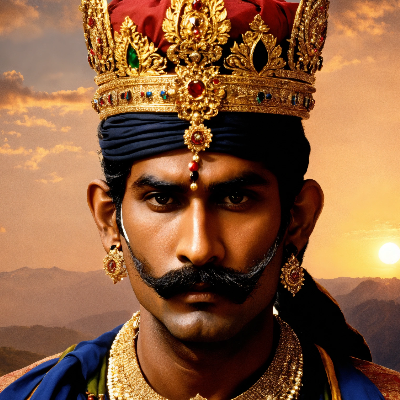
Bahlika — Elder of the Kuru House and King of the Bahlika Kingdom
Bahlika · Vahlika · Balhika · Vahlikaraja · Praateepaya
Bahlika was a king of the Bahlika kingdom, a senior elder of the extended Kuru clan, and the oldest warrior to take the field in the Kurukshetra War. He was a son of King Pratipa of Hastinapur and his wife Sunanda, a brother of Shantanu — the celebrated Kuru king who became the grandfather of both the Pandavas and the Kauravas — and consequently a paternal uncle of Bhishma, the great patriarch and commander who anchored the Kaurava side in the first ten days of the war. Bahlika is attested in the Adi Parva, the Sabha Parva, the Udyoga Parva, the Bhishma Parva, and the Drona Parva of the Mahabharata, as well as in the Harivamsha. He is remembered for voluntarily surrendering any claim to the Hastinapur throne, for actively seeking peace before the war, and for dying at the hands of Bhima on the fourteenth day of battle.
✦ The Name
The name Bahlika — also rendered Vahlika or Balhika in different transliterations — denotes a geographic and ethnic identity rather than a personal descriptive epithet in the conventional sense. The Bahlika people and territory are associated in the tradition with the north-western lands, identified by later scholarship with the region of Balkh in present-day Afghanistan. The name of the king and the name of his kingdom thus came to be used interchangeably, with the man becoming identified with the territory he ruled. The patronymic Praateepaya — son of Pratipa — is applied to him and to his brothers in passages of the Udyoga Parva that discuss the succession of the Kuru throne.
✦ Lineage
- Father: Pratipa — King of Hastinapur and a celebrated monarch of the Kuru lunar dynasty, described in the tradition as a ruler of great righteousness who performed penances in his later years and retired to the forest after installing his sons.
- Mother: Sunanda — daughter of the king of Sivi, recorded in the Adi Parva (Chapter 90) as the wife of Pratipa.
- Brothers: Devapi and Shantanu. Devapi was afflicted with a skin disease and retired from worldly life while still young, renouncing his place in the succession. Shantanu became King of Hastinapur; his son by the goddess Ganga was Bhishma, born Devavrata, the supreme patriarch of the Kuru house. Shantanu's union with Satyavati produced the line that eventually divided into the Kauravas and the Pandavas.
- Son: Somadatta — King of Bahlika after his father, a capable warrior who fought at Kurukshetra on the Kaurava side alongside Bahlika and his own sons. Somadatta was killed by Satyaki on the fourteenth day of the war.
- Daughter: Pauravi, also known as Rohini — recorded in the Harivamsha as a daughter of Bahlika who married Vasudeva of the Yadava clan. She is identified in that text as the mother of Balarama and Subhadra, two of the most significant figures in the broader Krishna narrative.
- Grandsons: Bhuri, Bhurishravas, and Shala — the three sons of Somadatta, all of whom fought and died at Kurukshetra.
- Nephew: Bhishma — son of Shantanu and the goddess Ganga, and the supreme elder of the Kaurava cause at Kurukshetra. Through Shantanu's line, the entire generational architecture of the Pandava-Kaurava conflict descended.
✦ Textual Variant: The Birth Order of Pratipa's Sons
The texts present an inconsistency regarding the birth order of Pratipa's three sons. The Adi Parva (Sambhava Parva, Section XCV, Ganguli translation) names them in the sequence Devapi, Santanu, and Valhika — placing Bahlika as the youngest of the three. The Udyoga Parva (Section 147), by contrast, names them as Devapi the eldest, Vahlika the next, and Santanu the youngest. These two accounts are directly contradictory. The Udyoga Parva's account — which places Bahlika as the middle son — is the version most commonly reproduced in secondary and encyclopaedic sources. Both versions agree that Devapi was the eldest and that Bahlika relinquished any claim to Hastinapur in favour of Shantanu; they differ only on which of the two — Bahlika or Shantanu — was the younger.
✦ The Renunciation of Hastinapur
The Udyoga Parva narrates the circumstances by which the Hastinapur throne passed from Pratipa's line to Shantanu. Devapi, the eldest son, was afflicted with a skin ailment — the texts describe it as a physical defect that made him unacceptable to the Brahmanas and the citizens as a king, since by the tradition of the time a physically imperfect man could not perform the royal consecration rites. Accordingly, Devapi was excluded from the inheritance and retired to the forest to undertake penance.
At this point, Bahlika was next in line. The Udyoga Parva records that rather than claiming the throne, Bahlika departed from Hastinapur entirely and went to live with his maternal uncle, subsequently inheriting the rich kingdom of his maternal grandfather — the territory that came to bear his name. Some versions of this account specify that the land had been previously conquered or gifted, and one variant records that Jarasandha, the powerful king of Magadha, granted Bahlika a territory in exchange for Bahlika's agreement not to support the kingdom of Panchala in a war against Magadha. The details of the land's origin vary across recensions, but all agree on the outcome: Bahlika chose a separate kingdom over the Hastinapur throne and gave Shantanu his explicit blessing to become king.
✦ Presence at Major Pre-War Events
Despite ruling a separate kingdom, Bahlika remained a recognised presence within the world of the Kuru dynasty across the generations that followed. He is recorded as attending the demonstration of martial skills by the young Kuru princes — the Rangbhoomi — where Dronacharya's students displayed their weapons training before the assembled elders and citizens of Hastinapur. He was present at the coronation of Yudhishthira as crown prince. During Yudhishthira's Rajasuya sacrifice — the great ceremony of royal consecration that required the acknowledgement of all tributary kings — the Sabha Parva records that Bahlika accepted Yudhishthira's overlordship and presented him with a chariot fashioned from gold as a gift of homage. He was also present at the infamous dice game through which Duryodhana's manipulation stripped the Pandavas of their kingdom and sent them into exile — an event he witnessed without being able to prevent.
✦ The Alignment with Duryodhana
The tradition presents Bahlika's siding with the Kauravas as the product of loyalty and institutional obligation rather than conviction. He is described in the epic as a man who genuinely desired peace among the Bharatas and who sought, before the outbreak of hostilities, to dissuade both sides from going to war. The Udyoga Parva preserves the tradition that his deepest wish was for the brotherly unity of the extended Kuru family to be maintained. When that peace failed and war became inevitable, however, Bahlika's deep marital and political ties to the Hastinapur establishment — formed across generations of alliance — bound him to Duryodhana's cause. His son Somadatta and his grandsons Bhuri, Bhurishravas, and Shala all declared for the Kauravas, and Bahlika joined them.
✦ Classification at Kurukshetra and Battle Record
In the Udyoga Parva's Rathatiratha-sankhyana — the formal assessment in which Bhishma rated the great warriors of both armies for Duryodhana's information — Bahlika was designated an Atirathi, the second-highest grade of warrior, signifying an archer capable of matching multiple opponents simultaneously in the field. Bhishma's assessment acknowledged that despite his great age, Bahlika retained genuine battlefield capability. He was, by any reckoning, the oldest living participant in the Kurukshetra War.
The battle accounts across the Bhishma Parva and the Drona Parva record several distinct engagements. On the first day of the war, Bahlika fought against Dhrishtaketu. On the ninth day, Bhima destroyed his chariot, though he was rescued from that danger by Lakshmana Kumara. On the fourteenth day he fought against the Upapandavas — the five sons of Draupadi — and Shikhandi simultaneously, resisting their combined pressure. He also killed the Pandava ally Senavindu on that day.
✦ The Final Combat and Death
The Drona Parva narrates Bahlika's death within the extended fighting of the fourteenth day — a day whose battle, uniquely in the war, continued beyond sunset and deep into the night. After Bahlika killed Senavindu, Satyaki — the Yadava hero of the Pandava side — battled Bahlika's son Somadatta and struck him repeatedly with arrows until he fell unconscious from his chariot. Bahlika, infuriated at the sight of his son felled in this way, rushed to Somadatta's aid and turned his attack toward Satyaki, pelting him with arrows.
Bhima intervened to protect Satyaki. The old king of Bahlika directed nine sharp arrows at Bhima and then drove a dart or heavy arrow directly into Bhima's chest with such force that Bhima momentarily lost consciousness — a notable achievement for a warrior of any age against the second Pandava, who was the most physically powerful man in the war. Bhima recovered, took up his great mace, and hurled it at Bahlika's head. The blow was fatal and immediate, and Bahlika fell.
✦ Theological Significance: The Madhvacharya Account
A theological reading of Bahlika's death is preserved in the Mahabharata Tatparya Nirnaya, a philosophical commentary by the Vaishnava theologian Madhvacharya. This text presents Bahlika as a great devotee of Vishnu who had prior to the war made a personal request to Bhima — himself identified in the Dvaita tradition with Mukhyaprana, the principal form of Vayu — that Bhima be the instrument of his death, thereby enabling him to attain liberation through contact with a divine warrior. The text records that Bhima agreed to this, with the condition that Bahlika must first cause him genuine harm in battle. Bahlika's driving of a dart into Bhima's chest is presented in this reading as the fulfilment of that condition. Bhima then fulfilled his promise, killing Bahlika with the mace and thereby, in this theological interpretation, conferring liberation upon him.
This account belongs to the Dvaita Vedanta tradition's interpretive framework and is not a narrative element of the primary Mahabharata text itself. It represents a significant secondary theological reading rather than an element of the core epic.
✦ The Extinction of the Bahlika Line
The Kurukshetra War annihilated the male line of Bahlika's house across three successive generations. Bahlika himself fell to Bhima on the fourteenth day. His son Somadatta was killed by Satyaki on the same day, following the death of Bhurishravas. Bahlika's grandson Bhurishravas, the most celebrated warrior of the house, was killed by Satyaki after having his arm severed by Arjuna — the most morally contentious death in the Drona Parva. Bhuri and Shala, the other two grandsons, also perished in the course of the war. Bhurishravas's sons Pratipa and Parjanya had already been killed by Abhimanyu on the thirteenth day. Three generations of Bahlika's direct male descendants were obliterated within the eighteen days, bringing the principal Bahlika line of the Kuru family to an effective end in the field.
✦ Connection to the Wider Genealogy
Bahlika occupied the foundational position in the lateral Bahlika branch of the Kuru genealogy. His father Pratipa stood as the common ancestor of both the main Hastinapur line — through Shantanu, Bhishma, and the Ambika-Ambalika branch that produced Dhritarashtra, Pandu, and Vidura — and the Bahlika collateral line through Bahlika himself. By the time of the Kurukshetra War, Bahlika and his son and grandsons fought as contemporaries of the third and fourth generations descending from Shantanu's union with Satyavati, a measure of the exceptional longevity the tradition attributes to him.
The Harivamsha account of Bahlika's daughter Rohini, also called Pauravi, adds a remarkable genealogical connection: if she is indeed Bahlika's daughter and the mother of Balarama and Subhadra through Vasudeva, then Bahlika stood in the relation of maternal grandfather to Balarama — the elder brother of Krishna — and to Subhadra, who became the wife of Arjuna and the mother of Abhimanyu. This would make Bahlika a collateral ancestor of Abhimanyu, the very hero whose sons Pratipa and Parjanya — Bahlika's great-great-grandsons through Bhurishravas — Abhimanyu killed at Kurukshetra. The Harivamsha presents this connection without drawing attention to its genealogical complexity.
✦ References
Primary Sources
- Mahabharata, Adi Parva, Sambhava Parva, Section XCV (Chapter 90) — Records the marriage of Pratipa to Sunanda, daughter of the king of Sivi, and names their three sons as Devapi, Santanu, and Valhika in that sequence, with Devapi entering the forest while still young and Santanu becoming king. This version makes Bahlika the youngest son.
- Mahabharata, Adi Parva, Chapter 177 — Records the attendance of Somadatta and his sons Bhuri, Bhurishravas, and Shala at Draupadi's swayamvara, confirming the Bahlika line's continued presence in major Kuru events.
- Mahabharata, Sabha Parva, Digvijaya Parva and Rajasuyika Parva sub-sections — Records Nakula's western campaign and Bahlika's formal acknowledgement of Yudhishthira's sovereignty, including the gift of a golden chariot, establishing Bahlika's political stance toward the Pandavas before the war.
- Mahabharata, Udyoga Parva, Section 147 (Bhagwat Yana Parva) — Narrates the succession history of Pratipa's sons in detail: Devapi the eldest excluded due to his skin disease, Vahlika the middle son departing to his maternal grandfather's kingdom, and Shantanu the youngest becoming king of Hastinapur with Bahlika's blessing. This version makes Bahlika the middle son.
- Mahabharata, Udyoga Parva, Rathatiratha-sankhyana Parva — Contains Bhishma's formal assessment of warriors, in which Bahlika is classified as an Atirathi despite his great age.
- Mahabharata, Bhishma Parva — Records Bahlika's participation in the early days of the war, including his engagement against Dhrishtaketu on the first day and the destruction of his chariot by Bhima on the ninth day.
- Mahabharata, Drona Parva (night-battle chapters, fourteenth day) — The principal source for Bahlika's death: his killing of Senavindu, his intervention to aid the fallen Somadatta, his exchange with Bhima, his landing of the blow on Bhima's chest, and Bhima's fatal mace-throw that ended his life.
- Harivamsha, Chapter 23 — Records Bahlika's son Somadatta and the three grandsons Bhuri, Bhurishravas, and Shala. Also attests Bahlika's daughter Pauravi, called Rohini, as the wife of Vasudeva and mother of Balarama and Subhadra.
- Madhvacharya, Mahabharata Tatparya Nirnaya (Chapter 26, verses 265–266) — A Dvaita Vedanta theological commentary presenting the account of Bahlika's prior request to Bhima to be the instrument of his death, and Bhima's granting of that wish as an act of compassion toward a fellow Vaishnava devotee.
Modern and Secondary Reference Works
- Wikipedia — Bahlika (king) article (en.wikipedia.org/wiki/Bahlika_(king)) — Consulted for day-by-day battle record, family members including Rohini/Pauravi, and the summary of Bahlika's death sequence; cites Vettam Mani's Puranic Encyclopedia and Bibek Debroy's Mahabharata translation.
- Vyasa Mahabharata Online Encyclopedia — Bahlika entry (vyasaonline.com/encyclopedia/bahlika) — Confirms Bahlika as the elder brother of Shantanu and the oldest warrior at Kurukshetra; records his death by Bhima and the extinction of his line.
- Pranasutra — Bhima Krupa: Killing of Bahlika (pranasutra.in) — Provides an extended narrative account of Bahlika's final battle drawn from the Drona Parva, including the sequence involving Somadatta's fall, Bahlika's intervention, his wounding of Bhima, and Bhima's fatal mace-throw; also cites the Mahabharata Tatparya Nirnaya for the Madhvacharya theological account.
- Sacred Texts Archive — Mahabharata, Adi Parva, Sambhava Parva, Section XCV (sacred-texts.com/hin/m01/m01096.htm) — Provides the Ganguli translation of the genealogical passage naming Pratipa's sons as Devapi, Santanu, and Valhika, which places Bahlika as the youngest.
- Sacred Texts Archive — Mahabharata, Udyoga Parva, Section 147 (sacred-texts.com/hin/m05/m05149.htm) — Provides the Ganguli translation of Dhritarashtra's narration of the succession, naming Devapi the eldest, Vahlika the middle, and Shantanu the youngest — the version that makes Bahlika the middle son.
- Vettam Mani — Puranic Encyclopedia, Motilal Banarsidass, 1975 — Cited as a comprehensive secondary reference for Bahlika's genealogy, his role at Kurukshetra, and the relevant Parva-level citations.
- Glorious Hinduism — Mahabharata Family Tree (glorioushinduism.com) — Consulted for analysis of the birth-order discrepancy between the Adi Parva and Udyoga Parva accounts of Pratipa's sons, and for genealogical detail on the Harivamsha's confirmation of Somadatta's three sons.