
About
Gayatri — Second Consort of Brahma, Goddess of Pushkara, Personified Form of the Gayatri Mantra
Gayatri Devi · Vedamata · Manonmani (in Shaiva identification)
Gayatri, in the Puranic tradition centred on the pilgrimage site of Pushkara, is the woman of humble origin who is ritually purified and married to the creator deity Brahma in order to allow a sacrifice to proceed at its appointed auspicious moment, after Brahma's principal consort fails to arrive in time. She is worshipped today at Pushkara alongside Brahma and is widely venerated as the personified form of the Gayatri Mantra, the most sacred verse of the Rigveda, and is given the title Vedamata, mother of the Vedas. Her narrative is preserved principally in the Padma Purana, with variant tellings and additional iconographic elaboration in the Skanda Purana and the Matsya Purana, and in later devotional and regional literature associated with the Pushkara temple complex. The identity, relationship, and even the distinctness of this figure from Brahma's other consort are handled very differently across these sources, as detailed below.
✦ The Name
The name Gayatri, as applied to this figure, derives from the same root as the Gayatri metre and the Gayatri Mantra of Rigveda III.62.10, from gayatra, associated with song or sacred chant. In the Pushkara narrative tradition, however, a distinct folk etymology is also current: the woman who becomes Brahma's second wife is said to have been ritually elevated to Brahmin status by being passed through the body of a cow, an act of purification that is said to have given her the name Gayatri, understood in this context as one who has been drawn through a cow. This popular etymology exists alongside, rather than in place of, the mantra-based etymology, and the sources do not reconcile the two. Her title Vedamata, mother of the Vedas, is shared with the mantra-goddess identity and reflects her standing as the mother or source of Vedic sacred knowledge. In the Shaiva identification described below she is also called Manonmani, a name associated with the mantra-form of the goddess as consort of the solar Shiva-aspect Bharga.
✦ Lineage
- Origin: in the principal Pushkara narrative, Gayatri is said to have been the daughter of a milkmaid or cowherd woman, of low or non-Brahmin birth, before her ritual elevation and marriage to Brahma.
- Consort: Brahma — the creator deity of the Hindu Puranic tradition, first of the Trimurti, whom she assists in the completion of a sacrifice at Pushkara.
- Sponsor of her elevation: in most versions of the narrative, Indra, king of the gods, is said to have selected her and arranged for her ritual purification so that the sacrifice could proceed; some versions of the tradition instead credit the sage Vishvamitra with her consecration for the rite.
No primary source consulted records parentage for Gayatri beyond her identification as a cowherd's or milkmaid's daughter, nor does any source consulted record children born to her.
✦ The Sacrifice at Pushkara and the Marriage to Brahma
The Padma Purana narrates that Brahma, having slain the demon Vajranabha, who had been tormenting sages and their disciples, resolved to perform a great sacrifice at the site that would become known as Pushkara. Vedic sacrifice of this kind required the presence of the officiant's wife, so Brahma sent word for his consort, in most versions identified as Sarasvati or Savitri, to attend. When she did not arrive by the fixed auspicious moment, Brahma, unwilling to let the moment pass, asked Indra to find a substitute wife so the rite could begin. Indra selected a cowherd's daughter, and because the sacrifice required a woman of Brahmin status, the girl was ritually passed through the body of a cow to elevate her caste standing, emerging purified and thereafter known as Gayatri. Brahma married her on the spot, and with her assistance completed the sacrifice, during which she is described as carrying a vessel of nectar upon her head and making the ritual offerings.
✦ The Confrontation with Brahma's First Consort
When Brahma's first consort finally arrived and found Gayatri installed in her place at the sacrifice, she reacted with fury. In most versions of the narrative she is enraged and pronounces a curse restricting Brahma's worship to Pushkara alone, so that no other temple to him would be honoured anywhere else in the world; some versions extend her anger into curses against other gods present at the rite, including Indra, Vishnu, and Agni. In one variant preserved in the Padma Purana, Brahma, Vishnu, and Lakshmi together succeed in pacifying the first consort, after which she accepts Gayatri amicably as a sister rather than a rival. Following the confrontation, the first consort is said to have withdrawn to a nearby hill, where a separate temple to her stands to this day, visible from within the precincts of the main Brahma temple, while Gayatri's own shrine, in some tellings, lies at the opposite end of the same hill out of continued wariness of the elder goddess's temper. In certain versions of the story, Gayatri is said to have later softened the first consort's curse, blessing Pushkara instead with its standing as Tirtharaj, the foremost of all pilgrimage sites.
✦ Textual Variants and Inconsistencies
The identity of Brahma's first consort in this narrative is given differently across sources: some name her Savitri, others Sarasvati, and some sources use the two names interchangeably for the same figure, while the temple tradition at Pushkara itself houses shrines described in some accounts as belonging to Savitri and Gayatri, and in others as belonging to Sarasvati and Gayatri, without consistent distinction between Savitri and Sarasvati as separate goddesses.
A further and more fundamental inconsistency concerns whether Gayatri is a genuinely distinct goddess from Brahma's first consort at all. The Matsya Purana states that a female form emerged from the left half of Brahma's own body and is celebrated under three names at once, Sarasvati, Savitri, and Gayatri, treating all three as a single being under different appellations rather than as separate individuals. Against this, the Padma Purana's Pushkara narrative as generally told requires Gayatri to be a distinct, separately originated woman, since the entire drama of the story depends on her being a substitute bride rather than the first consort under another name. The Skanda Purana, for its part, identifies Gayatri as Brahma's wife in a manner that treats her as effectively continuous with Sarasvati, again in tension with the substitute-bride narrative. No resolution between these positions is offered consistently across the Puranic corpus, and this profile presents Gayatri as she appears in the substitute-bride tradition of the Pushkara narrative, while noting that other major Puranas do not treat her as a separate figure at all.
A separate Shaiva tradition of considerably later date, attested in Shaiva iconographic material from around the tenth century CE onward, identifies Gayatri as the consort of a solar aspect of Shiva called Bharga, under the name Manonmani, holding within her the power of her husband. This Shaiva identification appears to represent a later theological development that draws the Vedic Gayatri veneration and her five-headed iconographic form into the framework of Shakta and Shaiva goddess worship, distinct from the Vaishnava-inflected Pushkara narrative centred on Brahma.
✦ Iconography and Worship
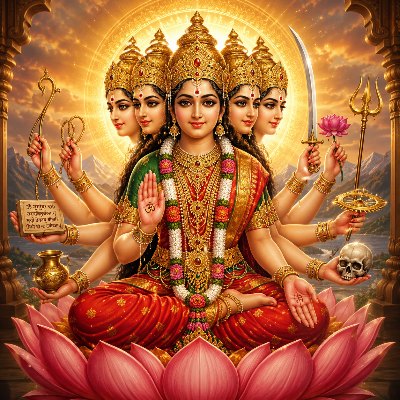
Gayatri's most elaborate iconographic form, shared with the broader Gayatri-goddess tradition, depicts her with five heads and ten arms, a form associated in Puranic narrative with her power to overcome a demon named Vetra. In this form she is shown holding a sword, a lotus, a trident, a discus, a skull, and the gesture of boon-granting in her left hands, and a goad, a noose, a manuscript, a vessel of nectar, and the gesture of reassurance in her right hands. At Pushkara, she is enshrined in the main Brahma temple seated beside the deity, generally placed opposite the shrine of his first consort, while a separate temple to her also stands at one end of the hill on which the first consort's own shrine is located. Pushkara itself, centred on its sacred lake, is regarded as one of the principal pilgrimage sites of the Hindu tradition, and Gayatri's worship there is inseparable from the veneration of Brahma, since the two are enshrined and propitiated together as the deities of this single sacrifice.
✦ Theological Significance
Gayatri's narrative functions theologically to account for two otherwise puzzling features of the tradition: the extreme rarity of temples dedicated to Brahma despite his status as creator, and the near-universal daily veneration of the Gayatri Mantra by contrast. The story explains the first through the first consort's curse and the second through Gayatri's own subsequent blessing of the site, positioning her as the goddess whose grace, rather than Brahma's own creative primacy, secures Pushkara's continuing sanctity. Her elevation from cowherd's daughter to consort of the creator, achieved through ritual purification rather than birth, also carries a theological undertone regarding the transformative power of Vedic ritual to confer standing irrespective of origin, a theme distinct from, though sometimes folded into, her separate identity as the personified mantra and mother of Vedic knowledge.
✦ Connection to the Wider Genealogy
Gayatri is joined to the highest tier of the Puranic divine order through her marriage to Brahma, the creator deity from whom the entire cosmos and its inhabitants, including the sage lineages that produce the Vedic patriarchs and the royal dynasties of the Solar and Lunar lines, are said to originate. Her presence at Pushkara links her also to the network of gods said to have attended Brahma's sacrifice there, including Indra, Vishnu, Agni, and, in the accounts naming him as her consecrator, the sage Vishvamitra, himself a major figure of the Puranic and epic tradition descended from the Kushika line of kings.
✦ References
- Padma Purana: the principal source for the narrative of Brahma's sacrifice at Pushkara, the selection and purification of Gayatri as substitute bride, and the confrontation and reconciliation with Brahma's first consort.
- Skanda Purana: identifies Gayatri as Brahma's wife in a manner treating her as continuous with Sarasvati, and contributes to the account of worship at the Pushkara temple hill.
- Matsya Purana: presents Sarasvati, Savitri, and Gayatri as three names for a single female form said to have emerged from Brahma's body, in tension with the substitute-bride tradition.
- Rigveda, Mandala III, hymn 62, verse 10: the source of the Gayatri Mantra and Gayatri metre from which the mantra-goddess identity draws its name and theological basis.
- Vettam Mani, Puranic Encyclopaedia: consulted for cross-referencing the variant identifications of Gayatri, Savitri, and Sarasvati across Puranic sources.
- Modern devotional and pilgrimage-site accounts of the Pushkara Brahma and Gayatri temples: consulted for details of the temple layout, the milkmaid-purification tradition, the iconographic five-headed ten-armed form, and the later Shaiva identification of Gayatri as Manonmani.