
About
Bhagiratha — Son of Dilipa, the King Who Brought the Ganga from Heaven to Earth, Liberator of the Sixty Thousand, the Name of Perseverance
Bhagiratha · Bhagīratha · Dilipa-putra · Ganga-avataraka · Sagara-putras-taraka · Shruta-pita · Hamsi-mata · Kakutstha-pitamaha · Raghu-prapitamaha · Dasharatha-praprapitamaha · Rama-purvajanma · Bhagirath-Prayatna-namahetu
Bhagiratha is the son of King Dilipa (son of Anshuman, grandson of Sagara) and a king of the Ikshvaku Solar Dynasty of Ayodhya; the man who accomplished the descent of the sacred river Ganga from the celestial realm to the earth — one of the greatest sustained individual achievements recorded in the entire Hindu tradition; the liberator of the sixty thousand sons of Sagara who had been reduced to ash in Patala by the sage Kapila's wrathful gaze; the father of Shruta (son) and Hamsi (daughter, who married the sage Kautsa); and the ancestor of Kakutstha, Raghu, Aja, Dasharatha, and Rama. His name has passed permanently into every major Indian language as the common noun for extraordinary perseverance in an apparently impossible cause — Bhagirath Prayatna (Bhagiratha's effort) is the phrase used across India when someone accomplishes something that should not have been possible through sheer sustained determination. His Ganga is called Bhagirathi — the river of Bhagiratha — in the upper reaches of the Himalayan watershed, and this name is preserved in the modern geographical designation of the Bhagirathi river in Uttarakhand. His story is narrated in the Valmiki Ramayana (Bala Kanda, Chapters 42–44 — Vishvamitra narrating it to Rama on the journey to Mithila), the Mahabharata (Vana Parva, Chapter 108), the Bhagavata Purana (Canto 9, Chapter 9), the Brahmanda Purana (Chapter 97), the Vishnu Purana (Book 4, Chapter 4), and the Padma Purana. He received guidance from the great sage Tritula during his tapas — the Puranic Encyclopaedia names Tritula as his guru. The tradition assigns him position 48 in the Solar Dynasty lineage counting from Brahma — and Rama was the 67th, making nineteen generations between them.
✦ The Name
The Sanskrit name Bhagiratha — written Bhagīratha — is explained through two distinct etymological traditions. The standard derivation is from bhaga (fortune, divine favour, the six divine qualities of Vishnu: sovereignty, righteousness, glory, fame, wealth, and detachment) and ratha (chariot, the one who rides the chariot). The compound means the chariot of fortune, the one who carries divine favour, the divinely fortunate charioteer — a royal name recording both the king's function (chariot-warrior) and his divine favour (bhaga). A folk etymological tradition recorded in the Padma Purana and the Bengali texts on Bhagiratha's unusual birth uses bhaga in the anatomical sense (vulva) and connects the name to the extraordinary manner of his birth — in some Bengali traditions, when Dilipa died without an heir, two of his widows united and one became pregnant by the other; the child born was Bhagiratha; the name in this tradition records the unusual birth. This Bengali tradition — found in the Padma Purana's Bengali recension and the Krittivasi Ramayan — is a regional variant not in the Valmiki Ramayana or the standard Puranic sources.
✦ Lineage
- Father: Dilipa (Dilipa-1) — son of Anshuman; grandson of Sagara; who also tried and failed to bring the Ganga to earth; who ruled for thirty thousand years; profiled separately in this series
- Paternal grandfather: Anshuman — who received Kapila's prophecy about the Ganga and his grandson; who also tried and failed; profiled separately in this series
- Paternal great-grandfather: Asamanjas — expelled prince; profiled separately in this series
- Paternal great-great-grandfather: Sagara — whose sixty thousand sons were burned to ash; who named the ocean; profiled separately in this series
- Guru: Tritula — the great sage who guided Bhagiratha during his tapas and gave him philosophical instruction on the path to liberation; named in the Puranic Encyclopaedia and the Wisdomlib source
- Wife: unnamed in primary canonical sources
- Son: Shruta — who succeeded him on the throne of Ayodhya
- Daughter: Hamsi — who married the sage Kautsa; confirmed in both the Glorious Hinduism source and the Wikipedia Bhagiratha article which cites the Mahabharata's statement that Bhagiratha married his daughter Hamsi to the sage Kautsa
- Position in Solar Dynasty: Sagara → Asamanjas → Anshuman → Dilipa → Bhagiratha → Shruta → Nabhaga → Sindhudvipa → Ayutayu → Rituparna → Sarvakama → Sudas → Saudasa → Asmaka → Mulaka → Dilipa-2 (Khatvanga/Dīrghabāhu) → Raghu → Aja → Dasharatha → Rama
✦ The Decision — Renouncing the Throne for the Ancestors
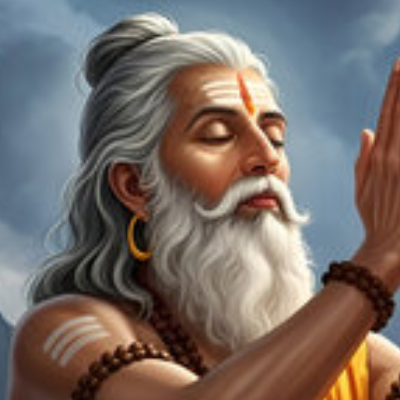
When Dilipa died, Bhagiratha was crowned king of Ayodhya. He established just and peaceful rule. But the inherited mission — the liberation of the sixty thousand sons of Sagara — weighed on him from the first day of his reign. Unlike his father and grandfather who had tried to accomplish both their royal duties and the Ganga mission simultaneously, Bhagiratha took the more radical decision: he delegated the entire administration to his ministers and left Ayodhya entirely. He went to Gokarna — a sacred site on the western coast of India — and began his tapas with the Ganga as his singular focus. The Valmiki Ramayana records the form of his austerities with precise attention: he raised his hands above his head and held them there; he surrounded himself with the five fires on the four sides and above; he stood on a single toe with full body weight balanced on one foot; he ate food only once a month; he practised complete control of his senses. He maintained these austerities for thousands of years without break. The tradition records that his name became synonymous with perseverance through this act — a king who gave up his kingdom and stood for thousands of years on one toe in the five-fire enclosure, eating once a month, arms raised, for a single purpose.
✦ The First Boon — Brahma Agrees to Send the Ganga
Brahma appeared before Bhagiratha, pleased with the depth and duration of his austerities, and asked what he wished. Bhagiratha asked for two things: a son to continue his lineage (because he had been performing such severe tapas that he had not yet had children); and the descent of the Ganga from heaven to earth to liberate the sixty thousand sons of Sagara. Brahma granted both boons. But he told Bhagiratha of a difficulty: the force of the Ganga's descent from the celestial realm was so extreme that the earth could not withstand the impact — if she descended unimpeded, her force would shatter the earth entirely. Only one being in all the three worlds was capable of receiving and controlling that force: Shiva. Bhagiratha would have to propitiate Shiva separately. Bhagiratha resumed his tapas — this time directed at Shiva alone. He stood on one toe for a year in intense concentration on Shiva. Shiva appeared and agreed to receive Ganga in his matted locks.
✦ The Descent — Ganga's Arrogance and Shiva's Matted Locks
When Ganga was ordered to descend by Brahma and Shiva stood ready to receive her, the goddess descended from the celestial realm with all her force and pride. She thought — as she rushed downward — that the impact of her descent would sweep Shiva himself away toward Patala. She was testing whether her force could overpower the one who had agreed to contain her. Shiva understood her intention. He received her on his head. His matted locks — the jata, the accumulated mass of his penance — received the entire force of Ganga's celestial descent and contained it completely. Ganga struggled to find a way out of the vast labyrinth of Shiva's hair. She could not. The waters circled and wound through the matted locks for many years — a thousand years in one account, several years in another — without finding any outlet. Bhagiratha, watching from below, saw that the Ganga had descended onto Shiva's head and then disappeared into his hair. No drop was reaching the earth. The entire enterprise seemed to have failed at this final stage. He performed more tapas — more austerities directed at Shiva, asking him to release the Ganga. Shiva was pleased and shook his head. One drop of water fell from his matted locks. That single drop fell on the earth and became the river Ganga as it flows in northern India today.
✦ Leading the Ganga — The Jahnu Episode
Once released from Shiva's locks, the Ganga flowed across the northern plains of the subcontinent toward the sea. Bhagiratha walked ahead of her in his chariot, leading the way. The Ganga followed him wherever he led. Along the route she flooded the sacrificial ground of the sage Jahnu — the water extinguished the sacred fire and drowned the yajna site. Jahnu was furious at this disturbance of his penance. He used his yogic power and drank the entire river — swallowing Ganga completely. The Ganga suddenly disappeared from the earth again. Bhagiratha, the gods, and the assembled sages were horrified. They came to Jahnu with prayers and entreaties — explaining the sacred mission of the Ganga's descent and begging him to release her. Jahnu was satisfied by their reverence and their honest account. He released the Ganga from his left ear. The river emerged and flowed onward. From this episode the Ganga received the epithet Jahnavi — daughter of Jahnu. Bhagiratha led her further — to the sea, and through the sea to Patala. In Patala the sacred waters of the Ganga touched the ash heaps of the sixty thousand sons of Sagara. Every one of them was liberated. The Valmiki Ramayana records Brahma's declaration: since Bhagiratha accomplished this task through his own personal effort, the Ganga would also be known as Bhagirathi — the river of Bhagiratha — forever.
✦ Return and Reign
After the liberation of his ancestors Bhagiratha returned to Ayodhya. The Glorious Hinduism source records: he was crowned and established a just and peaceful rule. He married. He had two children — a son named Shruta and a daughter named Hamsi. He gave Hamsi in marriage to the sage Kautsa. He donated hundreds of thousands of cows and their calves to the sage Kohala — a specific act of generosity recorded by the Mahabharata. He believed deeply in the merit of donating cows. He performed the funeral rites of his ancestors with full ceremony. The kingdom prospered under his rule. Then, after only a couple of years of ruling, spiritual thoughts began arising in his mind — the Glorious Hinduism source records this directly. The man who had already spent thousands of years in forest tapas found himself drawn back to the spiritual life. He left the kingdom to his son Shruta and went into the forest for further meditation and penance. The Puranic Encyclopaedia (Wisdomlib) records a specific teaching exchange between Bhagiratha and his guru Tritula — the sage instructed Bhagiratha that the ego would be annihilated when tendencies toward the senses were completely suppressed and perfect truth was realised; that the path was to give away all wealth, move without ego and pride, and take alms even from enemies. Bhagiratha's final years were given to this interior work — the same sustained determination that had brought the Ganga to earth now turned inward.
✦ Bhagirath Prayatna — A Name That Entered the Language
The phrase Bhagirath Prayatna — Bhagiratha's effort — has entered every major Indian language as the standard expression for an apparently impossible task accomplished through sustained extraordinary effort. It is used in political speeches, corporate communications, newspaper editorials, academic writing, and everyday conversation across the subcontinent. When the Indian government's river-linking project was discussed, it was routinely described as a Bhagirath Prayatna. When scientists at ISRO accomplished their Mars Orbiter Mission on a minimal budget, commentators called it a Bhagirath Prayatna. The tradition records many extraordinary acts — but only Bhagiratha's three-stage tapas (propitiate Ganga, propitiate Brahma, propitiate Shiva; then survive the Jahnu episode) has given the language a common noun for determination. A sculpture of Bhagiratha can be seen beneath the spout of almost every traditional drinking fountain in the old settlements of Nepal — his image permanently associated with the giving of water.
✦ References
- Valmiki Ramayana (Bala Kanda, Chapters 42–44) — the primary canonical source: Bhagiratha's tapas at Gokarna; the five-fire austerity; eating once a month; Brahma appearing; the two boons; Brahma's warning about the earth's inability to bear the force; Shiva's agreement; Ganga's arrogant descent; Shiva containing her in his matted locks; Ganga circling for years; Bhagiratha's further tapas; Shiva releasing one drop; the flow across the plain; the Jahnu episode; Ganga named Jahnavi; leading Ganga to the sea and Patala; the liberation of the sixty thousand; Brahma declaring the Ganga henceforth called Bhagirathi
- Mahabharata (Vana Parva, Chapter 108) — the parallel epic account; Bhagiratha's daughter Hamsi given to the sage Kautsa; the cow donations to Kohala
- Bhagavata Purana (Canto 9, Chapter 9) — the parallel Puranic account; the succession confirmed; Bhagiratha's position in the Solar Dynasty
- Brahmanda Purana (Chapter 97); Vishnu Purana (Book 4, Chapter 4); Padma Purana (Part 4, Chapter 21) — parallel Puranic confirmations of the descent narrative
- Puranic Encyclopaedia (Vettam Mani, Wisdomlib) — the complete Bhagiratha entry: the genealogy from Vishnu through Brahma to Bhagiratha; Tritula as his guru; the philosophical teaching on ego-annihilation; the Narada Purana's Yama dialogue
- Wikipedia — Bhagiratha; Glorious Hinduism — Bhagiratha; Greenmesg — Valmiki Ramayana Bala Kanda Penance of King Bhagiratha; Shivknowledge.com — The Story of Bhagiratha and the Ganga; Hindu Blog — Story of King Bhagiratha; Medium — Ramayana Simplified Part 13 The Story of Bhageeratha: modern summaries drawing from the above primary sources