
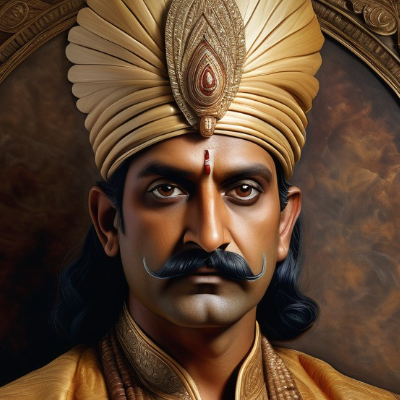
About
Shruta — Son of Bhagiratha, King of Kosala, Successor of the Solar Dynasty's Greatest Ascetic-King
Shruta · Sruta · Bhagirathaputra · Kosalanaresh · Nabhagapita · Suryavanshi
Shruta was a king of the Ikshvaku Solar dynasty, the son of King Bhagiratha of Ayodhya and the father of Nabhaga, the next king in the succession. He is also recorded as a brother of Hamsi, a daughter of Bhagiratha given in marriage to the sage Kautsa. Shruta's place in the tradition is structural rather than narrative: no independent episode is attached to his reign in any primary source consulted, and his significance lies entirely in his position as the direct successor of Bhagiratha — the most celebrated of the Solar dynasty's intermediate kings — and as the father of Nabhaga, through whom the dynasty continued toward the later celebrated generations of Raghu, Aja, Dasharatha, and Rama. He appears by name in the Solar dynasty genealogical lists of the Garuda Purana, the Vishnu Purana, the Bhagavata Purana's Ninth Skandha, and the Harivamsha, and is referenced in secondary sources drawing on the Valmiki Ramayana's dynastic recitation. One secondary source, drawing on the Yoga Vasishtha's account of Bhagiratha's final years, preserves the narrative detail that Bhagiratha formally installed Shruta as king of Kosala before departing for the forest to pursue liberation, and that Bhagiratha attained moksha thereafter.
✦ The Name
The name Shruta derives from the Sanskrit root shru, meaning "to hear" or "to learn through hearing," with its past participle shruta carrying the meanings "heard," "learned," "renowned," or "celebrated." As a royal name it encodes both scholarly accomplishment and public reputation — the king who is known, whose deeds have been heard of, who has received and transmitted learning. The Vedic tradition's most authoritative category of sacred knowledge is shruti, the heard text, and the name Shruta honours this mode of reception and transmission. The patronymic Bhagirathaputra means "son of Bhagiratha." The designation Nabhagapita means "father of Nabhaga." Kosalanaresh means "king of Kosala."
✦ Lineage
- Father: Bhagiratha, king of Ayodhya and the most celebrated of the Solar dynasty's intermediate kings, whose extraordinary austerities across many years finally brought the sacred river Ganga down from the heavens to the earth, liberating the sixty thousand sons of his ancestor Sagara who had been reduced to ash by the gaze of the sage Kapila. His name became a byword for impossible perseverance accomplished through unfailing faith. The Wikipedia article on Bhagiratha, drawing on the Ramayana, Mahabharata, and Puranic sources, confirms Shruta as his son and Hamsi as his daughter.
- Sister: Hamsi, a daughter of Bhagiratha given in marriage to the sage Kautsa, her union recorded among Bhagiratha's meritorious acts in the Mahabharata's Anushasana Parva. She is a figure distinct from any other bearer of that name in the tradition.
- Son: Nabhaga, the next king of the Solar dynasty in the succession following Shruta, through whom the Ikshvaku line continued toward the later celebrated generations. The Garuda Purana's dynastic list explicitly names Nabhaga as the son of Shruta, and this sequence is confirmed in parallel by the Vishnu Purana, the Bhagavata Purana's Ninth Skandha, and the Harivamsha.
✦ The Coronation by Bhagiratha
The only biographical moment associated specifically with Shruta in the tradition is the occasion of his installation as king. A secondary source drawing on the Yoga Vasishtha's account of Bhagiratha's final years records that after completing all his worldly duties — bringing the Ganga to earth, liberating his ancestors, giving Hamsi to Kautsa, and governing the kingdom with justice through his middle years — Bhagiratha felt the arising of spiritual inclination in his old age and resolved to leave the world for the forest. Before departing he performed Shruta's formal consecration as king of Kosala. He then withdrew to the forest and attained liberation there. Shruta thus received the kingdom not as an ordinary inheritance but as a deliberate and ceremonial transmission from the most revered king of his dynasty's intermediate period — the final worldly act of a man whose name had become synonymous with impossible ascetic perseverance. No primary Mahapuranic verse specifically dedicated to the coronation episode has been found in the sources consulted, and the account rests on the Yoga Vasishtha tradition as cited by the secondary source.
✦ Shruta's Place in the Solar Dynasty Succession
The Garuda Purana's genealogical list places the sequence immediately following Bhagiratha as Bhagiratha — Shruta — Nabhaga, and the Vishnu Purana and Bhagavata Purana ninth skandha preserve the same chain. Through Nabhaga, this succession continues toward Sindhudvipa and the later Solar dynasty kings Pratayu, Shrutuparna, Sarvakama, Sudasa, and onward through Dilipa II, Raghu, Aja, Dasharatha, and Rama. Shruta belongs to the intermediate category of Solar dynasty kings — figures whose importance is structural, maintaining the chain rather than generating independent narrative — comparable to other transitional kings of this type in the dynastic record whose reigns are attested by name in the genealogical lists but who are not the subjects of dedicated narrative episodes in the primary texts.
✦ Textual Variants and Inconsistencies
The Garuda Purana, the Vishnu Purana, and the Bhagavata Purana all give the same direct succession of Bhagiratha — Shruta — Nabhaga, confirming Shruta's position without variant. The Valmiki Ramayana's dynastic recitation, however, is considerably shorter than the Puranic lists and omits a number of intermediate kings across the whole dynasty, a discrepancy that scholars have noted extensively. As the Wisdomlib analysis of Solar dynasty genealogies records, the Ramayana list is considered defective in length compared to the Puranic lists, which are supported by the Mahabharata. Shruta's name is among those absent from the abbreviated Ramayana list, but this is consistent with the Ramayana's general compression of the dynasty rather than a specific variant tradition about his position.
✦ Connection to the Wider Genealogy
Shruta stands in the Solar dynasty's Ikshvaku line as the single generational link between Bhagiratha and Nabhaga. His father Bhagiratha was himself the son of Dilipa I, who was the son of Anshumana, who was the son of Asamanjasa, who was the son of Sagara — the king whose sixty thousand sons were destroyed by the sage Kapila's gaze, making the liberation of those ancestors the purpose of Bhagiratha's entire life's endeavour. Through his son Nabhaga, Shruta connects this celebrated cluster of the Solar dynasty to the later cluster whose most celebrated figure is Rama, son of Dasharatha, son of Aja, son of Raghu, son of Dilipa II — the succession running from Nabhaga through Sindhudvipa, Pratayu, Shrutuparna, Sarvakama, Sudasa, and onward. Without Shruta maintaining the succession from Bhagiratha, the dynastic chain linking the Sagara-Bhagiratha cluster to the Raghu-Rama cluster would have been severed.
✦ References
Primary Sources
- Garuda Purana, Chapter 138 (Wisdomlib edition): The most directly confirmatory primary source for this profile; its Solar dynasty genealogical list explicitly states that Shruta was the son of Bhagiratha and that Nabhaga was the son of Shruta, placing him precisely in the dynastic succession.
- Vishnu Purana, Book 4, Chapters 2–4: Contains the Solar dynasty genealogical passages in which the Bhagiratha succession is given and Shruta's name appears in the dynastic chain between Bhagiratha and Nabhaga.
- Bhagavata Purana, Ninth Skandha: The genealogical account of the Solar dynasty confirming the Bhagiratha — Shruta — Nabhaga succession.
- Harivamsha, Harivamsha Parva: Contains the Solar dynasty genealogical list in which Shruta's position between Bhagiratha and Nabhaga is attested.
- Mahabharata, Anushasana Parva: Records Bhagiratha's meritorious acts including the giving of Hamsi to the sage Kautsa, establishing the siblinghood of Shruta and Hamsi as children of Bhagiratha.
- Yoga Vasishtha: The tradition cited in secondary sources for the narrative of Bhagiratha's formal installation of Shruta as king before his forest departure and final attainment of liberation.
Secondary and Reference Sources
- Vettam Mani, Puranic Encyclopaedia (1975): Entry identifying Shruta as son of Bhagiratha and father of Nabhaga within the Solar dynasty succession.
- Wikipedia, "Bhagiratha": Confirms Shruta as son and Hamsi as daughter of Bhagiratha, drawing on the Ramayana, Mahabharata, and Puranic sources collectively.
- Wisdomlib, "Genealogy of the Solar Dynasty in the Puranas and the Ramayana": Provides the scholarly analysis confirming that the Puranic dynastic lists are more complete and reliable than the Ramayana list, supporting the inclusion of Shruta as an intermediate king not found in the abbreviated Ramayana genealogy.
- Bhagavanbhakthi Solar Dynasty genealogy (citing Valmiki Ramayana and Bhagavata Purana): Secondary source confirming Shruta as son of Bhagiratha and Nabhaga as son of Shruta within the Solar dynasty succession list.