
About
Ambarisha — Son of Nabhaga, Emperor of Seven Continents, the Devotee Who Made Vishnu Powerless, the Model of Bhakti
Ambarisha · Ambarīṣa · Ambarish · Maharaja Ambarisha · Nabhaga-putra · Vaishnava-shreshtha · Bhakta-paradhina-karta · Sudarshana-priya · Durvasa-kshama-data · Srimati-pita · Ikshvaku-vamsha-nripa
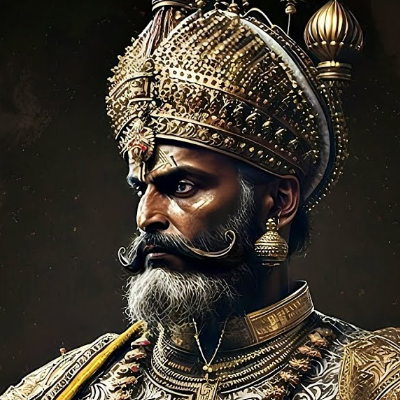
Ambarisha — known in the Vaishnava tradition as Maharaja Ambarisha — is a legendary king of the Ikshvaku Solar Dynasty of Ayodhya; the son of King Nabhaga (the younger of two Solar Dynasty kings who bore this name — the son of Bhagiratha's descendant Shruta's line); the husband of a devoted queen; the father of Srimati (among other children); and the tradition's supreme example of a royal devotee — a king who ruled the entire earth encompassing all seven continents yet remained entirely detached from material enjoyment, dedicating every faculty of his being to the service of Vishnu. He is the central figure of the Bhagavata Purana's Ninth Canto (Chapter 4) — one of the most celebrated Puranic episodes — in which his confrontation with the irascible sage Durvasa establishes the theological principle that Vishnu is entirely subject to the love of his devotees (aham bhakta-paradhinah — I am completely under the control of my devotees) and that even Brahma and Shiva cannot protect a person who has offended a pure Vaishnava. He received from Vishnu the Sudarshana Chakra as a personal protective weapon — a distinction given to no other mortal king in the tradition. He observed the Ekadashi and Dvadashi vow for an entire year culminating in a three-day final fast — and it was the breaking of this fast with a single sip of water, on his priests' advice, at the moment the auspicious Dvadashi time was ending, that triggered Durvasa's fury and set in motion the most theologically rich confrontation between a sage and a Vaishnava king in all of Puranic literature. A textual note on genealogy: multiple figures named Ambarisha appear across the tradition — another celebrated Ambarisha is the son of Mandhata (a much earlier Solar Dynasty king) and a Vishnu devotee who features in the Shunahshepa episode; the Dharma Renaissance blog notes this plurality and the Bhagavata Purana's own text places the Ekadashi-Durvasa Ambarisha specifically as the son of Nabhaga in the post-Bhagiratha lineage.
✦ The Name
The Sanskrit name Ambarisha — written Ambarīṣa — is a compound of ambara (sky, atmosphere, the infinite expanse of heaven; also a garment) and isha (lord, master, ruler). The compound means lord of the sky, master of the atmosphere, the ruler of the infinite expanse. As a name for a universal emperor it records his sovereignty — the king whose dominion extends to the sky itself. The name also carries a spiritual resonance in the Vaishnava reading: the devotee whose mind is established in the infinite, whose consciousness dwells in the limitless sky of divine awareness, whose inner space is the sky that Vishnu alone fills.
✦ Lineage
- Father: Nabhaga — a king of the Solar Dynasty in the post-Bhagiratha lineage; the Bhagavata Purana (Canto 9, Chapter 4, Text 1) gives the chain as Nabhaga (the elder) → Nabhaga (the son, also called Naabhaaga) → Ambarisha; the Glorious Hinduism source describes him as a great-grandson of Vaivasvata Manu — which places this lineage very early; the standard Puranic genealogy places him in the line of Bhagiratha's descendants many generations later
- Divine protection: Vishnu's Sudarshana Chakra — given as a permanent protective weapon to Ambarisha because of his absolute devotion; the only mortal king recorded as having received Vishnu's own divine discus as a personal protective boon
- Daughter: Srimati — who came to wash the feet of the visiting sages Narada and Parvata when they came to court; who became central to the Narada-Parvata-Srimati episode in which Narada gave Srimati a monkey-faced husband as a lesson in the danger of selfish desires — this separate episode involving Srimati's marriage is narrated in the Bhagavata Purana and multiple secondary sources
- Position in Solar Dynasty: a post-Bhagiratha Solar Dynasty king in the line Bhagiratha → Shruta → Nabhaga → (second Nabhaga/Naabhaaga) → Ambarisha; the exact inter-generational count varies across Puranic genealogies but all place him several generations after Bhagiratha and many generations before Raghu and Rama
✦ Character and Devotional Practice
The Bhagavata Purana's portrait of Ambarisha is the tradition's most detailed description of a royal devotee's integrated practice. He ruled the entire earth encompassing all seven continents and possessed inexhaustible wealth and unparalleled glory. Despite this he remained entirely detached from material possessions — viewing them as illusory — and governed with dharma, treating his subjects with paternal care. He dedicated all his senses to Vishnu's service in a comprehensive way that the Bhagavata Purana enumerates specifically: his mind was fixed on Vishnu's lotus feet; his speech was dedicated to chanting Vishnu's names; his hands were engaged in cleaning the temple and performing worship; his ears were engaged in hearing the Lord's glories; his eyes were engaged in seeing the divine form; his body was engaged in touching the feet of Vishnu's devotees; his nose was engaged in smelling the flowers offered to Vishnu; his tongue was engaged in tasting the food offered to Vishnu; his feet were engaged in visiting Vishnu's temples; and his head was engaged in bowing before Vishnu. This complete sensory dedication — each sense redirected from its ordinary worldly object to its Vishnu-oriented equivalent — is the Bhagavata Purana's definition of perfect bhakti yoga, illustrated through Ambarisha's life. Vishnu performed the Sudarshana Chakra to be always with him — a statement of divine intimacy: the king's complete surrender made the divine weapon his permanent companion.
✦ The Ekadashi and Dvadashi Vow — The Setup for the Crisis
Ambarisha undertook the Ekadashi and Dvadashi vrata — a rigorous observance in which he fasted on the eleventh day of every fortnight of every month of an entire year, breaking the fast on the twelfth day at the prescribed auspicious moment. At the culmination of this year-long practice he undertook a final three-day fast — abstaining from all food and water — as the concluding act of the vow. He performed this final fast at Madhuvana on the banks of the Yamuna, one of Vishnu's most sacred sites. After three days and three nights of complete fasting, the precise auspicious moment arrived for the Dvadashi parana — the ritual breaking of the fast. At this moment Durvasa arrived. Ambarisha received the sage with full honour and invited him to eat as his guest. Durvasa agreed and went to bathe in the Yamuna — but unreasonably delayed his return. The auspicious moment for the parana was approaching its end. Ambarisha faced a dharmic dilemma of exquisite precision: breaking the fast before feeding the guest was improper hospitality; allowing the Dvadashi moment to pass without breaking the fast would invalidate the entire year-long vow. On the advice of his learned priests — who pointed out that water is technically neither food nor drink and that sipping it would technically break the fast without violating the hospitality — Ambarisha sipped a small quantity of water. He then waited, with hands folded, for Durvasa to return.
✦ Durvasa's Fury and the Kritya Demon
When Durvasa returned he immediately knew — through his yogic perception — that Ambarisha had sipped water. He was enraged. His interpretation of the event was different from Ambarisha's priests': the king had broken his fast before feeding his guest — a violation of the sacred duty of hospitality. In his fury Durvasa tore a strand of hair from his head and created from it a terrifying demon — a kritya — blazing with fire, wielding a trident, shaking the earth with its footsteps, charged with the specific mission of killing Ambarisha. It advanced toward the king. Ambarisha did not react with anger, fear, or resistance. He stood calmly, his mind fixed on Vishnu, his hands folded in prayer. His complete surrender and his complete innocence activated what had been placed within him — the Sudarshana Chakra, which Vishnu had assigned as his permanent protector. The Chakra immediately destroyed the kritya demon and then turned toward Durvasa. The Bhagavata Purana's verse records this with the precision of a Vaishnava theological statement: the Sudarshana Chakra, blazing like the fire of cosmic dissolution, moved toward the sage who had attempted to harm the Lord's devotee.
✦ Durvasa's Flight — Brahma, Shiva, and Vishnu Cannot Help
Durvasa fled in terror, the Sudarshana Chakra blazing behind him. He traversed the entire cosmos — flying through the sky, descending to caves, plunging into the ocean, ascending to the higher planetary systems — and the Chakra followed him everywhere. He went to Brahmaloka and fell at Brahma's feet. Brahma told him he could not protect him from Vishnu's weapon on behalf of one who had offended a pure Vaishnava. He went to Mount Kailasha and fell at Shiva's feet. Shiva told him the same — only Vishnu himself could withdraw the Chakra, and even Vishnu might not be able to help. He went to Vaikuntha — Vishnu's own abode — and fell at Vishnu's feet in desperate supplication, his body trembling and scorched. Vishnu's response to Durvasa's surrender at his feet is the theological centrepiece of the entire episode. The Bhagavata Purana preserves Vishnu's words directly: he told Durvasa that he was completely under the control of his devotees — that his heart was captured by those who had surrendered to him with complete love, and that such devotees knew nothing but him and he knew nothing but them. He told Durvasa plainly: I cannot give you protection. I am bound by my devotee's love. Go to Ambarisha and seek his forgiveness. That is the only way you can be saved. This declaration — aham bhakta-paradhinah, I am completely under the control of my devotees — is one of the most celebrated verses in the entire Bhagavata Purana, quoted extensively in Vaishnava theological literature as the definitive statement of the relationship between the Lord and the surrendered devotee.
✦ Ambarisha's Forgiveness — The Fast Concluded
Durvasa returned to Ambarisha and fell at his feet. The man who had tried to kill the king was now prostrated before him, trembling and scorched by the Sudarshana Chakra's heat. Ambarisha — who had been standing throughout this entire cosmic drama with hands folded and mind fixed on Vishnu, having not eaten since the single sip of water — was now asked to save the sage who had tried to destroy him. He prayed to the Sudarshana Chakra with an elaborate hymn — described in the ISKCON Bangalore source as one of the most powerful prayers in the Vaishnava tradition. He asked the Chakra to spare Durvasa. He expressed his continued respect for the sage as a Brahmin and declared that if his devotion had any merit and if his observance of the vow had any power, then the Chakra should forgive the sage. The Sudarshana Chakra withdrew. Durvasa was freed. He blessed Ambarisha and departed. Ambarisha, who had been waiting without eating since the single sip of water — now for many months or a year in some versions — finally broke his fast properly, fed everyone present, and concluded the vow. The Bhagavata Purana notes the duration with quiet emphasis: throughout the entire period in which Durvasa had been fleeing across the cosmos and seeking refuge in every realm — a period described as a full year — Ambarisha had simply waited, fasting, without anger, without fear, in complete surrender. The king who had already fasted for three days concluded his ordeal by fasting for a year more, not through choice but because his guest had not yet been fed. His vow was complete. He had broken it technically with a sip of water to preserve its ritual validity; he had then completed it with a year of inadvertent additional austerity; and he had demonstrated through the ordeal that perfect devotion and perfect dharma were entirely compatible.
✦ Theological Significance — Bhakti Above All
The Ambarisha-Durvasa episode is the Bhagavata Purana's most concentrated theological statement about the nature of bhakti and its relationship to both ritual observance and divine authority. Three things are established simultaneously through this episode. First: that the devotee's safety is Vishnu's personal responsibility — not as an abstract principle but as an active fact; the Sudarshana Chakra moved without being called, acting on the prior arrangement of divine protection. Second: that even the greatest sages — even a partial avatar of Shiva like Durvasa — cannot harm a pure Vaishnava, and that Brahma and Shiva cannot protect someone who has offended one; the hierarchy of divine beings is reorganised around devotion rather than ritual status. Third: that Vishnu's own power is subordinated to his love for his devotees — that the most powerful being in the cosmos describes himself as completely under the control of those who have surrendered to him. The episode critiques rigid ritualism (Durvasa's insistence on ceremonial precedence) from within a framework of strict dharmic observance (Ambarisha's precise adherence to the vow), arguing that devotion is what gives ritual its life and that love is what makes the Lord's power available.
✦ References
- Bhagavata Purana (Canto 9, Chapter 4 — the primary canonical source: Ambarisha as the son of Nabhaga; his rule over seven continents; his comprehensive sensory dedication to Vishnu; the Sudarshana Chakra given as permanent protection; the Ekadashi-Dvadashi vow; Durvasa's arrival; the water-sipping; Durvasa's fury; the kritya demon; the Sudarshana Chakra destroying the demon; Durvasa fleeing; Brahma and Shiva unable to help; Vishnu declaring himself bound by his devotee; Durvasa returning to Ambarisha; Ambarisha's prayer to the Chakra; the withdrawal; the fast concluded; Chapter 5 — Ambarisha's prayer to the Sudarshana Chakra preserved in full; the declaration aham bhakta-paradhinah)
- Vishnu Purana (Book 4) — the genealogical chain confirming Ambarisha's position in the Solar Dynasty
- Wikipedia — Ambarisha; Grokipedia — Ambarisha; Glorious Hinduism — Ambarisha; Vyasaonline — Durvasa (the Ambarisha episode); Vedabase — Bhagavata Purana Canto 9 Chapter 4; ISKCON Bangalore — Ambarisha Maharaja's Prayers to Sudarshana Chakra; Bhagavata Keshavaswami — Durvasa Offends Ambarish; Dharma Renaissance Blog — Ambarisha Son of Mandhata: modern summaries drawing from the above primary sources