
About
Madayanti — Queen of Mitrasaha, Mother of Asmaka
Madayanti · Madayantika
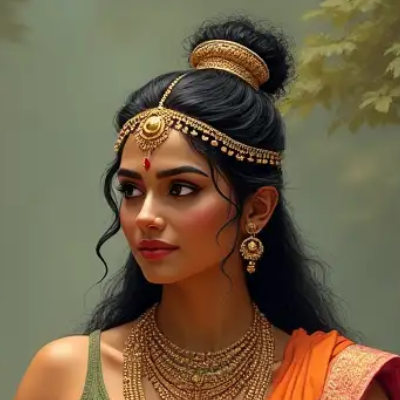
Madayanti is the queen of Mitrasaha, also known as Kalmashapada, a king of the Solar dynasty in the Ikshvaku line. She is recorded in the Mahabharata and in several major Puranas as a figure of considerable moral resolve whose intervention at a moment of dynastic crisis preserved the Ikshvaku royal lineage. When her husband was rendered incapable of fathering a son — either through a curse or through the continuing effects of his affliction — Madayanti approached the sage Vasishtha, the royal preceptor, and requested him to beget a son upon her through the ancient institution of niyoga, the authorised practice whereby a designated man fathers a son on behalf of an incapacitated husband. The son born of this union was Asmaka, who became the progenitor of the Asmaka people and the kingdom that bore his name. Madayanti's story appears in the Adi Parva and Vana Parva of the Mahabharata, in the Vishnu Purana, the Bhagavata Purana, and the Vayu Purana, with variant details across these sources.
✦ The Name
The name Madayanti is a feminine present participle formed from the Sanskrit root mada, signifying intoxication, exhilaration, or the state of gladness that arises from beauty, love, or wine. Madayanti thus carries the sense of she who gladdens, she who intoxicates, or she who exhilarates — a name that reflects the conventions of feminine beauty-naming in the Sanskrit epic and Puranic tradition. The variant form Madayantika, found in a small number of passages, is a diminutive or affectionate extension of the same root and carries no distinct semantic difference.
✦ Lineage
- Own parentage: Not recorded in any surviving primary source.
- Husband: Mitrasaha, also called Kalmashapada — a king of the Ikshvaku Solar dynasty, son of Sudasa. Mitrasaha received the epithet Kalmashapada, meaning one with spotted feet, following the curse placed upon him by the sage Shakti, son of Vasishtha, after a dispute over precedence. The curse caused him to become a flesh-eating Rakshasa for a period of twelve years. Vasishtha, the royal preceptor and father of the slain Shakti, eventually released Mitrasaha from the curse at the end of the appointed period.
- Son: Asmaka — born through niyoga from Vasishtha, who fathered the child at Madayanti's request in order to preserve the royal line. Asmaka became the progenitor of the Asmaka janapada, one of the sixteen great kingdoms of ancient India listed in the Puranic and Buddhist geographical traditions.
✦ The Episode of the Dynastic Crisis
The central narrative in which Madayanti appears concerns the continuation of the Ikshvaku royal line at a moment when it faced extinction. Her husband Mitrasaha had, while still under the influence of the Rakshasa curse, devoured a Brahmin and his wife, thereby incurring a further curse from the dying woman that he would die at the moment of sexual union with his own queen. This second curse rendered it impossible for Mitrasaha to father a son upon Madayanti even after Vasishtha released him from the first curse.
Faced with the prospect of the lineage ending, Madayanti approached Vasishtha and requested that he father a son upon her through niyoga, invoking his duty as the royal family's preceptor to preserve the dynasty he served. Vasishtha accepted. Madayanti conceived. The texts then record an extraordinary detail regarding the gestation: the child remained in the womb for an unusually prolonged period before birth. The Mahabharata account states that Madayanti bore the child for seven years without giving birth, and that eventually Vasishtha struck her abdomen with a stone to effect the delivery — a detail that gives the son his name, Asmaka, derived from the Sanskrit word for stone. The son thus born was healthy and went on to found the Asmaka line.
✦ Textual Variants and Inconsistencies
The accounts across the primary texts agree on the essential outline — Madayanti as wife of Kalmashapada, niyoga with Vasishtha, birth of Asmaka — but differ on several particulars.
The duration of the gestation is the most prominent variant. The Mahabharata gives seven years as the period Madayanti carried the child. Certain Puranic accounts, including passages in the Vishnu Purana, give twelve years. The reason for the prolonged gestation is also explained differently: some texts attribute it to the unusual potency of Vasishtha's seed; others present it without explicit explanation, as a miraculous circumstance.
The Vishnu Purana and the Bhagavata Purana give genealogical lists of the Ikshvaku line that include Asmaka as the son of Kalmashapada but do not always name Madayanti explicitly, referring instead to the king's queen without identifying her by name. The Mahabharata Adi Parva and Vana Parva are the principal sources that name her as Madayanti and give the narrative in detail.
In the Valmiki Ramayana's Bala Kanda, the story of Kalmashapada and the curse of the sage Shakti is narrated as part of the background of the Vasishtha lineage, but Madayanti is not named in that recension's handling of the episode; the focus there is on the conflict between Vishvamitra and Vasishtha rather than on the dynastic succession.
✦ Connection to the Wider Genealogy
Madayanti occupies a pivotal position in the Solar dynasty genealogy. Through her son Asmaka — begotten by Vasishtha through niyoga — the Ikshvaku line continued beyond the reign of Mitrasaha. Asmaka's own descendants formed the Asmaka kingdom, one of the major political units of the Puranic geographical tradition. The lineage descending from Asmaka eventually includes Mulaka and further descendants recorded in the Puranas. In the broader Ikshvaku genealogical sequence, Madayanti stands between the cursed and dynastically interrupted reign of Mitrasaha-Kalmashapada and the restored continuation of the Solar line through Asmaka, making her intervention the hinge on which that continuation turns.
✦ References
Primary Sources
- Mahabharata, Adi Parva, Chapters 174–177 (CE critical edition numbering): The principal narrative source for Madayanti; narrates the curse on Kalmashapada, the killing of Shakti, Vasishtha's role, and Madayanti's request for niyoga with the seven-year gestation and stone-birth detail.
- Mahabharata, Vana Parva (Aranyaka Parva), Chapter 57: Retells portions of the Kalmashapada-Vasishtha narrative including Madayanti's role in the restoration of the line.
- Vishnu Purana, Book IV, Chapter 4: Provides the Ikshvaku dynastic list including Kalmashapada and his son Asmaka; gives the niyoga account with the twelve-year gestation variant; does not always name Madayanti explicitly.
- Bhagavata Purana, Skandha IX, Chapter 9: Includes the Ikshvaku lineage with Asmaka listed as Kalmashapada's successor; the niyoga with Vasishtha is noted in the genealogical context.
- Vayu Purana, Chapter 88: Lists the Solar dynasty and records Asmaka as born through Vasishtha's intervention; corroborates the essential genealogical outline.
- Valmiki Ramayana, Bala Kanda, Chapter 56: Narrates the Kalmashapada episode in the context of the Vasishtha-Vishvamitra conflict; Madayanti is not named but the dynastic circumstances are relevant background.
Secondary Sources
- Vettam Mani, Puranic Encyclopaedia (1975), entry on Madayanti: Summarises the niyoga episode and the birth of Asmaka; confirms Madayanti's identification as wife of Kalmashapada.
- H. C. Raychaudhuri, Political History of Ancient India (1923): Discusses the Ikshvaku dynastic sequence and the position of Kalmashapada-Mitrasaha within it; relevant for contextualising Asmaka's place in the Solar line.
- Monier-Williams Sanskrit-English Dictionary: Documents the etymology of both madayanti (from mada) and asmaka (from asman, stone), relevant to the name analysis sections of this profile.