
About
Ashmaka — Son of Kalmashapada, King of the Solar Dynasty
Ashmaka · Kalmashapada-putra · Madayanti-putra · Vasishtha-kshetraja
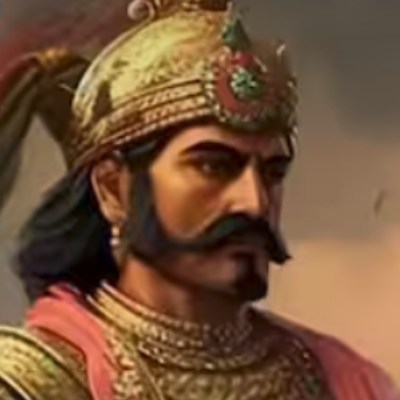
Ashmaka is a king of the Ikshvaku Solar dynasty, the son of Kalmashapada — the cursed king of Ayodhya also known as Mitrasaha and Soudasa — and of Madayanti, Kalmashapada's queen. His birth is extraordinary: because Kalmashapada was afflicted by a brahmin woman's curse that would cause him to die if he united with his own wife, Madayanti approached the sage Vasishtha — the royal preceptor of the Solar dynasty and the very sage whose son Shakti had been devoured by the possessed Kalmashapada — and requested that Vasishtha father a child upon her through the sanctioned practice of niyoga, so that the Solar lineage would not be extinguished. Ashmaka is thus described in the primary sources as the kshetraja son of Kalmashapada — that is, the son of the field, meaning the son born of Madayanti as the legitimate heir of Kalmashapada — while being biologically the son of Vasishtha. He appears in the Vishnu Purana, the Bhagavata Purana, the Vayu Purana, and the Valmiki Ramayana's Uttara Kanda as a link in the Solar succession. His position as an ancestor of the line leading eventually to Dilipa and Raghu is attested across these sources, though the number of kings between Ashmaka and Dilipa is not uniform across the Puranic lists.
✦ The Name
The name Ashmaka is derived from the Sanskrit root ashman, meaning stone or rock. The name may carry the sense of one who is firm or solid as stone, conveying stability and endurance — qualities appropriate to a king who represents the restored continuity of a dynasty that had been in grave danger of extinction. The name is also associated in the geographical and political tradition of ancient India with the Ashmaka janapada, one of the sixteen mahajanapadas listed in early Buddhist and Hindu texts, a territory placed in the region of the upper Godavari. Whether the janapada takes its name from this figure in the Puranic tradition or whether the connection is a later aetiological construction is not settled in the primary sources.
✦ Lineage
- Legal father: Kalmashapada, also known as Mitrasaha and Soudasa, king of Ayodhya of the Ikshvaku Solar dynasty, who was cursed by the sage Vasishtha's son Shakti, possessed by a Rakshasa for twelve years, and restored to his nature by Vasishtha's purification.
- Mother: Madayanti, queen of Kalmashapada, who requested the niyoga arrangement from Vasishtha to preserve the Solar lineage during the period when the king could not father a child without dying.
- Biological father: Vasishtha, the brahmarshi and royal preceptor of the Solar dynasty, one of the seven great sages of the tradition, who agreed to Madayanti's request and fathered Ashmaka through niyoga; Ashmaka is therefore simultaneously the legitimate dynastic heir of Kalmashapada and the biological son of Vasishtha.
- Paternal grandfather (legal): Sudasa, the Solar dynasty king from whom Kalmashapada inherits the throne and from whom the patronymic Soudasa is derived.
✦ The Circumstances of His Birth
The Uttara Kanda of the Valmiki Ramayana describes the gestation and birth of Ashmaka in terms that mark it as exceptional even by the standards of the epic tradition. After Vasishtha agrees to Madayanti's request and she conceives, the child remains in the womb for an extraordinarily extended period — the text specifies a duration of seven years in some recensions, while other sources give variant figures. Madayanti, unable to deliver the child naturally after this long gestation, strikes her womb with a stone — ashman — to bring about the birth, and from this act the child receives the name Ashmaka. This aetiological explanation of the name directly connects the birth narrative to the etymology: he is named for the stone used to effect his delivery. Through Ashmaka, born under these dramatic and extraordinary circumstances, the Solar dynasty is preserved and continues into the subsequent generations that will eventually produce Dilipa and Raghu.
✦ Position in the Solar Dynasty and Connection to Dilipa
Ashmaka is placed in the Solar succession immediately after Kalmashapada in all the major Puranic lists — the Vishnu Purana, the Bhagavata Purana, and the Vayu Purana are consistent on this point. The dynasty continues through him toward the line that eventually reaches Dilipa, the father of Raghu. However, as noted in the profile of Kalmashapada, the names and number of kings placed between Ashmaka and Dilipa are not uniform across these three Puranas. Each text inserts a somewhat different sequence in this portion of the Solar genealogy. The Vishnu Purana, Bhagavata Purana, and Vayu Purana each provide their own list, and while the broad shape of the lineage — from Ashmaka through several generations to Dilipa — is consistent, the specific intervening names differ. A reader using this profile as part of a genealogical reference system should treat the connection between Ashmaka and Dilipa as established in general terms across the primary sources, while recognising that the exact genealogical distance and the names of the intervening kings cannot be resolved into a single authoritative sequence from the available texts.
✦ References
Primary Sources
- Valmiki Ramayana, Uttara Kanda, Sargas 59–65: Narrates the niyoga arrangement between Madayanti and Vasishtha, the extended gestation, the striking of the womb with a stone, and the naming of Ashmaka; provides the most detailed account of his birth circumstances.
- Vishnu Purana, Book 4, Solar Dynasty genealogy: Places Ashmaka in the Ikshvaku succession as the son of Kalmashapada and a link in the line leading toward Dilipa and Raghu.
- Bhagavata Purana, Skandha 9, Solar Dynasty section: Includes Ashmaka in the genealogical register of the Solar line with brief reference to the circumstances of his birth.
- Vayu Purana, Solar Dynasty genealogical list: An independent Puranic register placing Ashmaka in the Solar succession after Kalmashapada; the list of intervening kings between Ashmaka and Dilipa differs in some names from the Vishnu and Bhagavata accounts.
- Mahabharata, Adi Parva: The Mahabharata's account of Kalmashapada and the niyoga arrangement provides contextual background for Ashmaka's birth, though the Mahabharata's treatment focuses more on Kalmashapada's story than on Ashmaka individually.
Modern Reference Works
- Vettam Mani, Puranic Encyclopaedia (Motilal Banarsidass, 1975), entry on Ashmaka: Notes the birth narrative, the niyoga arrangement, the etymology of the name, and the figure's position in the Solar dynasty genealogy; acknowledges the variation in the Puranic lists for this portion of the lineage.
- F. E. Pargiter, Ancient Indian Historical Tradition (Oxford University Press, 1922): Analyses the Puranic Solar dynasty genealogical lists comparatively and addresses the discrepancies in the sequence of kings between Ashmaka and the later Solar monarchs including Dilipa.