
About
Punarvasu Atreya — Sage-Physician of the Charaka Samhita, Teacher of the Six Founding Schools of Ayurveda
Punarvasu Atreya · Atreya · Krishnatreya · Chandrabhaga · Bhagavan Atreya
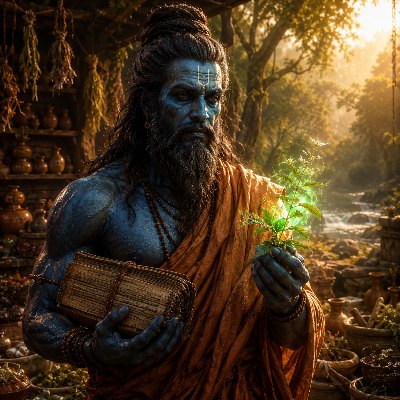
Punarvasu Atreya is the sage-physician identified in the Charaka Samhita as the principal source of the teachings on internal medicine, kaya-chikitsa, that were later systematised by his disciple Agnivesha and further edited and expanded by the physician Charaka into the text that bears his name. He is presented in the Ayurvedic tradition as the teacher from whom six distinct schools of early medical thought descend, each founded by one of his disciples, and he is honoured as a foundational figure of Ayurveda alongside Charaka and Sushruta. He appears principally in the Sutrasthana of the Charaka Samhita, is referenced in the Bhela Samhita and the Kashyapa Samhita, and is mentioned briefly in the Mahabharata under the name Krishnatreya as a celebrated teacher of medicine.
✦ The Name
The name Atreya is a patronymic meaning descendant of Atri, formed from the name of the Vedic sage Atri. Because the term Atreya can in principle denote any son, distant descendant, disciple, or clan-member of Atri, the Charaka Samhita takes care to specify this particular Atreya as the direct son of Atri, and it is this specification, along with the qualifying name Punarvasu, that distinguishes him from the wider body of Atreya sages to whom a large portion of the fifth mandala of the Rigveda is attributed. The name Punarvasu is understood by the tradition to mark him as born under the lunar asterism of that name, following a naming convention also seen elsewhere in the tradition, such as the naming of the Pandava prince Arjuna as Phalguna for the constellation under which he was born. The epithet Krishnatreya, by which he is called in the Mahabharata and frequently within the Charaka Samhita itself, is explained in the secondary tradition either as a reference to his descent from the Krishna branch of the Yajurveda, or as a reference to a dark complexion. The name Chandrabhaga identifies him as a son or resident associated with the river or region of that name, understood in some accounts as a reference to his dwelling on the banks of the river Chandrabhaga.
✦ Lineage
- Father: Atri — one of the great Vedic sages, a seer to whom a large portion of the hymns of the fifth mandala of the Rigveda is attributed, and traditionally counted among the Saptarishis.
- Teacher: Bharadvaja — the sage who, according to the Charaka Samhita's own account, journeyed to the god Indra to obtain the knowledge of Ayurveda on behalf of suffering humanity and subsequently transmitted it to Atreya and the other assembled sages.
- Disciples: Agnivesha, Bhela, Jatukarna, Parashara, Harita, and Ksharapani — the six students to whom Atreya taught Ayurveda, each of whom went on to compose his own treatise or Samhita; of these, Agnivesha's work was held in the highest regard and became the basis of the Charaka Samhita.
✦ The Transmission of Ayurveda from Indra and the Assembly of Sages
The opening chapter of the Sutrasthana of the Charaka Samhita narrates that, in an age when disease had begun to afflict living beings and disturb their capacity to pursue righteous conduct, wealth, and spiritual liberation, a great assembly of sages gathered on a slope of the Himalaya to deliberate on how suffering might be relieved. The assembly resolved that the sage Bharadvaja should journey to the abode of the god Indra to request the knowledge of Ayurveda on behalf of all beings. Bharadvaja did so, received the teaching from Indra in condensed form, and returned to impart it to the assembled sages, among whom Atreya was present. Atreya received and expounded this teaching most fully, and it is from his exposition, delivered afterward to his own students, that the substantive medical content of the Charaka Samhita is said to derive.
✦ The Six Disciples and the Founding of the Six Schools
Having received and mastered the teaching, Atreya instructed six principal disciples, Agnivesha, Bhela, Jatukarna, Parashara, Harita, and Ksharapani, each of whom composed an independent treatise recording the master's teaching as he had understood and received it. This gave rise to six schools of early Ayurvedic thought, each associated with one disciple's Samhita. Of these, the Agnivesha Tantra was regarded by the tradition as the most complete and authoritative, and it was this text that the physician Charaka, working some centuries later, took up, edited, and expanded into the treatise now known as the Charaka Samhita, with further material added still later by the redactor Dridhabala. The work of another disciple, Bhela, survives independently as the Bhela Samhita, portions of which are preserved in manuscript form and are quoted by later Ayurvedic commentators.
✦ Service as Physician to King Nagnajit of Gandhara
A tradition recorded by some modern historians of Ayurveda holds that Atreya served as the personal physician of King Nagnajit, a ruler of the Gandhara kingdom who is mentioned in the Mahabharata. This tradition is used by some scholars to propose an approximate historical placement for Atreya, though the dating of Atreya himself varies considerably across secondary sources, some placing him as early as the second millennium BCE and others closer to the sixth century BCE, and no primary source consulted gives an explicit or uncontested date for his life.
✦ Textual Variants and Inconsistencies
The Charaka Samhita contains a second and distinct tradition, given in its section on Rasayana, or rejuvenation therapy, in which it is Atri himself, rather than his son Atreya, who is said to have received the relevant knowledge directly from Indra. This account exists alongside, rather than in place of, the main Sutrasthana narrative in which Bharadvaja is the intermediary who brings the general teaching of Ayurveda from Indra to the assembly of sages including Atreya; the two traditions concern different bodies of medical knowledge, general therapeutics in one case and rejuvenation therapy in the other, and the text does not treat them as contradictory, though some later commentators have found the two accounts of divine transmission to sit awkwardly together.
A further point of ambiguity concerns the very identity of Atreya as a single historical figure. Because the term Atreya can denote any descendant or disciple of the sage Atri, and because the names Atreya and Punarvasu are used almost interchangeably within a single chapter of the Charaka Samhita without being formally equated, some scholars of the text have raised the question of whether all occurrences of the name in the Samhita refer to one consistent individual or whether the name functioned in part as a title carried by more than one teacher within the same lineage. The predominant reading, followed here, treats the references as designating a single teacher, the son of Atri, distinguished by the epithet Punarvasu.
✦ Theological and Historical Significance
Atreya occupies a foundational position in the historical self-understanding of the Ayurvedic tradition, serving as the link between the divine origin of medical knowledge, traced to Indra, and its human transmission through a chain of named teachers and disciples that culminates in the Charaka Samhita, one of the two most authoritative classical texts of Ayurveda alongside the Sushruta Samhita. His role as teacher of six disciples who each produced independent treatises reflects a broader pattern within the Ayurvedic tradition of attributing textual authority to a chain of named masters and their students, and his position as the source of the material eventually codified by Agnivesha and Charaka accounts for his continued invocation as the ultimate authority behind that treatise's teachings on kaya-chikitsa.
✦ Connection to the Wider Genealogy
Punarvasu Atreya is connected to the wider Puranic and Vedic genealogical tradition through his father Atri, one of the great Vedic seers and, in the broader Puranic scheme, one of the mind-born sons of Brahma and traditionally reckoned among the Saptarishis, the seven great sages. Through Atri's association with the Rigveda's fifth mandala, Atreya belongs to the wider Atreya clan of seers to whom numerous Vedic hymns are attributed. Through his disciple Agnivesha and his indirect connection to the physician Charaka, he stands at the head of the transmission chain underlying one of the two principal classical schools of Ayurvedic medicine, the other being the surgical tradition of Sushruta.
✦ References
- Charaka Samhita, Sutrasthana, Chapter 1: the principal primary source, narrating the assembly of sages on the Himalaya, Bharadvaja's mission to Indra, the transmission of Ayurveda to Atreya, and his teaching of the six disciples.
- Charaka Samhita, Chikitsasthana, Rasayana section: preserves the variant tradition of Atri receiving knowledge of rejuvenation therapy directly from Indra.
- Mahabharata: references Krishnatreya as a celebrated teacher of the medicine of internal disorders, cited as an early attestation of Atreya's reputation outside the Ayurvedic corpus itself.
- Bhela Samhita: the surviving treatise of Atreya's disciple Bhela, contributing to the record of the six schools founded by Atreya's students.
- Kashyapa Samhita: uses the names Atreya and Punarvasu in close conjunction, contributing to the secondary tradition's identification of the two as referring to the same teacher.
- Wisdomlib, "The Identity of Atreya" (essay on the Charaka Samhita and Sushruta Samhita): consulted for the scholarly discussion of Atreya's identity, the near-interchangeable use of the names Atreya and Punarvasu, and his derivation as a descendant of the Vedic sage Atri.
- Modern secondary accounts of the history of Ayurveda (Ayurvedopedia, EasyAyurveda): consulted for the traditional list of Atreya's six disciples, his epithets, and the tradition of his service to King Nagnajit of Gandhara, while noting the wide variation in proposed dates for his life across these sources.