
About
Chandrabhaga — Wife of Kushadhvaja, Mother of Mandavi and Shrutakirti
Chandrabhaga
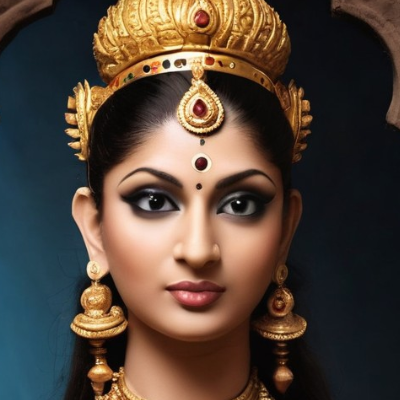
Chandrabhaga is the wife of King Kushadhvaja, ruler of the kingdom of Sankasya and the younger brother of Janaka, the king of Mithila and father of Sita. She is recorded in the Ramayana tradition as the mother of two daughters, Mandavi, the elder, and Shrutakirti, the younger. Together with their cousins Sita and Urmila, Chandrabhaga's daughters were married in the celebrated joint wedding ceremony of the Bala Kanda to the four sons of King Dasharatha of Ayodhya: Mandavi became the wife of Bharata, and Shrutakirti the wife of Shatrughna. Chandrabhaga's significance in the Ramayana tradition rests principally on this maternal role, situating her household within the Videha royal family alongside that of Janaka and his wife Sunayana, the parents of Sita and Urmila.
✦ The Name
The name Chandrabhaga is a Sanskrit compound of chandra, meaning moon, and bhaga, meaning portion, share, or fortune, together suggesting one who possesses a portion or share of lunar radiance, or one favoured by the moon. The name is also borne in the wider tradition by a river of the same name in the northwestern subcontinent, though no direct connection between the river and this figure is recorded in the primary sources consulted.
✦ Lineage
- Husband: Kushadhvaja — king of Sankasya; younger brother of Janaka, king of Mithila; son of King Hrasvaroman of Mithila and his wife Keikasi; he was installed as ruler of Sankasya by his brother Janaka after Janaka defeated the previous king of that realm, Sudhanvan, in battle
- Brother-in-law: Janaka — king of Mithila; Kushadhvaja's elder brother; father of Sita, the wife of Rama
- Sister-in-law: Sunayana — wife of Janaka; mother of Sita and Urmila
- Elder daughter: Mandavi — described in the wider devotional tradition as an incarnation of the shankha, the conch shell associated with the goddess Lakshmi; married to Bharata, the second son of Dasharatha; mother of two sons, Taksha and Pushkala
- Younger daughter: Shrutakirti — described in the wider devotional tradition as an incarnation of the chakra, the discus associated with the goddess Lakshmi; married to Shatrughna, the fourth son of Dasharatha; mother of two sons, Subahu and Shatrughati
✦ The Joint Wedding at Mithila
Chandrabhaga's daughters Mandavi and Shrutakirti were raised at Mithila alongside their cousins Sita and Urmila, the daughters of Janaka and Sunayana. When the marriage of Rama to Sita was arranged following Rama's success at Janaka's bow-sacrifice, the sages and the assembled kings determined that the occasion should be marked by a fourfold wedding: Rama married Sita, Lakshmana married Urmila, Bharata married Mandavi, and Shatrughna married Shrutakirti. According to a tradition recorded in later devotional retellings, Chandrabhaga and Kushadhvaja were away on pilgrimage at the time the marriage arrangements were finalised, and Janaka made the decision on their behalf, the news being received by the couple with great joy upon their return.
✦ Theological Significance
Within the wider devotional tradition surrounding the Ramayana, Sita is understood as the principal incarnation of the goddess Lakshmi, while her sister and cousins-in-law who married Rama's brothers are understood as parallel manifestations of objects and entities associated with Vishnu and Lakshmi. In this framework, Urmila is identified with Adishesha, the great serpent upon whom Vishnu reclines; Mandavi, Chandrabhaga's elder daughter, is identified with the shankha, the conch shell of Lakshmi; and Shrutakirti, her younger daughter, is identified with the chakra, the discus of Lakshmi. Through this theological reading, Chandrabhaga's household is understood in the devotional tradition as having produced, alongside the household of Janaka, the full complement of feminine manifestations accompanying Rama's incarnation and that of his brothers.
✦ Textual Variants and Inconsistencies
The weapon and emblem associated with each daughter is given inconsistently across secondary devotional sources. Mandavi is most commonly identified as the incarnation of the shankha, the conch shell, and Shrutakirti as the incarnation of the chakra, the discus, in the majority of sources consulted. Some retellings, however, reverse this assignment or substitute other emblems, a variation that appears to arise from differing regional and devotional traditions rather than from any single authoritative primary-text source specifying the assignment definitively.
The fate of Mandavi and Shrutakirti in the later narrative is also given inconsistently. Some accounts, drawing on the Uttara Kanda, state that the two sisters, along with Rama and his brothers, ended their earthly lives by entering the river Sarayu. Other secondary retellings state that Mandavi and Shrutakirti passed away before this final episode, leaving Urmila as the one who lived on to look after the children of the family. These versions are not reconciled in the sources consulted.
✦ Connection to the Wider Genealogy
Through her husband Kushadhvaja, Chandrabhaga is connected to the royal house of Videha, descended in the Suryavamsha, the solar dynasty, and closely allied through Kushadhvaja's brother Janaka to the Mithila branch of that same royal line. Through her daughters' marriages, Chandrabhaga's household is joined directly to the Raghuvamsha, the lunar-descended royal house of Ayodhya headed by Dasharatha, making her the mother-in-law of two of Rama's three brothers and placing her grandsons Taksha, Pushkala, Subahu, and Shatrughati within the extended Ayodhya royal family. Through her daughter-in-law's relationship to Sita, who is married to her nephew-in-law Rama, Chandrabhaga's family is closely bound to the central royal lineage of the entire Ramayana narrative.
✦ References
- Valmiki Ramayana, Bala Kanda: Primary source for the account of Kushadhvaja's kingdom of Sankasya, the joint wedding of the four sons of Dasharatha to Sita, Urmila, Mandavi, and Shrutakirti, and the family relationships of the Videha royal house.
- Valmiki Ramayana, Uttara Kanda: Source for the account of the final episode of the Ayodhya royal family at the river Sarayu, in which Mandavi and Shrutakirti are recorded by some traditions as having taken part.
- Wikipedia — Kushadhvaja, Mandavi, and Shrutakirti articles: Secondary sources consolidating the genealogical details of Chandrabhaga's family, the naming of her grandsons, and the weapon-incarnation tradition associated with her daughters.
- Vettam Mani, Puranic Encyclopaedia. Motilal Banarsidass, 1975: Consulted for cross-verification of the Videha royal genealogy and the family of Kushadhvaja.