
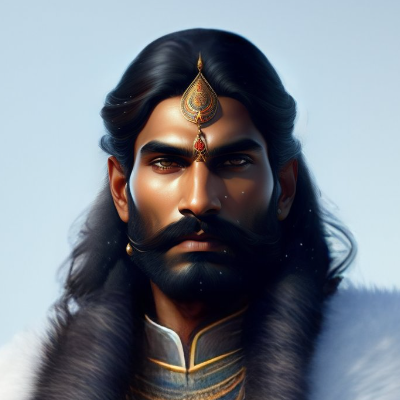
About
Uru — Son of Chakshusha Manu, Father of Anga, Ancestor of Prithu
Uru · Chakshusha-putra · Anga-pita · Dhruva-vamshaja · Shashtha-Manava
Uru is a prince of the sixth manvantara, named in the Bhagavata Purana's fourth skandha as one of the sons of Chakshusha Manu — the sixth Manu, son of Ripu and Brihati, and a descendant of Dhruva through the line of Shilisti — and the figure through whom the Bhagavata Purana continues the genealogical line of Chakshusha's descendants. He is the father of six sons, of whom the most significant is Anga — the progenitor of the Anga lineage and the father of Vena, whose own son Prithu is one of the most celebrated kings in the entire Bhagavata Purana tradition, regarded as the first true sovereign of the earth and the figure from whose name the earth herself receives the name Prithvi. Through this downstream connection, Uru stands at a crucial genealogical juncture — above him the line ascends through Chakshusha Manu, Ripu, Shilisti, and Dhruva to Manu Svayambhuva and Brahma, and below him the line descends through Anga and Vena to Prithu, one of the most theologically and narratively significant kings in the Puranic tradition. He appears also in the Vishnu Purana in the same genealogical context.
✦ The Name
The name Uru is Sanskrit, meaning wide, broad, extensive, or great — from the root ur or uru carrying the sense of breadth and expansiveness. In the Vedic tradition uru is used in compounds and epithets to convey vastness and greatness — the Rigvedic phrase uru-krama meaning of wide stride or taking vast steps is used of Vishnu in the famous three-stride cosmological hymn. As a personal name, Uru encodes the quality of breadth and greatness of scope appropriate to a son of a Manu and a progenitor of a significant royal lineage. The name belongs to the monosyllabic naming tradition common among the earliest figures of the primordial Solar and Manu lineages, where brevity and elemental simplicity of name are characteristic of the most ancient genealogical stratum.
✦ Lineage
- Father: Chakshusha Manu, the sixth Manu — the presiding sovereign of the sixth manvantara within the current kalpa — son of Ripu and Brihati, and a descendant of Dhruva through the line of Shilisti. Chakshusha Manu's manvantara has already concluded in the Puranic cosmic framework, the current age being the seventh manvantara presided over by Vaivasvata Manu.
- Paternal grandfather: Ripu, the eldest son of Shilisti and Suchhaya, prince of the lineage of Dhruva, whose wife was Brihati.
- Paternal great-grandfather: Shilisti, one of the sons of Dhruva, whose wife was Suchhaya.
- Paternal great-great-grandfather: Dhruva, the celebrated boy-devotee of Vishnu, son of King Uttanapada and his wife Suniti, who was granted the eternal position of the pole star — the Dhruva nakshatra.
- Wife: Agneyi, named in the Bhagavata Purana as the wife of Uru — a name derived from Agni, the fire god, suggesting a lineage connection to the fire deity or to the Agni gotra tradition. Her parentage is not specified with clarity in the primary sources consulted.
- Son Anga: The most genealogically significant of Uru's six sons, named in the Bhagavata Purana as the progenitor of the Anga lineage and the father of Vena — the deeply troubled king whose misrule prompts the sages to churn his body and produce from it the great sovereign Prithu. Anga is also described in the Bhagavata Purana as a righteous king whose grief at his wicked son Vena's conduct is one of the narrative's most poignant elements.
- Son Atreya: Named in certain Puranic sources as one of the six sons of Uru, though the lists of Uru's sons vary slightly across the Bhagavata Purana and Vishnu Purana.
- Other sons: The Bhagavata Purana names six sons of Uru and Agneyi in total — Anga, Sumana, Khyati, Kratu, Angiras, and Shivi in certain recensions, though the names and their number vary across different Puranic lists and the identification of specific sons with specific names is not entirely uniform across the major sources.
✦ Significance Through the Downstream Lineage
Uru's primary significance in the tradition is genealogical — he is the link between Chakshusha Manu above him and the Anga lineage below him that eventually produces Prithu. The story of Prithu is one of the Bhagavata Purana's most celebrated royal narratives. Prithu — born when the sages churned the body of the wicked king Vena after Vena's misrule had plunged the world into disorder and drought — is regarded in the Puranic tradition as the first true king, the sovereign who establishes the relationship between the ruler and the earth, who milks the earth as a cow to restore its productivity, and from whose name the earth receives her name Prithvi meaning the wide one or the earth of Prithu. Prithu is identified in the Vaishnava tradition as a partial avatara of Vishnu and his story occupies several chapters of the Bhagavata Purana's fourth skandha immediately following the Dhruva narrative.
The genealogical chain that connects Uru to Prithu runs through his son Anga and Anga's son Vena. Vena is described in the Bhagavata Purana as a king of great initial promise who falls into irreligion and misrule — he forbids all sacrifice and worship of the gods, declaring himself the supreme deity and demanding that all offerings be made to him alone. The sages, unable to tolerate this, kill Vena with their sacred grass blades charged with mantric power. They then churn his body — first producing a dark dwarf-like being representing Vena's sinful nature, and then producing the radiant Prithu, who emerges fully formed as a great sovereign destined to restore the cosmic order. Uru, as Anga's father and Vena's grandfather, stands three generations above one of the Bhagavata Purana's most dramatic narrative sequences.
✦ Textual Variants
The Bhagavata Purana and the Vishnu Purana agree on the main genealogical sequence — Chakshusha Manu, Uru, Anga, Vena, Prithu — but vary in certain details of Uru's sons and in the name of his wife. The Vishnu Purana's account of this portion of the lineage provides a parallel register that confirms the core sequence while differing in some of the subsidiary names. The name Agneyi for Uru's wife is given in the Bhagavata Purana but may be rendered differently in other recensions. The list of Uru's six sons varies in certain names across different editions and translations of the Bhagavata Purana, reflecting the general pattern of variation in the primordial genealogical registers of that text.
✦ References
Primary Sources
- Bhagavata Purana, Skandha 4, Chapter 13: Names Uru as a son of Chakshusha Manu; identifies Agneyi as his wife and names his six sons including Anga; the principal primary source for his genealogical placement and his family.
- Bhagavata Purana, Skandha 4, Chapters 13–15: Continues the genealogical register from Uru through Anga, Vena, and Prithu; provides the narrative context that gives Uru's position in the lineage its downstream significance.
- Vishnu Purana, Book 1, sections on Chakshusha Manu's lineage: Names Uru in the genealogical continuation of Chakshusha's line and traces the sequence through Anga to Vena and Prithu; provides a parallel account with some variation in detail.
Modern Reference Works
- Vettam Mani, Puranic Encyclopaedia (Motilal Banarsidass, 1975), entries on Uru and Anga: Notes Uru's identification as a son of Chakshusha Manu and the father of Anga; addresses the downstream significance of the lineage through Vena to Prithu.
- Ganesh Vasudeo Tagare (trans.), Bhagavata Purana, Part 2 (Motilal Banarsidass, 1976): Critical translation of the fourth skandha including the genealogical continuation through Chakshusha, Uru, Anga, Vena, and Prithu; the notes address the significance of each figure in the sequence.
- F. E. Pargiter, Ancient Indian Historical Tradition (Oxford University Press, 1922): Analyses the Puranic genealogical lists for the descendants of Chakshusha Manu comparatively across the major Puranas and addresses the sequence leading from Uru through Anga to Vena and Prithu.