
About
Purvachitti — Celestial Apsara, Consort of Agnidhra and Mother of the Nine Varshas
Purvachitti · Purvacitti · Poorvachitti · Purvacittika
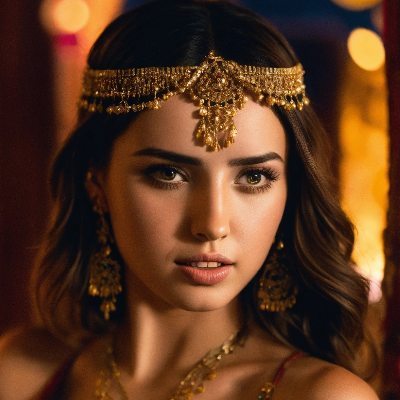
Purvachitti is a celestial Apsara of exceptional standing in the Hindu Puranic and epic tradition, counted among the six most celebrated divine nymphs of the heavenly court alongside Urvashi, Sahajanya, Ghritachi, Vishvachi, and Menaka. She is distinguished from the majority of Apsaras by the cosmological weight of her most consequential narrative episode: she is the consort of Agnidhra — the eldest son of King Priyavrata, ruler of Jambudvipa, and a figure belonging to the primordial Svayambhuva Manvantara lineage that the Bhagavata Purana places at the very beginning of the current cosmic cycle — and the mother of nine sons whose names became the names of the nine great varshas, the geographical divisions of Jambudvipa itself. Among these nine sons was Nabhi, whose son Rishabhadeva is identified in the Bhagavata Purana as a divine incarnation and whose grandson Bharata gave his name to the land of Bharatavarsha — the subcontinent known today as India. Purvachitti thus stands, through her nine sons, at the genealogical and cosmological origin of the very land of Bharata. Her story is told most substantially in the fifth skandha of the Bhagavata Purana, and she is also named in the Mahabharata among the six foremost Apsaras of Indra's court, as a presence at Arjuna's birth celebrations, and as a dancer who honoured Arjuna during his visit to Svarga. She appears in Puranic genealogical accounts as a daughter of Kashyapa by his wife Muni, and in enumerative catalogues of the celestial nymphs across the Mahabharata, the Brahmanda Purana, and related texts.
✦ The Name
The name Purvachitti is a Sanskrit compound formed from two elements: purva, meaning former, first, eastern, ancient, or prior, and chitti, a feminine nominal form related to chitta, meaning mind, consciousness, thought, or first perception. The compound carries several interlocking connotations. She of the first mind or she of the ancient consciousness suggests a figure of primordial seniority among her class — one whose awareness or existence precedes that of others. The element purva in the directional sense of eastern carries the additional resonance of the east as the direction of the rising sun, of primacy, and of auspicious beginning in Vedic directional symbolism. Together the name implies a figure of the highest seniority and perceptual primacy within the Apsara community, a reading consistent with her placement among the six foremost Apsaras in the Mahabharata's enumeration. The Cologne Sanskrit Dictionary additionally notes that the compound purvachitti can carry the meaning of foreboding or presentiment — she who perceives or knows before others — which adds a further dimension of prescient awareness to the name's semantic range. No major alternative personal names are recorded for Purvachitti in the primary sources, though the variant form Purvacittika appears in certain textual catalogues as a diminutive or alternate designation.
✦ Lineage and Relationships
- Birth lineage: The Bhagavata Purana's genealogical account of Kashyapa's progeny names Purvachitti among the Apsaras born of Kashyapa by his wife Muni, one of the thirteen daughters of Daksha — the Prajapati appointed by Brahma to oversee the generation of created beings. Kashyapa was the son of the sage Marichi, one of the ten mind-born sons of Brahma, placing Purvachitti's birth lineage within the most foundational tier of the Puranic genealogical system. Muni as the specific mother of this group of Apsaras distinguishes them from the Apsaras born of Kashyapa's wife Arishtha — who include Alambusa, Misrakesi, Tilottama, and Rambha among others — and from those assigned to Kashyapa's wife Pradha in other Puranic accounts.
- Celestial rank: Purvachitti is named in the Mahabharata's Adi Parva among the six foremost Apsaras of the celestial court, a grouping that places her at the summit of her class alongside Urvashi, Sahajanya, Ghritachi, Vishvachi, and Menaka. This is a distinction shared by very few among the many hundreds of Apsaras named across the tradition and marks her as a figure of the highest celestial standing.
- Consort: Agnidhra, the eldest son of King Priyavrata — the great primordial king of the Svayambhuva Manvantara lineage, son of Svayambhuva Manu and grandson of Brahma himself in the Bhagavata Purana's cosmological genealogy — and ruler of Jambudvipa, the greatest of the seven island-continents that constitute the inhabited world in the Puranic geographical scheme. Agnidhra was a righteous and capable king who, desiring to continue his dynasty and to attain Pitrloka — the realm of the forefathers — through the merit of fathering worthy sons, undertook austerities at the foot of Mount Mandara to attract a divine consort.
- Nine sons born of Purvachitti and Agnidhra: Nabhi, Kimpurusha, Harivarsha, Ilavrita, Ramyaka, Hiranmaya, Kuru, Bhadrashva, and Ketumala. Each of these sons became the ruler of one of the nine divisions of Jambudvipa, and each division took its name from the son who ruled it. Of these nine, Nabhi is by far the most consequential genealogically and cosmologically, as described below.
✦ The Episode of Agnidhra — The Bhagavata Purana Account
The fifth skandha of the Bhagavata Purana contains the principal and most substantially narrated account of Purvachitti, giving her story in greater detail than any other primary source. The narrative begins with King Priyavrata, a great and righteous ruler of the earliest cosmic age who eventually renounced his kingdom in pursuit of liberation and passed the rule of Jambudvipa to his son Agnidhra. Agnidhra ruled with complete dedication and righteousness, but as he aged without sons he became concerned about the continuation of his dynasty and about his own spiritual destination after death. Wishing to attain Pitrloka — the blessed realm where virtuous forefathers dwell — through the merit of having fathered and raised worthy sons, Agnidhra resolved to undertake yogic austerities to attract a divine wife capable of bearing children of extraordinary quality.
Agnidhra proceeded to the foot of Mount Mandara — one of the great sacred mountains of the Puranic cosmological geography, described as a place where the Apsaras from heaven often descended to enjoy its natural beauty and the divine fragrance of its forests — and there entered into deep meditation. Brahma, the creator god, perceiving Agnidhra's devotion, his worthiness, and the sincerity of his desire for sons who would perpetuate righteous rule, sent the Apsara Purvachitti to become his wife and bear his children. This commission by Brahma is a significant detail: unlike the many episodes in which Indra sends Apsaras to disrupt the austerities of sages whose power threatens the celestial hierarchy, Brahma's dispatch of Purvachitti to Agnidhra is an act of divine provision rather than disruption — a reward for righteousness rather than a weapon against spiritual accumulation.
Agnidhra, deep in his yogic practice, became aware of Purvachitti's presence through the sound of her anklets and the movement of her graceful form among the trees. He was immediately captivated by her extraordinary beauty. The Bhagavata Purana records that Agnidhra praised her with eloquent and devoted words, expressing his deep attraction and his conviction that Brahma himself had sent this divine being to him. He addressed her with reverence and ardour, acknowledging her celestial origin and declaring that his heart and gaze were inseparably fixed upon her. Purvachitti, for her part, was drawn to Agnidhra by his noble form, his intelligence, his learning, the beauty of his youth, and the generosity of his spirit. The Bhagavata Purana describes her as genuinely captivated by these qualities, presenting her attraction as authentic rather than merely dutiful compliance with Brahma's commission.
Purvachitti accepted Agnidhra's proposal and the two lived together as husband and wife for a period described in the Bhagavata Purana as many thousands — and in some readings many tens of thousands — of years, during which they enjoyed both worldly and heavenly happiness together in the region of Mandara. From this union were born the nine sons whose names became the names of the nine varshas of Jambudvipa. When the sons had grown to maturity and were capable of ruling their respective regions, Purvachitti communicated to Agnidhra that she had fulfilled the purpose for which she had come to him, that her duties as his wife and as the mother of his sons were complete, and that the time had arrived for her to return to the celestial realm. She then departed, ascending back to Brahmaloka — the realm of Brahma — from which she had been sent.
Agnidhra was unable to accept her departure with equanimity. The Bhagavata Purana records that after Purvachitti left, the king was consumed by longing for her and thought of her constantly, meditating upon her form and beauty in a manner that in spiritual terms constituted a form of profound and exclusive devotion — though directed toward a celestial being rather than toward the divine. Because of this intense, sustained contemplation of Purvachitti after her departure, Agnidhra after his own death was granted residence in Pitrloka alongside his celestial wife — the very destination he had originally sought through the merit of fathering worthy sons. His attainment of Pitrloka thus came both through the sons he had fathered and through the overwhelming devotion to Purvachitti that persisted after her departure, a detail that the Bhagavata Purana's commentarial tradition has treated as theologically significant: even attachment to a celestial being, if sufficiently pure and total in its orientation, can produce a form of liberation appropriate to its object.
✦ The Nine Sons and Their Cosmic Significance
The nine sons born of Purvachitti and Agnidhra — Nabhi, Kimpurusha, Harivarsha, Ilavrita, Ramyaka, Hiranmaya, Kuru, Bhadrashva, and Ketumala — are among the most cosmologically significant progeny of any Apsara in the tradition, because the regions of the known world that the Bhagavata Purana describes are named after them. Agnidhra divided Jambudvipa into nine portions and gave each son his own region to rule. The region given to Ilavrita became the central zone of Jambudvipa; Kimpurusha's region to the north of the Himalayas became Kimpurushvarsha; Bhadrashva's region lay to the east; Ketumala's to the west; Kuru's region to the far north became Kurukshetra in some traditions; and so forth. The geographical world of the Puranic cosmological system is thus — through the naming convention of these regions — a direct inheritance from Purvachitti's nine sons.
Of these nine sons, Nabhi is by far the most consequential. Agnidhra gave Nabhi the region that would eventually become Ajanabhavarsha, later known as Bharatavarsha. Nabhi and his wife Merudevi — one of the nine daughters of Mount Meru whom the nine sons of Agnidhra married — performed great sacrifices and austerities desiring a son equal to none. The Bhagavata Purana records that Vishnu himself, pleased by their devotion, appeared before them and declared that he would take birth as their son in a partial divine incarnation. The son born of Nabhi and Merudevi was Rishabhadeva — regarded in the Bhagavata Purana as an avatar or partial manifestation of Vishnu, and in the Jain tradition as the first Tirthankara, the first of the twenty-four enlightened teachers of the current cosmic age. Rishabhadeva in turn fathered a hundred sons, the eldest of whom was Bharata — the great emperor after whom Bharatavarsha, the subcontinent of India, takes its name. The genealogical chain from Purvachitti through Agnidhra, Nabhi, Rishabhadeva, and Bharata thus connects the Apsara directly to the naming and the very identity of the land of India.
✦ Appearances in the Mahabharata
Purvachitti's appearances in the Mahabharata are distinct from and independent of the Bhagavata Purana's Agnidhra narrative, belonging to the epic tradition's own treatment of the celestial court and its inhabitants. In the Adi Parva of the Mahabharata she is named in a celebrated passage — at chapter 74, verse 68 — among the six foremost Apsaras of Indra's court: Urvashi, Purvachitti, Sahajanya, Ghritachi, Vishvachi, and Menaka. This enumeration of six supreme Apsaras, as distinct from the broader catalogues that name scores or hundreds, places Purvachitti at the very summit of the celestial nymph hierarchy as understood by the Mahabharata tradition.
The Adi Parva also records that Purvachitti was present at the birth celebrations of Arjuna — the great Pandava archer and son of Indra — an event at which the gods, celestial musicians, and Apsaras gathered to mark the birth of the hero. Her presence at this occasion confirms her established standing as one of the principal Apsaras whose attendance was expected and appropriate at the most significant celestial and semi-divine events. The Vana Parva further records that when Arjuna visited Svarga — the celestial realm of his divine father Indra — to receive divine weapons from Indra in preparation for the Kurukshetra war, Purvachitti was among the Apsaras who danced in his honour at the celestial court. Both appearances confirm her active presence and high standing within the divine assembly of Indra's Svarga across different periods of the Mahabharata's narrative.
✦ Appearances in the Garga Samhita
The Garga Samhita — a Vaishnava text dedicated to the narrative of Krishna — contains a passage in which Purvachitti is mentioned in the context of King Raivata's visit to Brahmaloka to seek a suitable husband for his daughter Revati. The passage describes Purvachitti as singing in Brahma's court at the moment Raivata arrived, and the king found the opportunity of Brahma's attentive listening to her song to present his appeal. This brief appearance places Purvachitti specifically in Brahmaloka — Brahma's own celestial realm — rather than merely in Indra's court, consistent with the Bhagavata Purana's account in which she was dispatched to Agnidhra from Brahma's realm and returned to it after her sojourn on earth. It suggests a tradition in which Purvachitti's primary celestial affiliation was with Brahma's court rather than Indra's, distinguishing her somewhat from the majority of Apsaras whose court is consistently identified as Indra's Svarga.
✦ Textual Variants and Inconsistencies
The principal textual variation surrounding Purvachitti concerns her birth lineage. The Bhagavata Purana places her among the daughters of Kashyapa by his wife Muni. Certain other Puranic accounts place the Apsara class more generally under Kashyapa's wife Pradha rather than Muni, and the assignment of individual Apsaras to specific maternal lines varies between Puranic compilations without universal consistency. The Matsya Purana's account of the daughters of Arishtha — which names Alambusa, Misrakesi, Tilottama, and Rambha among others — does not include Purvachitti in that specific maternal group, consistent with the Bhagavata Purana's placement of her under Muni rather than Arishtha. These different maternal assignments reflect the broader inconsistency in Puranic genealogical schemes regarding the specific maternal lines of individual Apsaras, a question the tradition does not resolve uniformly.
The names of the nine sons of Purvachitti and Agnidhra also vary somewhat between the Bhagavata Purana and other Puranic sources. The Bhagavata Purana's fifth skandha names them as Nabhi, Kimpurusha, Harivarsha, Ilavrita, Ramyaka, Hiranmaya, Kuru, Bhadrashva, and Ketumala. The Vishnu Purana's account of Agnidhra's sons gives a partially different list — naming Nabhi, Kimpurusha, Ilavrita, Ramya, Shashtha, Hiranvana, Hari, Kuru, and Bhadrashva — with several names differing or appearing in different forms between the two texts. Nabhi is consistent across all versions as the most significant son, and the geographical principle — each son ruling a varsha named after him — is consistent across all accounts. The variation in the specific names of the other eight sons reflects the standard pattern of divergence between Puranic geographical and genealogical lists that compiled this material from different regional and textual traditions.
A further question concerns the relationship between Purvachitti's appearances in the Mahabharata — where she belongs to Indra's court — and her placement in the Bhagavata Purana and Garga Samhita within Brahma's celestial realm. These two affiliations are not explicitly harmonised in the primary sources. It is possible that the tradition regarded Brahmaloka and Svarga as connected celestial regions through which high-ranking Apsaras moved freely, or that the different texts simply reflect different institutional affiliations without treating them as contradictory. The Bhagavata Purana's account of Brahma personally dispatching Purvachitti to Agnidhra is consistent with a primary affiliation to Brahma's court, while her listing among the six foremost Apsaras of Indra's court in the Mahabharata is consistent with a presence in Svarga as well. The two are not mutually exclusive in the tradition's cosmological framework.
✦ Theological and Philosophical Significance
Purvachitti's theological significance is among the deepest of any Apsara in the tradition, operating on multiple levels simultaneously. At the cosmological level, her nine sons are the progenitors of the nine geographical divisions of Jambudvipa — the central and most important of the seven island-continents in the Puranic world map — making her the maternal origin of the inhabited world's very geographical structure. The land of Bharatavarsha, named after her great-great-grandson Bharata, is the sacred land in which all the epics and Puranas are set, the land in which dharma is most fully practised and liberation most readily attainable. That this land traces its name through a lineage rooted in an Apsara union gives Purvachitti a cosmogonic significance that most Apsaras, however celebrated, do not approach.
At the theological level of the Bhagavata Purana, the episode of Agnidhra and Purvachitti carries a distinctive philosophical dimension. Brahma's dispatch of Purvachitti to Agnidhra as a reward for his piety is presented as an act of divine grace in response to righteous desire — the king's wish for worthy sons and for the attainment of Pitrloka is fulfilled through divine provision rather than requiring the king to use deception or force. This distinguishes the episode from many Apsara narratives and frames Purvachitti's descent to earth as a sacred mission rather than a disruption. Her eventual departure — communicated to Agnidhra with clarity and honesty about the terms of her presence — and Agnidhra's consequent longing are treated by the Bhagavata Purana's commentarial tradition as an illustration of the power of single-pointed contemplation: Agnidhra's unwavering meditation upon Purvachitti after her departure, while an attachment to a relative rather than an ultimate reality, nonetheless carried him to the realm where she dwelt, demonstrating that even misdirected concentration — if sufficiently total — produces a result proportionate to its object.
Her placement among the six foremost Apsaras in the Mahabharata reflects a tradition that recognised her as a figure of the highest celestial rank, not merely a minor character in a single episode but one of the supreme exemplars of her class. This recognition is consistent with the magnitude of the genealogical and cosmological consequences her union with Agnidhra produced.
✦ Connection to the Wider Genealogy
Purvachitti's genealogical connections are among the most cosmologically extensive of any Apsara in the tradition. Through her nine sons, she is the maternal ancestress of the nine royal lines that ruled the nine geographical divisions of Jambudvipa. Through her son Nabhi specifically, she is the great-grandmother of Rishabhadeva — identified in the Bhagavata Purana as a partial avatar of Vishnu — and the great-great-grandmother of the emperor Bharata, after whom Bharatavarsha takes its name. This chain connects Purvachitti to the very identity of the sacred land of India and to a divine incarnation within the Vaishnava tradition.
Agnidhra's own lineage connects Purvachitti's descendants to the most primordial tier of the Puranic genealogical framework. Agnidhra was the son of Priyavrata, who was the son of Svayambhuva Manu — the first Manu of the current cosmic cycle, created directly by Brahma from his own body at the beginning of creation. Svayambhuva Manu was thus a son of Brahma himself. Through this paternal lineage, Purvachitti's sons are the great-grandsons of Brahma, the creator god, situating them at the junction of the absolute divine creative tier and the human and geographical world that their rule and their names constitute.
As a daughter of Kashyapa by Muni in the Bhagavata Purana's account, Purvachitti's own birth lineage runs through Kashyapa — son of Marichi, mind-born son of Brahma — to Brahma himself. Kashyapa is also, through his wife Aditi, the father of the twelve Adityas including Indra and Vishnu in his solar manifestation, making Purvachitti a half-sibling of sorts to the gods of Indra's court within the Puranic genealogical logic. The convergence of her birth lineage through Kashyapa and her consort Agnidhra's lineage through Svayambhuva Manu — both ultimately rooted in Brahma — is characteristic of the Puranic tradition's consistent tendency to anchor all significant lineages in the same small number of foundational creative figures.
✦ References
- Primary Sources
- Bhagavata Purana, Skandha V, Chapter 2 (verses 2–22): Principal and most substantially narrated primary source for Purvachitti; contains the complete account of Brahma's dispatch of Purvachitti to Agnidhra, the description of their meeting at Mount Mandara, their union, the birth of the nine sons, Purvachitti's departure, and Agnidhra's consequent attainment of Pitrloka through his longing for her.
- Bhagavata Purana, Skandha V, Chapters 3–4: Contains the account of Nabhi and Merudevi — son and daughter-in-law of Agnidhra and Purvachitti — and the birth of Rishabhadeva as a divine incarnation; establishes the genealogical chain flowing from Purvachitti's union toward the naming of Bharatavarsha.
- Bhagavata Purana, Skandha VI: Names Purvachitti among the Apsaras born of Kashyapa by his wife Muni, establishing her specific birth lineage within the Puranic genealogical framework.
- Mahabharata, Adi Parva, Chapter 74, verse 68: Names Purvachitti among the six foremost Apsaras of Indra's court alongside Urvashi, Sahajanya, Ghritachi, Vishvachi, and Menaka; also records her presence at Arjuna's birth celebrations.
- Mahabharata, Vana Parva, Chapter 43: Records Purvachitti among the Apsaras who danced in honour of Arjuna during his visit to Svarga to receive divine weapons from Indra.
- Vishnu Purana, Book II: Contains a parallel account of Agnidhra's sons and their rule over the divisions of Jambudvipa, with variant names for some of the nine sons; establishes the geographical principle consistent with the Bhagavata Purana account.
- Brahmanda Purana: Names Purvachitti in enumerative cataloguing passages listing the Apsaras of the celestial court and in genealogical passages relevant to the Agnidhra lineage.
- Garga Samhita, Chapter 6.3: Contains the episode of King Raivata's visit to Brahmaloka in which Purvachitti is described as singing in Brahma's court at the moment of the king's arrival, placing her specifically within Brahma's celestial realm.
- Secondary Sources
- Mani, Vettam. Puranic Encyclopaedia. Motilal Banarsidass, 1975: Provides reference entries on Purvachitti, Agnidhra, Nabhi, Rishabhadeva, and Bharata, identifying their relationships, principal textual sources, and the genealogical chain connecting Purvachitti's union to the naming of Bharatavarsha; essential cross-referencing tool for the connections in this profile.
- Tagare, G. V. (trans.). Bhagavata Purana. Ancient Indian Tradition and Mythology series. Motilal Banarsidass, 1976: Scholarly translation of the Bhagavata Purana including the fifth skandha chapters on Agnidhra and Purvachitti, providing annotated English rendition of the principal primary source for this profile.
- Wilson, H. H. (trans.). The Vishnu Purana. Trubner and Co., 1840: English translation of the Vishnu Purana with annotations, providing accessible rendition of the parallel account of Agnidhra's sons and the geography of Jambudvipa.
- Dowson, John. A Classical Dictionary of Hindu Mythology. Trubner and Co., 1879: Contains entries on Agnidhra, Nabhi, Rishabhadeva, and Bharata identifying their principal textual sources and genealogical significance, providing context for the chain of consequence flowing from Purvachitti's union.
- Monier-Williams, Monier. A Sanskrit-English Dictionary. Clarendon Press, 1899: Provides etymological analysis of the Sanskrit elements purva and chitta, establishing the full semantic range of the name Purvachitti including its connotations of primacy, ancient awareness, and foreboding.