
About
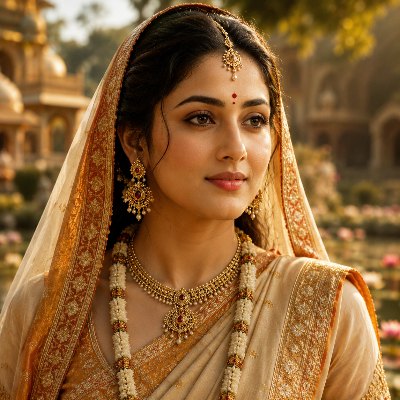
Sita — Avatar of Lakshmi, Daughter of the Earth, Wife of Rama, Mother of Lava and Kusha, and the Ramayana's Indispensable Centre
Sita · Sītā · Janaki · Vaidehi · Maithili · Bhusuta · Bhudevi-putri · Janakajamata · Ramapriyanandini · Lakshmisvarupa · Mithileshvari · Savitri · Dharitri-nandini
Sita is the daughter of the earth goddess Bhumi Devi — found by King Janaka of Mithila in a golden casket in a furrow of his ceremonial ploughing field, adopted as his daughter and raised as the princess of Videha — the wife of Rama the seventh avatar of Vishnu, the mother of the twin princes Lava and Kusha, a partial incarnation of Lakshmi, and the figure whose biography is the indispensable second narrative thread of the Valmiki Ramayana without which Rama's own story has neither motive nor resolution. She is identified in the Vishnu Purana and Padma Purana as an avatar of Lakshmi and in the Matsya Purana as a form of Devi herself. Her name derives from the Sanskrit sita — the furrow made by a plough — directly encoding the circumstances of her discovery. As a figure she contains within her biography every possible relationship of the Hindu tradition: she is daughter, wife, queen, exile, prisoner, mother, and finally the one who returns to the earth from which she came, refusing a world that has asked too much of her too many times. Her story spans all seven Kandas of the Valmiki Ramayana and she appears in the Vishnu Purana, Padma Purana, Matsya Purana, Linga Purana, Agni Purana, Garuda Purana, Skanda Purana, Shiva Purana, and the Vana Parva of the Mahabharata.
✦ The Names
Sita from the Sanskrit sita — furrow, the groove made by the ploughshare — designates the specific mode of her discovery and her origin as an earth-being rather than a womb-born creature. Her name is simultaneously her biography's opening fact and her theological identity's deepest statement: she is the earth's daughter, and the earth's furrow is where she first appeared. The metronymic Janaki — daughter of Janaka — is used throughout the Ramayana as an affectionate designation identifying her through the adoptive father who raised her. Vaidehi — princess of Videha — identifies her through her kingdom. Maithili — princess of Mithila — identifies her through her capital city. Bhusuta — daughter of the earth (bhu — earth, suta — child) — encodes her true cosmic parentage. Dharitri-nandini means the same: "daughter of Dharitri the earth." Lakshmisvarupa means "the form of Lakshmi" — her divine identification.
✦ Divine Identity and Previous Lives
The tradition identifies Sita as a partial incarnation of Lakshmi — Vishnu's eternal consort — who descended alongside Vishnu's Rama-avatar to fulfil the specific cosmic purpose of precipitating Ravana's destruction. The Vishnu Purana and Padma Purana both confirm this identification. The Linga Purana gives her specifically as a form of Lakshmi. The Matsya Purana identifies her as a form of Devi. These identifications give Sita's biography a dimension that her own apparent passivity at crucial moments does not immediately convey — she is not a victim of events but a divine presence around whose person and whose purity the entire cosmic drama of the Ramayana is organized. Several traditions give her previous lives that explain the specific quality of her relationship to Ravana and to the cosmic forces surrounding her. The Devi Bhagavata Purana and Brahma Vaivarta Purana identify her as the reincarnation of Vedavati — the woman performing austerities to become Vishnu's consort whom Ravana had molested, who immolated herself on a pyre and vowed to return in another age as the cause of Ravana's destruction. This identification makes Sita's abduction by Ravana the completion of a cosmic arc that began with the original violation — the same cosmic pattern completing itself across two lifetimes with Sita as its instrument. The Adbhuta Ramayana and certain regional traditions identify Sita as the biological daughter of Ravana himself — abandoned at Janaka's field because astrologers had prophesied that Ravana's firstborn would cause his destruction. This tradition makes the cosmic irony explicit: the being Ravana abandoned to avoid his fate became the instrument through which his fate was fulfilled.
✦ Lineage
- True mother: Bhumi Devi — the goddess of the earth, the personification of the earth itself as a divine being of patience, endurance, and nourishment. Sita's return to the earth at the end of her life is the return to her divine mother — the arc of her biography completing itself with the child re-entering the womb from which she first emerged through a furrow.
- Adoptive father: King Janaka (Siradhvaja Janaka) — the king of Videha and Mithila, profiled separately in this series. He found Sita in a golden casket in a furrow while ploughing the ceremonial ground of a yajna and was told by a celestial voice that she was his own daughter. He raised her with complete parental love and was so devoted to her wellbeing that he set the test of Shiva's bow specifically because the young Sita had picked up the bow playfully as a child, and Janaka realised only a being of Rama's divine quality could be worthy of her.
- Adoptive mother: Sunayana — the queen of Mithila and Janaka's wife, who raised Sita as her own daughter. The Valmiki Ramayana names her as the mother who participated in all of Sita's upbringing.
- Adoptive sister: Urmila — the biological daughter of Janaka and Sunayana, who married Lakshmana at the same ceremony at Mithila.
- Husband: Rama — the seventh avatar of Vishnu, profiled separately in this series. The tradition of Sita and Rama as the ideal couple — Sita as the ideal wife and Rama as the ideal husband — is the Ramayana's most central social teaching, even as the narrative simultaneously makes clear that the ideal relationship costs both parties more than any ordinary relationship would ever demand.
- Sons: Lava and Kusha — the twin princes born at Valmiki's ashrama during Sita's second exile, raised by Valmiki who taught them the entire Ramayana, and eventually reunited with their father Rama at the Ashvamedha yajna. Lava inherited Shravasti and Kusha inherited Kushavati.
✦ Discovery and Childhood in Mithila
The Valmiki Ramayana's Bala Kanda gives Sita's discovery in compact form: while King Janaka was ploughing the ceremonial ground for a yajna — a ritual ploughing performed by the king himself as a sacred act connecting royal authority to agricultural fertility — the ploughshare struck something, and when the earth was cleared there was a golden casket containing a radiant infant girl. A celestial voice told Janaka the child was his own daughter. He brought her home and named her Sita — the furrow — for the manner of her finding. Regional traditions elaborate on her childhood at Mithila in ways the canonical Ramayana does not. The Padma Purana narrates that as a young girl Sita had captured a pair of parrots from Valmiki's ashrama — the birds were recounting stories of Rama heard in the ashrama's sacred atmosphere. Sita was so enchanted by the stories that she refused to release the female parrot even when it was pregnant and pleading. The female parrot died of separation from her companion. The male parrot, returning to find his partner dead, cursed Sita: just as the female parrot had died separated from her companion while pregnant, so would Sita suffer separation from her husband while bearing her child. The male parrot was reborn as the washerman whose slander eventually caused Sita's second exile. This Puranic tradition gives Sita's second exile a specific karmic prehistory — an act of childhood thoughtlessness rippling forward through time to produce the worst suffering of her adult life. The Sagarworld source records the most charming episode of Sita's childhood: as a young girl she playfully lifted Shiva's enormous bow — the Pinaka — with one hand. The bow that no god, demon, or king could move was lifted by a princess playing in the armoury. Janaka, watching in amazement, understood that his daughter was a divine being and immediately resolved that only the person who could string this bow — whose power matched Sita's own divine quality — would be worthy of her.
✦ The Svayamvara and Marriage to Rama
The Bala Kanda narrates that kings from across the known world came to Mithila to attempt the bow-stringing test and every one of them failed — some could not even move the bow from its position, some could lift it but not string it, some could string it but not draw it. The bow had been a fixture of Janaka's armoury for so long that a generation of failed attempts had made him despair that Sita would ever be married. When Vishvamitra arrived with Rama and Lakshmana and suggested that Rama attempt the bow, Janaka agreed. Rama stood before the bow, picked it up with ease, strung it, drew it to full extent, and in drawing it broke it — the tremendous sound shaking the three worlds. Sita came forward and placed the garland of victory around Rama's neck. Janaka was overwhelmed with joy. The four marriages — Rama and Sita, Bharata and Mandavi, Lakshmana and Urmila, Shatrughna and Shrutakirti — were celebrated with full royal ceremony in a union between the Solar dynasty of Kosala and the Videha kingdom of Mithila. On the return journey to Ayodhya after the wedding, Sita encountered Parashurama's challenge — and her own response was characteristically Sita's: she did not speak. She stood beside Rama with complete faith, and Rama dealt with the challenge. Her first appearance in the domestic world of Ayodhya began the twelve years of married life described as a golden period — Rama and Sita living in complete happiness in the royal household before the exile crisis descended.
✦ The Decision to Follow Rama into Exile
When Rama came to tell Sita of the exile she was expected to remain in Ayodhya. Rama made the case clearly and with genuine concern for her welfare: the forest was dangerous, the life was hard, and there was no rational reason for her to give up comfort and safety for a journey into hardship. Sita's response — one of the tradition's most celebrated statements of conjugal devotion — was a counter-argument of considerable philosophical force. She told Rama that a wife's place was with her husband regardless of the circumstances of life — that the forest was not a hardship if he was there, and Ayodhya was not a home if he was absent. She listed the specific dangers of the forest and dismissed each one — tigers and snakes and wild animals were nothing to her if she was with him. She told him his shadow would be more home to her than any palace without him. The Valmiki Ramayana records this speech across several sargas with specific literary beauty. Rama accepted. The three departed together. The Aranya Kanda's narration of the exile's three phases — the serene period at Chitrakuta and the sage ashramas, the settled period at Panchavati, and the catastrophic period of the abduction — shows Sita not as a passive figure but as a person with a voice, preferences, opinions, and the capacity to make consequential choices. Her desire for the golden deer at Panchavati — which she knew was probably an illusion but wanted Rama to attempt retrieving anyway — is the tradition's portrait of a moment where human desire overrode divine discernment, with consequences that changed the entire subsequent course of events.
✦ The Abduction and Captivity in Lanka
When Ravana came disguised as a mendicant brahmin, Sita's own hospitality and her recognition of a brahmin's right to alms led her to cross the Lakshmana Rekha. The tradition presents this as a specifically Sita-quality moment — her dharmic instinct toward hospitality overrode the pragmatic protection boundary, and in the space between dharma and safety she was vulnerable. Ravana revealed himself, took her by force, placed her on his Pushpaka Vimana, and flew to Lanka. Her scream as Ravana carried her away was heard by Jatayu who fought Ravana and was mortally wounded. At Lanka, Ravana placed Sita in the Ashoka grove — the Ashoka Vatika — and attempted through every means available to persuade her to become his queen. His persuasions were sustained across months and took every form: flattery, gifts, threats, displays of power, appeals to practical reason, and appeals to her beauty. Sita refused every one with complete consistency and without a moment's wavering. The specific instrument of her refusal is one of the Ramayana's most celebrated images: she placed a blade of grass between herself and Ravana, telling him that this blade was all the barrier she needed — because her chastity and her devotion to Rama were a wall that no force in the cosmos could breach. The tradition presents this grass blade as more effective than any weapon because Ravana's boon of invincibility applied to force, not to choice. He could take her by force but he could not make her choose him. Hanuman found her in the Ashoka Vatika. She was thin from grief and fasting, her hair matted, wearing a single soiled garment she had not changed since her abduction. When Hanuman presented himself and showed her Rama's ring as proof of his identity she did not immediately trust him — she tested him, asking him why he was so small and why Rama had sent a monkey. When Hanuman explained in detail, she was satisfied. She gave him her hair jewel — the chudamani — as a recognition token for Rama. She told Hanuman that she would wait two more months — no more — and that if Rama had not come by then she would die.
✦ The Sundara Kanda and Sita's Messages
The Sundara Kanda — the Book of Beauty, named for Hanuman's heroism but centred on Sita — contains Sita's most extended direct speech in the entire Ramayana. She spoke to Hanuman with extraordinary clarity and composure for someone who had been in captivity for months: she identified herself, gave her situation precisely, gave Hanuman the chudamani, specified her deadline, and then gave a private message for Rama — a story known only to the two of them about an incident at Chitrakuta when a crow had pecked her foot, that Rama would recognise as authentic proof the message came from her. This private recognition signal gives Sita's message a dimension of intimate knowledge — she was not merely sending a general distress call but a specific private communication between two people whose relationship had enough private history to serve as authentication. After Hanuman had given Sita Rama's ring and received the chudamani and her messages, he offered to carry her back to Rama himself. Sita refused — giving reasons that the tradition presents as representing her dharmic understanding of what Rama's mission required. If Hanuman carried her, Rama would not have the glory of having rescued her himself. The rescue needed to be Rama's act, not Hanuman's. This refusal — given in captivity by a woman who could have been freed — is the Ramayana's portrait of Sita's own understanding of the cosmic drama she was inhabiting. She was not just a prisoner seeking escape. She was a divine participant in a cosmic mission that required each act to be performed by the appropriate person.
✦ The First Agni Pariksha
After Ravana's killing and Lanka's fall, Sita was brought from the Ashoka Vatika to meet Rama. The public context of the meeting — the assembled gods, the vanara army, Vibhishana's court, the entire audience of the war's conclusion — made it impossible for Rama to simply embrace her. As king and as a man whose wife had lived in another's house for months, he had a public obligation to demonstrate what his private knowledge already confirmed. He spoke the public statement that he could not take back a woman who had lived in another man's house. Sita, hearing this, showed no anger — only grief, and then complete composure. She asked Lakshmana to build a funeral pyre. She circled the fire, made her declaration of innocence calling on Agni as the cosmic witness of all dharmic acts, and stepped into the flames. Agni rose from the fire holding Sita unburned — declaring her complete purity before the assembled cosmos. Brahma and all the gods descended and declared Rama's true identity to him. The gods who had witnessed this act of grace received Sita from Agni's arms. Dasharatha's spirit descended and blessed them. The reunion of Rama and Sita in the public eye was also the reunion of Vishnu and Lakshmi — two aspects of the divine same consciousness briefly separated for the cosmic purpose that the Ramayana was. The Maya Sita tradition — present in the Adhyatma Ramayana and certain other texts — gives an alternative account: the real Sita had been hidden in fire throughout the captivity and what Ravana abducted was a shadow-Sita created by Agni. In this account the Agni Pariksha was not Sita's trial but Sita's release — the shadow returning to fire and the real Sita emerging. This tradition resolves the theological discomfort of Rama doubting Sita's purity by ensuring she was never actually in Ravana's captivity at all.
✦ The Return to Ayodhya and Coronation
The return to Ayodhya on the Pushpaka Vimana, the coronation, and the beginning of Rama Rajya are described in the Yuddha Kanda's conclusion and in the Uttara Kanda's opening. Sita was crowned queen alongside Rama — Vasistha performed the ceremonies that restored the kingdom's full ceremonial order. The twelve years of exile, the abduction, the captivity, the war, and the Agni Pariksha were all behind them. Rama Rajya began. The tradition describes Sita in this period as a queen of extraordinary qualities — presiding with Rama over a just and prosperous kingdom, the divine feminine principle of Lakshmi embodied in the royal household giving the kingdom its abundance and its blessing. Then the washerman's slander arrived at court — and everything changed.
✦ The Second Exile
The Uttara Kanda narrates that a washerman made a public statement that he would not accept his wife back after she had spent a night elsewhere, as a king might do with his wife. The reference was clearly to Sita. When this reached Rama, his response produced the second exile. Rama knew Sita to be pure beyond any question. But as a king he could not rule effectively — could not demand dharmic conduct from his subjects — if his own queen was the subject of public doubt. His decision to exile Sita for the sake of his public dharmic standing — while knowing privately that she was innocent — is the Ramayana's most contested act of all, presented in the Uttara Kanda without resolution or justification. He asked Lakshmana to take Sita to Valmiki's ashrama without telling her the reason until they arrived at the riverbank. At the Ganga's bank Lakshmana told her the truth and then crossed back across the river weeping. Sita made no protest. She sent her love to the three queen mothers and accepted the forest for the second time — this time alone, pregnant, without her husband or brother-in-law. Valmiki received her at his ashrama and gave her shelter. She gave birth to Lava and Kusha and raised them alone — the most extended portrait in the Ramayana of Sita as an independent person rather than as a wife: a woman who raised two extraordinary sons through her own intelligence, patience, and love without any external male protection or support.
✦ Lava, Kusha, and the Ashvamedha
Valmiki taught Lava and Kusha the entire Ramayana — twenty-four thousand shlokas — and the twins could recite it with perfection. When Rama's Ashvamedha horse was captured by the twins and the entire vanara army and then Bharata himself were defeated, Valmiki arrived and revealed the twins' identity to Rama. Rama, moved beyond words, heard the Ramayana from his own sons' mouths without initially knowing they were his sons. He then summoned Sita. Valmiki brought Sita to the assembly — before Rama, before the assembled court, before all the gods who had descended once again. Rama declared that he personally knew Sita's purity but that the people required a public demonstration once more. This second request — for another public proof after everything she had endured — was the last thing he asked of her. Sita's response was final and absolute. She called on Bhumi Devi — her true mother — to receive her if she had been completely faithful to Rama alone in thought, word, and deed. The earth split open. Bhumi Devi appeared on a golden throne carried by nagas, took Sita in her arms, and descended back into the earth. The throne closed above them. Sita was gone. Rama's grief was absolute. He wanted to follow Sita into the earth. Brahma told him this was not possible — his time in the mortal world had specific limits — and that he would see Sita again in the divine world. The Ramayana records that Rama from that moment no longer took any joy in his life. He ruled for many more years but as a man to whom the world's light had gone out.
✦ The Maithili Mahopanishad — Sita as Philosophical Teacher
The Wikipedia Sita article notes the Maithili Mahopanishad in the Valmiki Samhita's chapter five — a dialogue between Sita and the Saptarishis described to Parvati by Shiva. This text — part of the living philosophical tradition associated with Sita's biography — presents her in the specific role of a philosophical teacher engaging with the tradition's most learned sages on questions of ultimate reality. The tradition also includes Sita worshipped as Shakti in the Kaushika Sutra of the Atharvaveda, where she is associated with Parjanya and Indra in agricultural fertility contexts — the pre-epic layer of Sita's identity as a goddess of the earth and of agricultural abundance underlying the Ramayana's narrative use of her.
✦ Textual Variants and Inconsistencies
The most significant variant is the Maya Sita tradition versus the actual Sita's captivity — whether Sita herself was in Lanka or whether the real Sita was hidden in fire throughout. The Valmiki Ramayana's critical edition gives Sita herself in Lanka; the Adhyatma Ramayana and certain other texts give the fire-hidden Sita. The Jain Ramayana tradition of Sanghadasa's Paumachariya gives Sita as Ravana's biological daughter — the most striking structural inversion of the canonical account, which makes Ravana simultaneously Sita's biological father and her abductor. The regional Ramayana traditions of Southeast Asia, East Asia, and South India each elaborate Sita's biography differently — with the Tamil Kambar giving her divine qualities more prominent narrative attention and the Thai Ramakien giving different emotional emphases to the captivity period. The question of whether the Uttara Kanda — with its second exile — is a canonical part of the Valmiki Ramayana or a later addition is one of the most debated questions in Ramayana scholarship.
✦ Theological Significance
Sita's theological significance operates at every level simultaneously. As Lakshmi she is the divine feminine complement to Vishnu's Rama — the eternal consort who descends when he descends and whose presence in the mortal world is the condition for his full expression of divine love in human form. As Bhumi Devi's daughter she is the earth itself — the patient, nourishing, enduring principle that receives everything that is thrown at it and maintains its fundamental character unchanged. As a biographical figure she is the tradition's most complete portrait of how divine purpose uses human lives — her biography asks its readers to hold simultaneously the understanding that she was the instrument of the cosmic drama's most necessary act, and the recognition that the cost she paid for being that instrument was the highest any life can pay.
✦ References
- Valmiki Ramayana, all seven Kandas: The primary source for the entirety of Sita's canonical biography.
- Vishnu Purana and Padma Purana: Sita as an avatar of Lakshmi.
- Padma Purana: The parrot curse episode from Sita's childhood.
- Adhyatma Ramayana: The Maya Sita tradition — the fire-hidden real Sita and the shadow-Sita abducted by Ravana.
- Devi Bhagavata Purana and Brahma Vaivarta Purana: Sita as the reincarnation of Vedavati.
- Adbhuta Ramayana: Sita as the daughter of Ravana abandoned at Mithila.
- Vettam Mani, Puranic Encyclopaedia (1975): Entry on Sita; comprehensive collation of all primary references.
- A. K. Ramanujan, "Three Hundred Ramayanas" (1991): The definitive modern scholarly essay on the diversity of Sita traditions across South and Southeast Asia.
- Devdutt Pattanaik, Sita: An Illustrated Retelling of the Ramayana (2013): Comprehensive retelling with attention to variant traditions and their theological significance.