
About
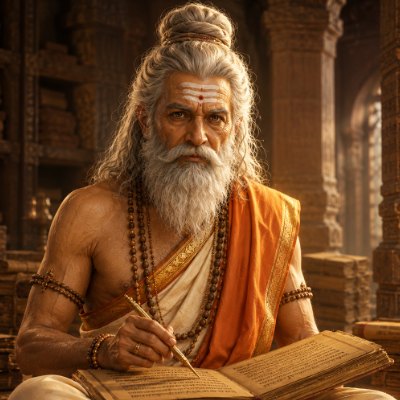
Medhatithi — Rigvedic Seer of the Kanva Lineage and Drashta of the Agni Hymns
Medhatithi · Medhatithi Kanva · Kanveya · Medhatitha
Medhatithi is an ancient Vedic rishi of the Kanva family, a sub-lineage of the Angirasas — the extensive clan of seers tracing their origin to the primordial rishi Angiras, one of the seven great seers of the Vedic tradition and a progenitor of numerous priestly and poetic families. In the Rigvedic and Anukramani tradition, Medhatithi is identified as a son or direct descendant of Kanva, himself the son of Ghora Angirasa, and as such represents the second generation of the Kanva kula in its recorded genealogical sequence. Medhatithi is the drashtara — the seer, in the traditional sense of one who directly perceived the truth of the mantras — of a substantial series of hymns in the first mandala of the Rigveda, principally those addressed to Agni and the Maruts. He is further distinguished by a narrative found in the Jaiminiya Brahmana in which the god Indra, taking the form of a ram, intervenes in Medhatithi's life in a manner that elevated him beyond the ordinary station of a mortal rishi. His descendants, known collectively as the Medhatithas, constitute a recognised sub-clan within the broader Kanva family. Medhatithi appears in the Rigveda and its Anukramanis as his primary textual locus, with secondary appearances in Brahmana literature and later Puranic and epic references.
✦ The Name
The name Medhatithi is a compound of two Sanskrit elements. The first, medha, carries the meaning of intelligence, wisdom, or sacrificial fat — the latter being the portion of the sacrificial animal offered in fire ritual, and by extension a term associated with the efficacy and essence of the sacred act. The second element, tithi, refers to a lunar day in the traditional calendar, though in personal names it functions more broadly as a marker of auspiciousness or sacred timing. The compound thus suggests a person of wisdom brought forth at an auspicious moment, or one whose intelligence is of sacrificial quality. The clan designation Kanva, appended as Medhatithi Kanva, identifies him as a member of the Kanva family within the Angirasa lineage. His descendants are called the Medhatithas, using his name as their own clan designator in the Anukramani tradition.
✦ Lineage
- Clan ancestor: Angiras — the primordial rishi regarded in Vedic and Puranic tradition as one of the saptarshis and a mind-born son of Brahma the creator; the founding figure of the Angirasa clan of seers, closely associated with fire ritual, the priestly office, and the Atharvaveda.
- Grandfather (clan lineage): Ghora Angirasa — a sage of the Angirasa lineage identified in the Rigveda Anukramanis as the father of Kanva; the same figure recorded in the Chandogya Upanishad (3.17) as the teacher who instructed Krishna son of Devaki on the equivalence of virtuous human life with Vedic sacrifice.
- Father (Vedic and Anukramani tradition): Kanva — the founding seer of the Kanva family, son of Ghora Angirasa, and the ancestral figure to whom the eighth mandala of the Rigveda and hymns 1.36 to 1.50 of the first mandala are collectively attributed; see the section on Textual Variants for the Epic tradition's reversal of this relationship.
- Descendants: The Medhatithas — a sub-clan within the broader Kanva family, identified in the Anukramani tradition as the sons and descendants of Medhatithi. The figure Priyamedha is among those identified in the Anukramanis as a descendant or son of Medhatithi and a seer within this sub-lineage.
✦ Hymnic Contributions in the Rigveda
Medhatithi is the drashtara — the seer who in Vedic understanding directly perceived rather than composed the mantras — of a substantial sequence of hymns in the first mandala of the Rigveda, running from hymn 1.12 through hymn 1.23. These hymns are directed principally at Agni, the fire deity who serves in the role of Hotar — the priestly invoker who carries oblations between the human and divine realms — and at the Maruts, the storm deities associated with Indra and with the force of atmospheric power. The Agni hymns attributed to Medhatithi are notable for their treatment of Agni as a divine messenger and intermediary, a figure through whom mortal supplication reaches the gods and through whom divine blessing returns to the worshipper. This characterisation of Agni as cosmic priest and ambassador is one of the defining theological emphases of Medhatithi's hymns within the first mandala. The Marut hymns complement this focus by addressing the collective divine forces associated with atmospheric and martial power. Within the Kanva family's broader corpus — which spans the eighth mandala in its entirety and portions of the first — Medhatithi's contribution is among the most individually identifiable, since the Anukramanis attribute this specific sequence to him by name rather than to the Kanva family as a collective.
✦ The Narrative of Indra and the Ram
The most distinctive individual narrative associated with Medhatithi beyond his hymnic authorship is preserved in the Jaiminiya Brahmana, one of the Brahmana texts of the Sama Veda tradition, with later allusions in Puranic literature. According to this account, the god Indra — the king of the gods and the deity of the thunderbolt, rain, and cosmic order — assumed the form of a ram, mesha in Sanskrit, and came to Medhatithi. The account describes Indra in this animal form carrying Medhatithi upward — transporting the sage to the heavenly realm — in recognition of the seer's ritual and spiritual merit. In some tellings the emphasis falls on Indra's act as a form of divine reward or elevation granted to the sage on account of his Soma-pressing or his hymnic excellence; in others the episode has the character of a divine test or intervention. The narrative is significant because it marks Medhatithi as a figure who attracted direct divine attention and physical intervention from Indra, distinguishing him from the many Rigvedic seers who are associated with their deity primarily through hymnic address rather than through narrative encounter. The image of Indra as a ram carrying a sage heavenward is among the more unusual of the theophanic episodes recorded in Brahmana literature and gives Medhatithi a distinctive legendary identity within the Kanva tradition.
✦ Textual Variants and Inconsistencies
The most significant textual inconsistency surrounding Medhatithi concerns the inversion of his relationship with Kanva across different layers of the tradition. In the Rigveda and the Anukramanis — the oldest and most directly authoritative sources for the genealogy of the Vedic seer families — Medhatithi is identified as a son or descendant of Kanva, bearing the clan name Kanva as his lineage designation. Hymns in the first mandala are attributed to Medhatithi Kanva, with Kanva functioning as a marker of his family affiliation. However, the Mahabharata in its Shanti Parva identifies a sage as Medhatithisuta — meaning the son of Medhatithi — which effectively positions Medhatithi as the father of Kanva rather than his son or descendant. This inversion of the parent-child relationship is a recognised pattern in the transition from Vedic to Epic and Puranic genealogical literature, where lineages are sometimes reordered, compressed, or reversed as they pass through successive layers of textual transmission. The Rigvedic and Anukramani account represents the earlier and more precisely attested record; the Mahabharata's reversal reflects the fluidity of genealogical tradition in the Smriti layer of the canon. Both accounts are recorded in the tradition and neither can be simply dismissed, but they cannot be harmonised without contradiction.
✦ Theological and Philosophical Significance
Medhatithi's hymns to Agni in the first mandala of the Rigveda contribute to one of the central theological themes of the Rigvedic tradition — the understanding of Agni as the indispensable mediator between the human and divine orders. By addressing Agni consistently in the role of Hotar, the divine priest who conveys offerings and invocations between realms, Medhatithi's hymns articulate a vision of sacrifice as a relational and communicative act rather than a merely mechanical one. This theological emphasis, carried through the Kanva family's broader corpus, represents a significant strand of early Vedic priestly thought. The narrative of Indra's intervention on Medhatithi's behalf further underscores the understanding within the tradition that the seer's activity — his hymnic perception and sacrificial devotion — was of sufficient merit to draw direct divine response, reinforcing the Vedic premise that the drashtara's perception of the mantra is itself a sacred act with real consequences in the cosmic order.
✦ Connection to the Wider Genealogy
Medhatithi stands at the third generational level of the Angirasa lineage as recorded in the Rigvedic Anukramani tradition. Above him are Kanva his father, Ghora Angirasa his grandfather, and Angiras the primordial ancestor of the entire clan. Below him are the Medhatithas, his own sub-lineage within the broader Kanva kula, including the figure Priyamedha. The Kanva family as a whole — encompassing Kanva, Medhatithi, Praskanva, Irimbitthi, Vatsa, Devatithi, Brahmatithi, Punervatsa, Nipatithi, and the Medhatithas — forms one of the most prolific and textually well-attested rishi families in the Rigvedic canon. Medhatithi's position within this family is that of the most individually prominent named member of the generation immediately following Kanva, and his own descendants extend the lineage further into the sub-clan of the Medhatithas. The Kanva gotra, deriving its name from Kanva and carrying the heritage of this entire lineage, continued as a living Brahminical clan designation well into the later tradition.
✦ Distinction from Medhatithi the Jurist
The Vedic rishi Medhatithi of the Kanva lineage is entirely distinct from the medieval scholar of the same name who composed a celebrated commentary on the Manusmriti, the Manubhashya, and who is dated by scholars to approximately the ninth century of the common era. The jurist Medhatithi was a legal theorist and Sanskrit commentator of the Dharmashastra tradition; he shares only the name with the Rigvedic seer. The conflation of these two figures is a recognised point of confusion in secondary and digital reference sources and should be avoided in any genealogical or historical analysis of either figure.
✦ References
- Primary Sources:
- Rigveda, Mandala 1, hymns 1.12–1.23: The principal body of hymns attributed to Medhatithi Kanva in the Anukramani tradition; addressed primarily to Agni in the role of Hotar and to the Maruts.
- Rigveda Anukramanis: The ancient indices of the Rigveda; identify Medhatithi as a son or descendant of Kanva and as a member of the Angirasa lineage; attribute the hymns of Mandala 1.12–1.23 to him by name; record the Medhatithas as a sub-lineage descended from him.
- Jaiminiya Brahmana: The Brahmana text of the Sama Veda tradition that preserves the narrative of Indra assuming the form of a ram and carrying Medhatithi to the heavenly realm.
- Mahabharata, Shanti Parva, chapter 208, verse 27: Refers to a sage as Medhatithisuta — son of Medhatithi — inverting the parent-child relationship found in the Rigvedic Anukramani tradition and positioning Medhatithi as the father rather than the son of Kanva.
- Secondary Sources:
- A. A. Macdonell and A. B. Keith, Vedic Index of Names and Subjects (1912): Contains entries on Medhatithi, the Kanva family, and the Anukramani attributions; establishes the genealogical and textual background of the Medhatithas within the Angirasa lineage.
- Vettam Mani, Puranic Encyclopaedia (1975): Provides an entry on Medhatithi noting the principal textual references and his position within the Kanva lineage.
- Wisdom Library, Medhatithi — multiple entries: Aggregates Vedic, Puranic, and epic references to Medhatithi, distinguishing where possible between the Rigvedic seer and later figures of the same name.