
About
Sunda — Elder Son of Nikumbha, Daitya Conqueror of the Three Worlds
Sunda · Sunda Daitya · elder brother of Upasunda
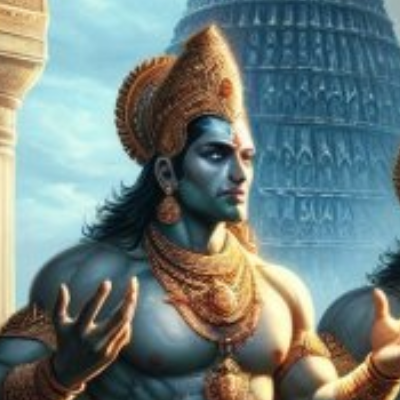
Sunda is a Daitya — a demon of the race descended from Kashyapa and Diti — and the elder of the two inseparable brothers Sunda and Upasunda, sons of the mighty Daitya Nikumbha of the lineage of Hiranyakashipu. His story, narrated together with that of his brother and inseparable from it, is told in the Sundopasundopakhyana, an embedded tale within the Adi Parva of the Mahabharata. The sage Narada recounts this story to the Pandava brothers — specifically as a cautionary parable to Yudhishthira about the dangers that a shared love-object could pose to fraternal bonds. Sunda and Upasunda, having conquered the three worlds through the power of severe austerities and boons received from Brahma, are ultimately destroyed by one another in a quarrel over the Apsara Tilottama, whom Brahma had specially commissioned Vishvakarma to create for the purpose of provoking exactly this fatal discord. Sunda has no children recorded in the Mahabharata, and no genealogical extension beyond the episode of his death is attested in any primary source connected to this figure.
✦ The Name
The name Sunda is a proper name of this demon within the Sanskrit epic and Puranic tradition. The name Upasunda, borne by the younger brother, incorporates the prefix upa meaning near, secondary, or subordinate — making Upasunda literally the one who is close to or secondary to Sunda, a name that encodes the younger brother's positional relationship within the pair. The Mahabharata consistently treats the two names as a unified pair, routinely referring to them together as Sunda-Upasunda or as the two brothers jointly, reflecting their characterisation as beings inseparable in will, purpose, and deed. It should be noted that the name Sunda is shared by an entirely separate figure in the Ramayana tradition — a Danava who is the son of Jamba (also written Jharjha) and the husband of the Yakshini Tataka, and the father of Marica and Subahu. That Sunda belongs to the Danava lineage of Jamba and has no connection to Nikumbha's line.
✦ Lineage
- Father: Nikumbha — a Daitya of the race of Hiranyakashipu, identified in the Vishnu Purana tradition as a son of Prahlada and in the Vayu Purana tradition as a son of Hlada; a figure of great power who has no independent narrative beyond his paternity of these two sons.
- Ancestor: Hiranyakashipu — the great Daitya king, son of Kashyapa and Diti, slain by Vishnu in his Narasimha avatar; the remote progenitor of the lineage through which both Sunda and Upasunda trace their descent.
- Brother: Upasunda — the younger of the two; indistinguishable from Sunda in character, purpose, and method throughout the narrative; killed by Sunda at the moment of mutual destruction, and simultaneously killing Sunda with his own blow.
✦ The Austerities on the Vindhya Mountains
The Sundopasundopakhyana recounts that the two brothers, driven by the shared ambition of conquering and subjugating the three worlds, went together to the Vindhya mountains and undertook austerities of extreme severity. They clothed themselves in tree bark, endured hunger and thirst, and intensified their penance progressively — ultimately cutting and offering pieces of their own flesh into the sacrificial fire as oblations. The heat generated by their tapas caused the Vindhya mountains themselves to emit vapour, and the gods were alarmed. The celestials attempted to break the brothers' concentration through illusions — conjuring images of their mothers, sisters, and wives being pursued and struck by a demon, calling out for rescue — but neither brother was moved. Neither persuasion nor illusion could break their shared resolve.
Pleased by the severity and persistence of their austerities, Brahma appeared before them and offered them a boon. The brothers asked first for knowledge of all weapons, mastery of all illusory arts, immense physical strength, and the power to assume any form at will — and finally requested immortality. Brahma refused immortality on the grounds that it could not be conferred on those whose austerities were motivated by the desire to subjugate others rather than by spiritual aspiration. He invited them instead to choose a form of death that would render them as close to immortal as possible. The brothers chose the boon that they would have no fear from any creature, mobile or immobile, throughout the three worlds — with the sole exception that they could be killed by each other. Brahma granted this, and the brothers returned from the mountains laden with powers.
✦ The Conquest of the Three Worlds
Armed with their boons, Sunda and Upasunda embarked on a campaign of conquest that the Mahabharata describes in terms of systematic devastation. They drove the gods from the heavens and usurped the celestial realms; they expelled the sages and Brahmins from their hermitages and silenced the sacrificial fires, suppressing the performance of the Vedic rites upon which the cosmic order depended. The Rishis and Siddhas were scattered and order in the three worlds collapsed. The Mahabharata describes the sun and moon, the planets and stars, grieving at the desolation wrought by the brothers. The celestial seers, bereft of their customary power to resist, fled to Brahma and laid before him the catastrophe that the brothers' boon had unleashed upon the world.
✦ The Creation of Tilottama and the Death of Sunda
Since no external being could destroy Sunda and Upasunda — their boon having made them invulnerable to all creatures in the three worlds except each other — Brahma determined that the only available instrument of their destruction was themselves. He summoned Vishvakarma, the divine architect and craftsman of the gods, and directed him to create a woman of surpassing beauty, assembling her from the finest portions of every precious substance and every gem. Vishvakarma fashioned the Apsara Tilottama — whose name, derived from tila (a tiny portion) and uttama (supreme), reflects her creation from the supreme portion of every substance. Brahma instructed Tilottama to go among the brothers and, through the power of her beauty, provoke such desire and rivalry between them that they would turn on each other.
Tilottama found the brothers on a river bank in the Vindhya region, where they were revelling with wine, women, and the spoils of their conquests. When she appeared gathering flowers, both brothers were simultaneously overpowered by desire. Each seized one of her hands — Sunda her right, Upasunda her left — and each declared her to be his own wife. Sunda invoked his seniority as elder brother; Upasunda refused to yield. The quarrel escalated from words to weapons. Both brothers took up their maces and struck each other on the head with full intent to kill, and both died from the mutual blows. Thus the boon itself — which they had framed to protect themselves from all external harm — became the mechanism of their destruction, exactly as Brahma had intended.
✦ Narrative Function within the Mahabharata
The Sundopasundopakhyana is narrated by the sage Narada to Yudhishthira specifically in the context of the Pandavas' shared marriage to Draupadi. Narada, warning the brothers that a shared wife carries the potential for the same fatal discord that destroyed Sunda and Upasunda, draws the explicit parallel: even the most complete and unwavering fraternal unity can be shattered by rivalry for a woman, and the bond of brotherhood offers no protection against the passions that love and desire can unleash. The tale is therefore not a standalone Daitya narrative but a purposefully embedded parable whose moral application to the Pandavas' situation is explicit within the text.
✦ References
- Mahabharata, Adi Parva, sections 208–211 (Sundopasundopakhyana): The primary and sole epic source for the entire narrative; narrated by Narada to Yudhishthira as a cautionary tale; covers the austerities, the boon, the conquest of the three worlds, the creation of Tilottama, and the mutual destruction of the brothers.
- Kathāsaritsāgara, chapter 15: Retells the Sunda and Upasunda story attributed to Narada; confirms the tale's circulation beyond the strictly epic tradition.
- Vettam Mani, Puranic Encyclopaedia (1975), s.v. "Sunda": Secondary reference consolidating the primary attestations; treats Sunda son of Nikumbha and the Sunda of the Ramayana tradition (father of Marica, son of Jamba) as distinct figures.
- Wisdomlib.org, s.v. "Sunda" and "Marica": Secondary reference useful for confirming the distinction between Sunda son of Nikumbha and Sunda son of Jamba, whose respective lineages are unrelated.