
About
Lava — Younger Twin Son of Rama and Sita, Named at Valmiki's Ashrama, Co-Reciter of the Ramayana, and Founder of Lavapuri
Lava · Lāva · Lavana · Ramaputra · Sitajanita · Valmiki-shishya · Lavapuri-nirmata · Shravasti-naresh · Ramayana-gayaka · Ikshvaku-vamsha-uttaradhikari
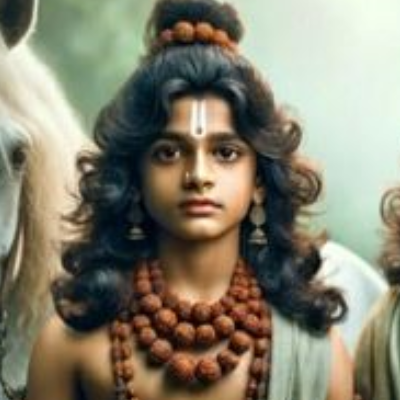
Lava is the younger of the twin sons of Rama and Sita, born at Valmiki's ashrama during Sita's second exile, named through the same kusha grass naming rite that named his brother Kusha, educated and trained by Valmiki in the complete Vedic curriculum and the complete text of the Ramayana, and the twin whose physical appearance is described as whitish golden in complexion like their mother Sita — in contrast to Kusha who had a blackish complexion like their father Rama. He inherited the kingdom of Lavapuri — identified with the extraordinary historical continuity in which the city of Lahore in modern Pakistan bears the name derived from Lava's own name (Lahore being a Sanskrit-derived rendering of Lavapuri). He is identified in the Sikh tradition, through the Bachitar Natak, as the ancestor of the Bedi clan to which Guru Nanak — the first Sikh Guru — belonged. His biography runs in complete parallel with his brother Kusha's across all the canonical episodes — their birth, their education, the horse capture, the Ramayana recitation, and the separation from their mother — and the two must be profiled together to be fully understood even when profiled separately, since their joint action is the primary mode of their narrative presence in all canonical sources. He appears in the Valmiki Ramayana's Bala Kanda and Uttara Kanda, in the Padma Purana, in the Bhagavata Purana and Vishnu Purana in genealogical contexts, and in the Jain Ramayana traditions of the Paumachariya where he is called Lavana.
✦ The Name
The name Lava is derived from the Sanskrit root lava — a cutting, a fragment, a small piece cut off — and also specifically from the verb lav meaning to cut, to reap, or to harvest. The name thus carries the sense of "the cut one," "the harvested one," or "the fragment." Its connection to the naming rite is specific: Valmiki's declaration at the naming ceremony was that "the last-born will be carefully dried by the female ascetics with the roots of the grass — he shall be called Lava." The name connects Lava to the root part of the grass — the cut roots that dried him after birth — encoding the lower and rooted portion of the sacred grass as his specific identity-marker in contrast to Kusha whose name connected to the growing tip. The Jain Ramayana's name Lavana — meaning salt or the salty one — is a variant form that some manuscript traditions preserve. The city name Lavapuri — "the city of Lava" — is connected to the modern Lahore in a tradition that the Gomangala source and the Wikipedia Lava article both acknowledge: "Lava and Kusha became rulers after their father Rama founded the cities of Lavapuri and Kasur, respectively."
✦ Lineage
- Father: Rama
- Mother: Sita — The tradition is explicit that Lava's complexion was whitish golden like Sita, giving him a specific physical inheritance from his mother that Kusha did not share — the two brothers' different complexions are the canonical physical markers of their dual parental inheritance.
- Twin brother: Kusha — In most canonical sources Lava is the younger twin, though the birth order varies across manuscript traditions.
- Teacher: Valmiki — who named Lava, educated him alongside Kusha, and taught both twins the complete Ramayana.
- Kingdom: Lavapuri — established for Lava by Rama after their recognition and reconciliation. The identification of Lavapuri with Lahore — one of the oldest cities of the northwestern subcontinent, whose name in the dominant popular tradition preserves the Sanskrit Lava — gives Lava a geographical legacy of extraordinary historical resonance. Shravasti is named in the Wikipedia Lava article as his city: "Lava and Kusha became rulers after their father Rama founded the cities of Lavapuri and Kasur, respectively." Other sources including the Valmiki Ramayana's Uttara Kanda give him Shravasti directly.
- Later descendants and community claims: The Bachitar Natak identifies the Bedi clan — to which Guru Nanak the first Sikh Guru belonged — as descending from Lava. This connects the initiating figure of the Sikh tradition to Lava's lineage and through Lava to Rama and Sita and the Solar dynasty's most sacred period.
✦ Birth and the Naming Rite
Lava was born on the same night as Kusha — the night of Shatrughna's visit to Valmiki's ashrama — and was named through the same protective rite. Valmiki's declaration gave him the name Lava specifically in relation to the root portion of the kusha grass and the drying of the second-born child. The two names — Kusha for the upper part, Lava for the cut roots — form a complementary pair: the growing part and the rooted part of the sacred grass, the tip that reaches toward the sky and the roots that anchor in the earth. The parallel to the two boys' later biographical identities — Kusha whose city Kushavati pointed toward the Vindhya mountain region and whose name connected to the highland interior, Lava whose city Lavapuri pointed to the northwestern plains — may be read into the complementarity of the two grass portions, though the tradition does not make this interpretation explicit.
✦ Education and Training
Lava's education at Valmiki's ashrama was identical to Kusha's in content — the complete Vedic curriculum, the complete military sciences, and the full Ramayana recitation. The Gomangala source notes that Lava specifically had a whitish complexion and that the two boys were trained together as a pair in all dimensions of their education. Their complementary physical descriptions — Kusha like his father, Lava like his mother — give their joint presence a quality of embodied completeness: together they represented their parents simultaneously, carrying both their father's dark divine quality and their mother's luminous earth-born beauty. The Gomangala source gives a vivid account of the horse capture episode from Lava's specific perspective: it was Lava who was with the younger ashrama children when the Ashvamedha horse came, and it was Lava who first noticed the notice on the horse's head and decided to capture it. Kusha was away collecting ritual materials. Lava tied the horse and when Shatrughna came and tried to retrieve it, the initial battle was Lava's alone against the royal army — his military training from Valmiki proving immediately effective. When Shatrughna defeated Lava and carried him away, it was the report to Sita of Lava's capture that caused her distress and brought Kusha rushing to his brother's rescue. The episode thus began with Lava's individual initiative and Kusha's individual rescue before the two came together for the subsequent larger battles.
✦ The Ramayana Recitation — Lava's Voice
The recitation of the Ramayana at the Ashvamedha yajna is the most theologically significant act of Lava's biography — and it was a joint act performed by both twins as a duet. The tradition records that their voices together had a quality that moved every listener to an extraordinary emotional state — the quality of two voices that had grown up together, had learned together, and whose musical training had produced a unified sound that was simultaneously each of theirs separately and something greater in combination. The Gomangala source gives specific detail about the daily progression: they sang through the Bala Kanda, the Ayodhya Kanda, the Aranya Kanda, the Kishkindha Kanda, the Sundara Kanda, and the Yuddha Kanda over six days, completing ninety-seven sargas of the Uttara Kanda before the seventh day's concluding events. Valmiki and Sita remained at the ashrama on the first day, with Lava and Kusha going to Ayodhya on Valmiki's instructions. They sang before Rama without being introduced to him — performing as wandering singer-sages whose identity was not disclosed until Valmiki's own declaration.
✦ After Sita's Departure — the Kingdom of Lavapuri
After Sita's return to the earth Lava and Kusha were taken into Rama's household in Ayodhya. The Gomangala source records that they learned administrative work in Rama's palace — receiving the practical training in governance that their ashrama education had not provided. After their marriages Lava built a palace at Lavapura — the source notes that this may be the present Lahore — founding the city whose name preserved his own across thousands of years of subsequent history. The Wikipedia Lava article confirms this identification: "Lava and Kusha became rulers after their father Rama founded the cities of Lavapuri and Kasur, respectively" — Kasur being a city near Lahore also preserved in the Punjab tradition as named for Kusha. The historical city of Lahore — one of the major cities of the Indian subcontinent, the capital of the Mughal empire under Akbar, the cultural centre of the Punjab, and the second-largest city of modern Pakistan — bearing a name derived from Lava's own name is one of the most striking instances of the Ramayana tradition's geographical legacy in the living landscape of South Asia. Whether the name is historically a derivation from Lava or a later popular etymology cannot be resolved with certainty through the available evidence, but the tradition's own consistent claim — preserved from the Valmiki Ramayana through the Jain Ramayana accounts to the modern popular tradition — identifies Lavapuri with Lahore.
✦ The Jain Ramayana — Lavana and Ankusha
The earliest textual account of the horse-capture episode involving the sons of Rama is found not in the Valmiki Ramayana but in the Jain Paumachariya of Vimalasuri — composed in the Prakrit language and dated to around the third century CE. In the Jain tradition Rama is called Padma, and the twin sons are called Lavana and Ankusha rather than Lava and Kusha. The Paumachariya narrates their capture of the royal horse and their conflict with Rama's army, establishing the narrative framework that was later elaborated in the Padma Purana and in Bhavabhuti's eighth-century Sanskrit play Uttararamacharita. The Jain version's existence as the earliest textual witness for this specific episode is a significant fact in the tradition's textual history — it suggests the horse-capture narrative circulated widely in different cultural contexts before receiving its present canonical form in the Uttara Kanda elaborations.
✦ Textual Variants — Lava as Elder
While the Valmiki Ramayana's canonical Uttara Kanda names Kusha first in the naming rite and thus implies his seniority, the Wikipedia Lava article states explicitly: "Lava and his elder twin brother Kusha." This identification of Lava as the younger and Kusha as the elder is the dominant account in the Wikipedia tradition and the Gomangala account. The Katha Sarit Sagara's account makes Lava the only born son and Kusha the grass-created one — a variant discussed in the Kusha profile above. The question of whether Lava was born first or second is a genuine textual variant that different manuscript traditions resolve differently. The canonical Uttara Kanda text's sequence — Kusha named first, Lava second — suggests Kusha as elder, but the popular tradition frequently reverses this. This profile adopts the canonical Valmiki Ramayana sequence.
✦ Theological Significance
Lava's theological significance runs in parallel with Kusha's and the two must be understood together to be fully appreciated. Together the twins are the tradition's portrait of a specific kind of knowledge — knowledge transmitted through love rather than through institutional authority. Valmiki taught them the Ramayana because it was the text whose composition was the work of his life and whose recitation required someone worthy of carrying it. He chose to teach it to the sons of the very couple whose story it narrated — creating a situation where the most intimate possible relationship to the text (these are our parents' lives) was combined with the most formally trained recitation capability (we have learned every syllable from the composition's author). Lava and Kusha as the first reciters of the Ramayana to its subject carry within them the paradox that is the Ramayana's own deepest quality: the story of Rama is told most truly by those who are most intimately connected to him through love, not by those who observe him from outside.
✦ References
- Valmiki Ramayana, Bala Kanda, sarga 1: Lava and Kusha's first appearance as Valmiki's disciples touching his feet.
- Valmiki Ramayana, Uttara Kanda, chapter 66: The birth on the night of Shatrughna's visit; Valmiki's naming rite with the kusha grass; the specific declaration of Lava's name as the second-born dried with the roots.
- Valmiki Ramayana, Uttara Kanda, chapters 94–97: The Ramayana recitation at the Ashvamedha yajna; Valmiki's declaration of paternity; Sita's departure; Lava and Kusha accepted into Rama's household.
- Padma Purana: The expanded account of the horse capture including the initial capture by Lava specifically and the subsequent battles.
- Vimalasuri, Paumachariya (c. 3rd century CE, Jain, Prakrit): The earliest textual account of the horse capture episode — Lava as Lavana, Kusha as Ankusha, Rama as Padma. The primary Jain Ramayana source for this narrative.
- Bhavabhuti, Uttararamacharita (c. 8th century CE, Sanskrit drama): The major Sanskrit literary elaboration of the Lava-Kusha story including the horse-capture and the recitation episodes.
- Guru Gobind Singh, Bachitar Natak (c. 1698 CE): The Sikh tradition's identification of the Bedi clan's descent from Lava.
- Vettam Mani, Puranic Encyclopaedia (1975): Entry on Lava (son of Rama) — collates all primary references.