
About
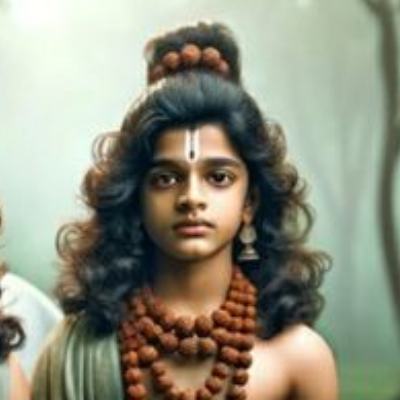
Kusha — Elder Twin Son of Rama and Sita, Named at Valmiki's Ashrama, Reciter of the Ramayana to His Father, and King of Kushavati
Kusha · Kūśa · Ramaputra · Sitajanita · Valmiki-shishya · Kushavati-naresh · Ramayana-gayaka · Uttarakanda-prathama-vachaka · Ikshvaku-vamsha-uttaradhikari
Kusha is the elder of the twin sons of Rama — the seventh avatar of Vishnu — and Sita, born at Valmiki's ashrama during Sita's second exile, named by Valmiki himself through the ritual of the kusha grass, educated and trained in all arms and in the complete text of the Valmiki Ramayana at the ashrama, and the figure whose singing of the Ramayana before Rama at the Ashvamedha yajna was the mechanism through which the father recognised his sons. He is described in the Valmiki Ramayana as having a blackish complexion like his father Rama, in contrast to his twin brother Lava who had a whitish golden complexion like their mother Sita. He inherited the kingdom of Kushavati — also recorded in some traditions as Kushavartana — established by Rama in the Uttara Kanda's succession arrangements after the reconciliation. He appears in the Valmiki Ramayana's Bala Kanda's first sarga — where Valmiki considers who will be able to recite his composition and the twins touch his feet — and in the Uttara Kanda's extended narrative of their birth, upbringing, and eventual reunion with Rama. He is also referenced in the Vishnu Purana and Bhagavata Purana in genealogical contexts, and the Sikh traditions of the Bedi clan claim descent from him.
✦ The Name
The name Kusha is derived directly from the kusha grass — the sacred darbha grass used in Vedic ritual, in the performance of purification rites, and as a protective substance whose ritual efficacy was deeply embedded in the Vedic tradition. The Valmiki Ramayana's Uttara Kanda chapter 66 gives the precise naming account: Valmiki took a handful of kusha grass with its roots, blessed it with mantras for protection against evil forces, and instructed the women ascetics at the ashrama to rub the elder child with the upper part of the kusha grass. He then declared: "Since they will rub the first-born of the children with the kusha grass blessed by the aid of mantras, his name shall be Kusha." The name thus encodes both the instrument of his protection at birth and the sacred grass's own ritual significance. As the elder twin, Kusha received the upper part of the grass — the growing tip — and his name carries the quality of the sacred grass's most vital part. The patronymic Ramaputra means "son of Rama." The epithet Kushavati-naresh means "king of Kushavati."
✦ Lineage
- Father: Rama — the seventh avatar of Vishnu. Kusha never knew his father during his childhood and education at Valmiki's ashrama — their relationship began only at the Ashvamedha yajna when Rama recognised the twins as his sons.
- Mother: Sita — the daughter of Bhumi Devi and adoptive daughter of King Janaka. Kusha was raised entirely by Sita and Valmiki — the mother who carried him in exile and bore him in the ashrama, and the sage who named him, educated him, and taught him the complete Ramayana.
- Twin brother: Lava — Kusha is consistently identified as the elder twin in the canonical Valmiki Ramayana account — this is confirmed specifically by the naming narrative in which Kusha's name is given first and Lava's second, and by the description of the kusha grass ritual in which the first-born received the upper part. The Wikipedia Lava article however gives Kusha as the elder — and this is the position adopted in the canonical account.
- Paternal grandparents: Dasharatha (paternal grandfather) and Kausalya (paternal grandmother). Through the Solar dynasty lineage Kusha descends from Vivasvat-Surya through Vaivasvata Manu, Ikshvaku, and the complete Raghu-Solar dynasty chain to Rama.
- Maternal grandfather: King Janaka of Mithila
- Teacher and guardian: Valmiki — who not only named Kusha at birth but educated him in the complete Vedic curriculum, in the complete science of arms, and in the recitation of all twenty-four thousand shlokas of the Valmiki Ramayana. The Valmiki Ramayana's Bala Kanda sarga 4 records that Kusha and Lava touched the feet of the contemplative Valmiki who was thinking about who would be capable of reciting his composition — the touching of the feet is the specific gesture indicating the student-teacher relationship, establishing that Kusha and Lava were Valmiki's disciples for the Ramayana's recitation.
- Kingdom: Kushavati — established for Kusha by Rama in the Uttara Kanda. The specific location of Kushavati is given in the tradition as being in the Vindhya mountain region. Kusha also ruled a territory connected to the name Kushavartana in certain manuscript traditions.
- Later descendants and community claims: The Sikh tradition records in the Bachitar Natak composed by Guru Gobind Singh that the Sodhi clan — to which Guru Gobind Singh (the tenth Sikh Guru) belonged — descends from Kusha. The Bedi clan — to which Guru Nanak (the first Sikh Guru) belonged — is said to descend from Lava. These dynastic claims connect the founding figures of the Sikh tradition to the twin sons of Rama.
✦ The Night of Birth — the Kusha Grass Rite
The Valmiki Ramayana's Uttara Kanda chapter 66 verse 1 gives the specific timing of the birth: "On the same night in which Shatrughna took shelter in the hermitage, Sita gave birth to two sons." Shatrughna was travelling toward Madhura to kill Lavanasura and had stopped for a night at Valmiki's ashrama — making him the first of the four brothers to be present on the night of the twins' birth, though he did not know until later that Sita was the mother and Rama was the father. The young ascetic women at the ashrama came to Valmiki in the night and told him that Rama's consort had given birth to twin sons and asked him to perform the rites that would preserve them from evil forces. Valmiki went to the newborns — described as as effulgent as the new moon and full of vigour — and performed the Rakshasa rite. He took a handful of kusha grass with its roots, blessed it with protective mantras, and declared the names: the first-born rubbed with the upper kusha would be Kusha, the second-born dried with the roots would be Lava. "By these names that I have given them, they will become renowned." The Hari Prasad Shastri translation notes that Shatrughna heard these pleasant tidings in the night from within the hermitage.
✦ Education at Valmiki's Ashrama
The Uttara Kanda narrates that Kusha and Lava grew up in Valmiki's ashrama under his direct instruction in both the Vedic scholarly curriculum and the military sciences. The Vyasa Mahabharata source gives the most direct summary: "They grew up in the forest hermitage, and Valmiki trained them with great wisdom, and he made the book of Ramayana in shlokas, and gave them skill in recitation." The tradition is explicit that their training was comprehensive — they received both the brahminical intellectual formation expected of sage-ashrama students and the kshatriya martial formation appropriate for their royal lineage. Their military capability — as demonstrated when they captured Rama's Ashvamedha horse and defeated successive waves of Rama's commanders — was not a self-taught natural gift but the product of Valmiki's specific instruction. The Ramayana recitation was the centrepiece of their education. Valmiki taught them all twenty-four thousand shlokas of his composition in sequence — beginning from the Bala Kanda through to the Uttara Kanda itself — and they learned to recite it in perfect unison as a duet. The Bala Kanda's first sarga records that they learned to recite with perfect melody and with the natural rhythm of the verse — and when the description of their recitation capability is given, the Ramayana notes that they were as skilled in music and recitation as they were in arms. The unusual circumstance that they were learning and reciting the story of their own parents' lives — without knowing the story was about their parents — gives their education a quality of veiled self-knowledge that the tradition uses with deliberate irony.
✦ The Ashvamedha Horse — Capture and the Battles
The Padma Purana's account — more detailed on this episode than the Valmiki Ramayana's Uttara Kanda's own brief treatment — narrates the horse capture as the event that brought Kusha and Lava to public attention. The Ashvamedha sacrifice's wandering horse came near Valmiki's ashrama. The two boys — reading the notice attached to the horse's head announcing that the horse belonged to the Ashvamedha of King Rama of Ayodhya — tied it. In the Gomangala source's account it was specifically Lava who captured the horse initially with the ashrama's younger children while Kusha was away collecting ritual materials. When Shatrughna came with his army to retrieve the horse and failed to subdue Lava, he carried Lava back toward Ayodhya. The other ashrama children reported to Sita, who wept. Kusha, returning, learned what had happened and rushed in pursuit. He defeated Shatrughna and freed his brother. Then came Bharata, then Lakshmana — each defeated in succession. Finally Rama himself came to the battlefield. The Padma Purana's version records that Sita intervened before the combat between father and sons could be completed. The Valmiki Ramayana's own Uttara Kanda gives the reuniting as occurring at the Ashvamedha yajna itself through the singing rather than through a direct battle.
✦ The Recitation of the Ramayana and Rama's Recognition
The Valmiki Ramayana's Uttara Kanda and the canonical account across multiple secondary sources narrate the Ramayana recitation at the Ashvamedha yajna as the mechanism of Rama's recognition of his sons. Valmiki sent Kusha and Lava to Ayodhya as part of the great assembly that came for the seventh and concluding day of the yajna. They appeared before the assembled court — before Rama seated on his throne with the golden statue of Sita beside him — and began their recitation. Their voices were extraordinary — the tradition records that their singing of the Ramayana moved every person in the assembly to tears, that even the most seasoned sages were affected by the quality of the recitation, and that Rama himself was caught in the narrative from the very first verses. They sang through all six of the first Kandas over multiple days. On the sixth day Rama began to suspect from the resemblance of the two boys to himself and Sita. On the seventh day, when they sang the Uttara Kanda's account of Sita's exile — the event Rama had himself caused and which he had never fully reconciled within himself — he was overwhelmed with grief. Valmiki then came forward and declared before the assembly: "I tell you the truth, O Rama, that these irrepressible twin brothers are your sons, O descendant of Raghu. I am the tenth son of Pracheta, so, far from speaking untruth it does not even spring up in my mind." Rama acknowledged the twins as his sons.
✦ Sita's Departure and the Kingdom
After Valmiki's declaration Rama asked Sita to take a public vow of purity one more time. Sita's response — calling on Bhumi Devi to receive her — and the earth's opening to take her back, are given fully in the Sita profile in this series. After their mother's departure Kusha and Lava were taken into Rama's household and lived in Ayodhya. The Gomangala source records that they learned administration from Rama's court. After their marriages Rama established Kushavati for Kusha. The tradition of Kusha founding a city named after himself — Kushavati or, in the tradition that connects his lineage to Punjab, Kasur near Lahore — gives his biography a geographical anchor in the northwestern subcontinent. The Valmiki Ramayana's reference to Kusha being given "responsibility over his respective region" after the coronation ceremony is the canonical primary source statement of his inheritance.
✦ Textual Variants and Inconsistencies
The most significant variant in the Lava-Kusha tradition is the Katha Sarit Sagara account — in which Sita bore only one son (Lava) and Valmiki created the second child (Kusha) from kusha grass when he lost Lava briefly. This variant gives the two boys different ontological origins — one fully born of Sita and therefore Kshatriya by birth, the other born of Valmiki's creative act from sacred grass and therefore brahminical. The Valmiki Ramayana's canonical Uttara Kanda chapter 66 is explicit that both boys were born of Sita on the same night — there is no creation of a grass child in the canonical text — and the kusha grass rite performed by Valmiki was a protective naming ceremony, not a creative act. The TemplePurohit source makes this explicit: "As evident from the scripture, Sita gave birth to two sons, there were no clones made by Valmiki." The variant exists as a theologically interesting folk tradition but is not the canonical Valmiki Ramayana's account. The birth order — which twin was elder — varies between sources that place Kusha as elder and those that place Lava as elder, reflecting different manuscript traditions.
✦ Theological Significance
Kusha's theological significance is concentrated in two dimensions. The first is his role as the tradition's first reciter of the Ramayana — he and his brother were the original performers of the text to the very person whose story the text narrates, creating the unique situation of a son reciting his father's biography to his father without either party initially knowing the relationship. This situation — which the Ramayana uses as both a narrative device and a theological statement — gives the Ramayana's recitation a quality of intimacy with its subject that no other text in the tradition possesses. The second is his identity as the continuation of the Solar dynasty's lineage — the seventh avatar's elder son carrying the Ikshvaku-Solar tradition forward into the next generation and giving the most celebrated royal lineage in the tradition its post-Ramayana continuation.
✦ References
- Valmiki Ramayana, Bala Kanda, sarga 1: Kusha and Lava touching Valmiki's feet as his disciples — the earliest appearance of their names in the text.
- Valmiki Ramayana, Uttara Kanda, chapter 66: The birth on the night of Shatrughna's visit; the kusha grass naming rite performed by Valmiki; the specific declaration of names.
- Valmiki Ramayana, Uttara Kanda, chapters 94–97: The recitation of the Ramayana at the Ashvamedha yajna; Valmiki's declaration of paternity; Rama's recognition; Sita's departure into the earth; the boys' acceptance into Rama's household.
- Padma Purana: The expanded account of the Ashvamedha horse capture and the battles with Shatrughna, Bharata, and Lakshmana.
- Guru Gobind Singh, Bachitar Natak (c. 1698 CE): The Sikh tradition's identification of the Sodhi clan's descent from Kusha.
- Vettam Mani, Puranic Encyclopaedia (1975): Entry on Kusha (son of Rama) — collates all primary references.