
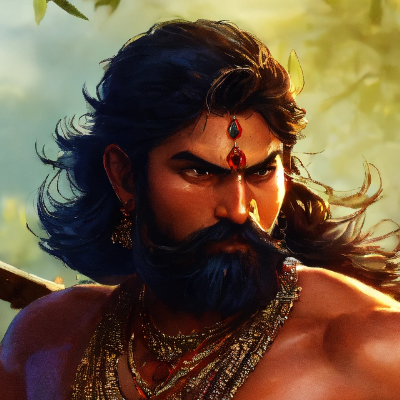
About
Anga — Son of Uru, King of the Anga Kingdom, Father of Vena
Anga · Uru-putra · Agneyi-putra · Vena-pita · Anga-rajya-sthapaka · Shashtha-Manava
Anga is a king of the primordial lineage descending from Chakshusha Manu — the sixth Manu — through his father Uru and his mother Agneyi. He is named in the Bhagavata Purana's fourth skandha, the Vishnu Purana, the Vayu Purana, and other Mahapuranas as the eponymous founder or progenitor of the Anga kingdom — one of the sixteen mahajanapadas of ancient India, corresponding broadly to the region of present-day eastern Bihar and West Bengal. He is also the father of Vena — the deeply troubled and ultimately wicked king whose misrule prompts the great sages to kill him with their mantric power, and from whose churned body the great sovereign Prithu is born. The Bhagavata Purana presents Anga himself as a righteous and accomplished king, and his grief at his son Vena's progressive wickedness — and his eventual abandonment of his kingdom in sorrow — is narrated with considerable pathos and theological depth. He is thus both a genealogical link of the highest importance and a figure with a genuine individual narrative character that distinguishes him from the purely register-level figures of this portion of the lineage.
✦ The Name
The name Anga is Sanskrit, meaning limb, body part, member, or a constituent part of a larger whole. In the tradition of Sanskrit nomenclature, anga also denotes a branch, a section, or an auxiliary — the Vedangas are the six auxiliary disciplines of the Vedic tradition, and the word anga in compound names frequently carries the sense of one who is an essential part or limb of something greater. As a personal name for a king who becomes the eponymous ancestor of the Anga kingdom, the name encodes the idea of a foundational member — a limb or constitutive part of the body politic of the primordial world. The Anga kingdom — one of the sixteen mahajanapadas listed in Buddhist and Hindu texts as the major political units of ancient India — preserves his name across many centuries of Indian political and cultural history.
✦ Lineage
- Father: Uru, a son of Chakshusha Manu — the sixth Manu — and his wife Agneyi, named in the Bhagavata Purana as the figure through whom the genealogical line of Chakshusha's descendants continues. Uru's six sons include Anga as the most genealogically significant.
- Mother: Agneyi, named in the Bhagavata Purana as the wife of Uru; her name derives from Agni, the fire god.
- Paternal grandfather: Chakshusha Manu, the sixth Manu, son of Ripu and Brihati, presiding sovereign of the sixth manvantara.
- Paternal great-grandfather: Ripu, son of Shilisti and Suchhaya, eldest of Shilisti's five sons.
- Paternal great-great-grandfather: Shilisti, one of the sons of Dhruva — the celebrated boy-devotee of Vishnu — and his wife Suchhaya.
- Wife: Sunitha, named in the Bhagavata Purana as the wife of Anga and the mother of Vena. Sunitha is identified in the Bhagavata Purana as the daughter of Mrityu — Death personified — and it is through this maternal inheritance from the personification of Death that Vena's mixed and ultimately destructive nature is explained in the text. The Bhagavata Purana presents Sunitha's parentage as the source of the fatal flaw in Vena's character — despite being born of a righteous father, Vena inherits a dark and destructive quality from his maternal grandfather Mrityu.
- Son: Vena, the troubled and ultimately wicked king whose misrule leads the great sages to kill him with their mantric power, and from whose churned body the first true sovereign Prithu is born — one of the most dramatic narrative sequences in the entire Bhagavata Purana.
✦ Anga as King — Righteousness and Grief
The Bhagavata Purana describes Anga as a righteous and accomplished king — one who performed sacrifices, governed with justice, and fulfilled his dharmic obligations as a sovereign. The text narrates that Anga performed a great Ashvamedha — a horse sacrifice — and that the gods, despite being duly invoked, did not appear to receive their portions of the offering. The priests, puzzled by this unprecedented absence of the gods from a properly performed sacrifice, consulted among themselves and then informed Anga that the gods were absent because his son was destined to be wicked — Vena's future sinfulness was already casting its shadow backward, rendering the sacrifice of even a righteous father incomplete. This episode is the Bhagavata Purana's narrative device for introducing Vena's character before he has even come to power, and it reveals Anga's own righteousness by contrast — he is a king so conscientious about ritual propriety that the absence of the gods at his sacrifice becomes the occasion for the revelation of his son's fatal nature.
As Vena grew and his wickedness became manifest — his cruelty, his arrogance, his contempt for dharma and for the sages — Anga attempted to correct him through counsel, instruction, and remonstrance. The Bhagavata Purana narrates that Anga's attempts had no effect on Vena, whose nature was too deeply marked by the influence of his maternal grandfather Mrityu to respond to paternal guidance. Anga's grief at his son's irredeemable wickedness became overwhelming. Unable to watch his son destroy the dharmic order he had spent his reign sustaining, and unable to correct him, Anga made the extraordinary decision to abandon his kingdom entirely. He left the palace in the night — alone, without informing anyone — and disappeared into the forest to pursue ascetic solitude, renouncing the throne, the kingdom, and the burden of his son's conduct. The Bhagavata Purana presents this departure not as a failure of duty but as the act of a man whose grief has reached the limit of what the householder life can contain — a movement toward renunciation driven by sorrow rather than by the conventional completion of the four stages of life.
After Anga's disappearance, the kingdom was left without a king. The sages, unable to locate Anga, eventually crowned Vena as king — a decision that, as the Bhagavata Purana makes clear, they would come to deeply regret. Anga himself is not mentioned again in the primary narrative after his departure for the forest. His fate as a renunciant is not narrated — the text's concern shifts entirely to Vena and then to Prithu. But Anga's departure is the hinge on which the entire subsequent narrative turns, and his character — righteous, grief-stricken, ultimately unable to remain in the world because of his son's wickedness — is one of the Bhagavata Purana's most humanly sympathetic royal portraits.
✦ The Anga Kingdom
The Anga kingdom — named after this figure — is one of the sixteen mahajanapadas listed in early Buddhist texts such as the Anguttara Nikaya and in Hindu sources including the Mahabharata. It corresponds broadly to the region of present-day Bhagalpur district in eastern Bihar and parts of West Bengal, with its capital traditionally identified as Champa on the banks of the Ganga. In the Mahabharata, Anga is the kingdom given by Duryodhana to Karna — the tragic hero of the epic — as an act of royal patronage that binds Karna to the Kaurava cause. The kingdom's association with Karna in the Mahabharata gives the name Anga a second major resonance in the epic tradition, entirely distinct from its Puranic genealogical origin in this figure.
✦ Theological Significance
Anga's story in the Bhagavata Purana raises one of the text's most searching theological questions about the nature of karma and heredity. The text presents a righteous king whose son is wicked not because the father failed in his duty — Anga performed all his dharmic obligations with full conscientiousness — but because the son's maternal inheritance from Mrityu introduced a fatal quality into his nature that no amount of paternal righteousness could overcome. This is not a comfortable or simple theological position — it raises the question of whether a being can be condemned by his inherited nature despite the righteousness of his father and his own actions, and the Bhagavata Purana does not resolve this tension easily. Anga's grief and his eventual departure are the human response to the recognition that some things are beyond the power of righteous action to correct — a recognition that the Bhagavata Purana presents with full pathos rather than with easy consolation.
✦ References
Primary Sources
- Bhagavata Purana, Skandha 4, Chapters 13–14: The principal source for Anga's narrative; names him as a son of Uru, identifies Sunitha as his wife, describes his righteous kingship, the episode of the gods' absence from his sacrifice, his grief at Vena's wickedness, and his departure into the forest.
- Vishnu Purana, Book 1, sections on Chakshusha Manu's lineage: Names Anga in the genealogical continuation and provides a parallel account of the Anga-Vena-Prithu narrative sequence with some variation in detail.
- Vayu Purana, sections on the descendants of Chakshusha Manu: An independent Puranic register naming Anga and placing him in the lineage sequence.
- Mahabharata, various parvas: References the Anga kingdom as the territory given to Karna by Duryodhana; provides the epic context for the kingdom whose name derives from this figure.
Modern Reference Works
- Vettam Mani, Puranic Encyclopaedia (Motilal Banarsidass, 1975), entry on Anga: Synthesises the Puranic material on Anga's genealogy, his narrative in the Bhagavata Purana, and his identification as the eponymous ancestor of the Anga kingdom.
- Ganesh Vasudeo Tagare (trans.), Bhagavata Purana, Part 2 (Motilal Banarsidass, 1976): Critical translation of the fourth skandha including the Anga narrative; the notes address the theological significance of Sunitha's parentage from Mrityu and Anga's departure from the kingdom.
- F. E. Pargiter, Ancient Indian Historical Tradition (Oxford University Press, 1922): Analyses the Puranic genealogical lists for the descendants of Chakshusha Manu and addresses the Anga lineage in comparative perspective.