
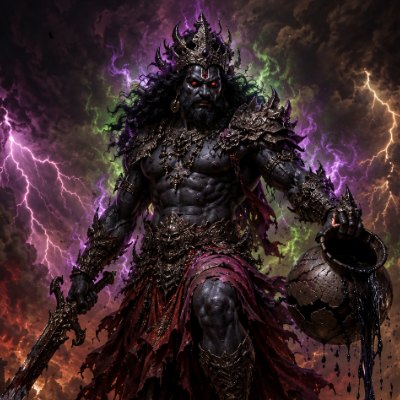
About
Adharma — Prajapati and Personification of Unrighteousness
Adharma · Adharman · Nirrti (conflated in certain accounts)
Adharma is a cosmological being in the Hindu Puranic tradition, conceived as the personification and progenitor of unrighteousness, vice, and moral disorder. He stands as the direct antithesis of Dharma — who is similarly personified as a Prajapati, a progenitor-being, and who represents cosmic order, righteousness, and virtue. Adharma figures most substantially in the Vishnu Purana and the Bhagavata Purana, where he is enumerated among the primordial beings produced at the dawn of creation and where his lineage is traced through several generations of increasingly destructive offspring. He is referenced also in the Vayu Purana and the Brahmanda Purana. These texts present Adharma not as a deity accorded worship but as a cosmological and taxonomic figure — a personification whose progeny account for the origin of the forces that work against cosmic order within the created universe.
✦ The Name
The name Adharma is a Sanskrit compound formed by the privative prefix a-, denoting negation, joined to dharma, which derives from the root dhr, meaning to hold, sustain, or uphold. Dharma in its broadest Puranic sense denotes cosmic order, righteous conduct, and the sustaining law of the universe. Adharma therefore signifies the negation or active violation of that sustaining principle. The name functions simultaneously as an abstract noun — unrighteousness as a quality — and as a personal name designating the being who embodies and propagates that quality. The epithet or name Nirrti, meaning dissolution or destruction, appears in some Puranic enumerations in a position comparable to that of Adharma, and certain secondary sources treat the two as related or overlapping figures; however, the principal primary texts do not consistently equate them as a single identity.
✦ Lineage
The Vishnu Purana and the Bhagavata Purana provide the most detailed accounts of Adharma's lineage. According to these texts, Adharma is among the primordial beings who came into existence at the beginning of creation, listed alongside Dharma and other such personified abstractions. His consort is named Mithya — also rendered as Nirrti in some accounts — whose name signifies falsehood or untruth, making her a fitting companion to the personification of unrighteousness. From this union are born offspring who further embody destructive and vicious qualities. The Bhagavata Purana specifies the following generational descent:
- Consort: Mithya (also called Nirrti in variant accounts) — whose name means falsehood or untruth; she is described as the wife of Adharma and the mother of his offspring.
- Son: Dambha — personification of hypocrisy, ostentation, and deceit; born of Adharma and Mithya.
- Daughter: Maya — in this genealogical context, personification of illusion or deception in its negative moral sense; born of Adharma and Mithya. This Maya is a distinct cosmological figure from the philosophical concept of Maya as cosmic illusion elaborated in Vedantic thought.
- Grandson: Lobha — personification of greed and covetousness; born of Dambha and Maya according to the Bhagavata Purana, which specifies that the siblings Dambha and Maya were united to produce further offspring, continuing the descent of vicious qualities.
- Granddaughter: Nikrti — personification of baseness or vileness; born alongside Lobha of Dambha and Maya.
- Great-grandson: Krodha — personification of anger and wrath; born of Lobha and Nikrti.
- Great-granddaughter: Himsa — personification of violence and injury; born of Lobha and Nikrti.
- Great-great-grandson: Kali — in this genealogical context, the personification of strife, discord, and the degenerate age; born of Krodha and Himsa. This Kali is the male personification of the Kali Yuga and is distinct from the goddess Kali.
- Great-great-granddaughter: Durukti — personification of harsh or abusive speech; born of Krodha and Himsa alongside Kali.
The Vishnu Purana presents a broadly comparable genealogy, though with some variation in the names and sequence of offspring. Where the Bhagavata Purana specifies Maya as the daughter of Adharma and Mithya, the Vishnu Purana's account as summarised in secondary scholarly literature attributes slight differences in the pairing of the second generation. These variations are noted below in the section on textual inconsistencies.
✦ Role in Primordial Creation
In the Puranic scheme of creation, the universe comes into being through a series of emanations from the supreme being — in Vaishnava texts, from Vishnu or Narayana — proceeding through Brahma as the secondary creator. Among the earliest products of this creative process are pairs of opposing principles personified as beings. Dharma and Adharma form one such pair: Dharma embodies the sustaining moral order that upholds the universe, while Adharma embodies its negation and dissolution. Both are treated as Prajapatis — progenitor-beings — in that both give rise to lineages of offspring who populate the moral and cosmological landscape of the created world. The Bhagavata Purana presents this scheme as part of its account of secondary creation, in which abstract qualities — both virtuous and vicious — acquire personal form and produce progeny, thereby providing a mythological genealogy for the vices and virtues experienced within creation. Adharma's lineage, culminating in Kali and Durukti, thus provides the Puranic tradition with a cosmological explanation for the presence of strife, anger, greed, violence, and discord in the world.
✦ Textual Variants and Inconsistencies
The principal inconsistency across the primary sources concerns the name of Adharma's consort and the precise relationship of certain offspring. The Bhagavata Purana names the consort Mithya, meaning falsehood. The Vishnu Purana, in the account preserved and discussed in the Puranic Encyclopaedia of Vettam Mani and in the scholarship of Wendy Doniger, gives the consort's name as Nirrti or a near-equivalent, meaning dissolution. Some accounts appear to treat Nirrti as a separate primordial being altogether — a goddess associated with misfortune and decay who appears independently in Vedic literature, particularly in the Atharva Veda — and her identification with Adharma's consort in the Puranic material may represent a secondary conflation of originally distinct figures.
A further inconsistency concerns the generation at which Dambha and Maya are placed. The Bhagavata Purana is explicit that they are the direct children of Adharma and Mithya and that their union produces Lobha and Nikrti. Some secondary summaries of the Vishnu Purana suggest a slightly different ordering, though the overall shape of the descent — moving from hypocrisy and deception through greed and vileness to anger, violence, and ultimately Kali — is consistent across the two principal Puranic sources.
✦ Theological and Philosophical Significance
The figure of Adharma serves a specific theological function within the Puranic cosmological framework. By personifying unrighteousness as a Prajapati and tracing from him a lineage of vices, the Puranic authors embed the problem of moral disorder directly into the structure of creation itself. This is not a statement that evil is co-eternal with the supreme being or that it is ultimately real in a philosophical sense — the Puranas, particularly the Bhagavata Purana with its strong Vaishnava theological orientation, maintain the ultimate sovereignty of the divine — but it is a narrative mechanism for explaining why vice, strife, and the degradation of ages exist within a divinely ordered cosmos. The genealogy of Adharma thus mirrors and balances the genealogy of Dharma, whose own progeny include personifications of virtuous qualities. Together, the two lineages constitute a complete taxonomy of the moral forces at work in creation.
The descent from Adharma to Kali is particularly significant in the context of the doctrine of the four yugas, or world-ages. Kali, born at the furthest remove from the primordial Adharma yet directly descended from him through several generations of accumulated vice, presides over the Kali Yuga — the final and most degenerate of the four ages — in which righteousness is reduced to its minimum and adharma reaches its fullest expression in the world. The genealogy of Adharma thus also functions as a compressed mythological history of moral decline across cosmic time.
✦ Connection to the Wider Genealogy
Adharma belongs to the generation of primordial Prajapatis produced in the earliest phase of Puranic creation, alongside figures such as Dharma (the personification of righteousness and cosmic order), Kama (desire), Krodha (anger, who also appears as Adharma's great-great-grandchild in a separate genealogical strand), and others. His lineage intersects with the broader Puranic genealogical scheme at the figure of Kali — the male personification of the Kali Yuga — who is described in the Bhagavata Purana as a descendant of Adharma and who plays a significant independent narrative role in the Devi Bhagavata Purana and other texts as the presiding spirit of the degenerate age. Kali is further said in the Bhagavata Purana to have a son named Bhaya (fear) and a daughter named Mrityu (death) through his consort Durukti, extending the lineage of Adharma yet further into the cosmological taxonomy of destructive forces.
✦ References
Primary Sources
- Bhagavata Purana, Skandha 4, Chapters 7–8 — provides the most detailed account of Adharma's lineage, naming his consort Mithya, their children Dambha and Maya, and the subsequent generational descent through Lobha, Nikrti, Krodha, Himsa, Kali, and Durukti.
- Vishnu Purana, Book 1, Chapter 7 — enumerates Adharma among the primordial beings produced at creation and provides a genealogy of his offspring, broadly consistent with though in places variant from the Bhagavata Purana account.
- Vayu Purana — contains a reference to Adharma in its account of the primordial Prajapatis and the opposing principles of creation, though its treatment is briefer than that of the Vishnu and Bhagavata Puranas.
- Brahmanda Purana — includes Adharma in its cosmological enumeration of primordial beings, largely in alignment with the Vayu Purana's account.
- Atharva Veda — contains references to Nirrti as a Vedic goddess of dissolution and misfortune, relevant to understanding the possible conflation of Nirrti with Adharma's consort in later Puranic literature.
Modern Reference Works
- Vettam Mani, Puranic Encyclopaedia (1975), entry on Adharma — summarises the Puranic genealogy of Adharma and notes the principal textual sources, providing a useful collation of the scattered references.
- Wendy Doniger O'Flaherty, The Origins of Evil in Hindu Mythology (1976) — analyses the cosmological function of Adharma and the personification of vice in the Puranic genealogical scheme, placing the figure within the broader Hindu theological treatment of moral disorder.
- Wisdom Library (wisdomlib.org), entries on Adharma, Mithya, Dambha, Lobha, and Kali (genealogical) — provides verse-level references to the relevant Bhagavata and Vishnu Purana passages and collates variant readings across Puranic sources.