
About
Urmila — Princess of Mithila, Wife of Lakshmana, and Queen of Ayodhya
Urmila · Urmila-devi · Lakshmana-patni · Janaka-putri · Videha-kanya
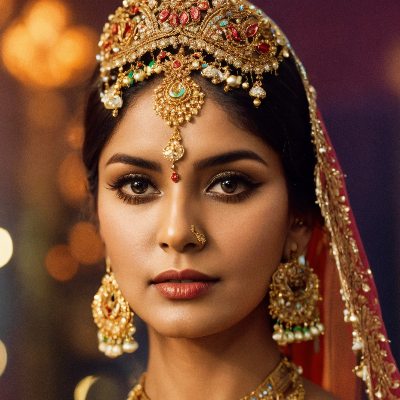
Urmila is a princess of Mithila, the second daughter of King Janaka — the philosopher-king of the Videha kingdom — and the wife of Lakshmana, the third son of King Dasharatha of Ayodhya and the devoted younger brother of Rama. She is named in the Valmiki Ramayana and participates in the great marriage ceremony at Mithila in which Sita, her elder sister, is wed to Rama, and Mandavi and Shrutakirti, daughters of Janaka's brother Kushadhvaja, are wed to Bharata and Shatrughna respectively. Urmila's most significant narrative circumstance is her separation from Lakshmana during the fourteen years of forest exile — Lakshmana accompanies Rama and Sita into the forest while Urmila remains at Ayodhya. This separation, and Urmila's response to it, receives relatively brief treatment in the Valmiki Ramayana itself but becomes a subject of sustained literary and devotional elaboration in later texts, regional Ramayanas, and vernacular retellings. She is the mother of two sons, Angada and Chandraketu, both named in the Uttara Kanda of the Valmiki Ramayana.
✦ The Name
The name Urmila is Sanskrit in origin. It derives from the word urmi, meaning wave — as in a wave of water or, by extension, a wave of emotion or sensation — combined with the suffix la, which in Sanskrit nominal formation can indicate one who possesses or embodies the quality named by the root. Urmila may thus be understood as one who is wave-like, one who is full of feeling, or one who moves with the grace and energy of a wave. Some commentators have also connected the name to urna, wool or softness, though the urmi derivation is more widely accepted in classical lexicography. The epithet Videha-kanya, meaning daughter of the Videha kingdom, and Janaka-putri, meaning daughter of Janaka, are used in the tradition to identify her by her royal origin.
✦ Lineage
- Father: Janaka, the philosopher-king of Mithila in the Videha kingdom, celebrated in the Vedic and Upanishadic traditions as a royal sage of the highest order and in the Ramayana as the foster-father of Sita.
- Mother: Named in some traditions as Sunayana, the chief queen of Janaka, though the Valmiki Ramayana does not name the mother of Urmila explicitly in the marriage passages.
- Elder sister: Sita, the most celebrated figure in the Ramayana tradition, foster-daughter of Janaka discovered in a furrow of the earth, wife of Rama — the seventh avatara of Vishnu and the hero of the Valmiki Ramayana — and regarded in the devotional tradition as an avatara of the goddess Lakshmi.
- Paternal cousins (treated as sisters at marriage): Mandavi, daughter of Kushadhvaja — Janaka's brother — wed to Bharata, second son of Dasharatha; and Shrutakirti, also daughter of Kushadhvaja, wed to Shatrughna, fourth son of Dasharatha.
- Husband: Lakshmana, third son of King Dasharatha of Ayodhya by his queen Sumitra, devoted companion of Rama throughout the forest exile, and a warrior of supreme skill; regarded in the devotional tradition as an avatara of Shesha, the cosmic serpent upon whom Vishnu reclines.
- Sons: Angada and Chandraketu, both named in the Uttara Kanda of the Valmiki Ramayana as sons of Lakshmana and Urmila, each given a kingdom by Rama at the conclusion of the epic period.
✦ The Marriage at Mithila
The marriage of Urmila to Lakshmana is narrated in the Bala Kanda of the Valmiki Ramayana. The sage Vishvamitra brings Rama and Lakshmana to Mithila, where Rama breaks the great bow of Shiva and thereby wins Sita's hand. King Janaka, wishing to solemnise four marriages together and to provide worthy husbands for all the young women of his household, proposes that Urmila be given to Lakshmana, and that the two daughters of his brother Kushadhvaja — Mandavi and Shrutakirti — be given to Bharata and Shatrughna respectively. Dasharatha and the sage Vasishtha arrive from Ayodhya and the four marriages are performed together in a single great ceremony. The text describes the ceremony with attention to its ritual propriety and to the suitability of the matches, but Urmila herself is not given individual speech or action in the Valmiki account of the wedding — she is named and placed, but the narrative focus remains on Sita and Rama.
✦ The Separation: Lakshmana's Departure for the Forest
When Rama is ordered into fourteen years of forest exile by King Dasharatha at the instigation of Queen Kaikeyi, Lakshmana resolves to accompany his elder brother. In the Valmiki Ramayana's Ayodhya Kanda, Lakshmana takes leave of his mother Sumitra and of Urmila before departing. The text records that Urmila wishes to accompany him, as Sita accompanies Rama, but Lakshmana dissuades her. He asks her to remain at Ayodhya to care for his aged parents — particularly his mother Sumitra — and to maintain the household in his absence. Urmila accepts this request and remains. The Valmiki text does not dwell at length on this moment or on Urmila's interior experience of the separation; it is narrated briefly and the focus shifts quickly to the departing trio of Rama, Sita, and Lakshmana.
The fourteen years that follow, during which Urmila remains at Ayodhya while Lakshmana serves Rama and Sita in the forest, are not narrated from her perspective in the Valmiki Ramayana. She is not a speaking or acting character during this period in the original text. Her circumstances during these years — her grief, her devotion, her conduct — are a subject that later traditions take up with considerable imagination and elaboration.
✦ Later and Regional Traditions
The relative silence of the Valmiki Ramayana regarding Urmila's experience during the exile became the occasion for later poets and regional traditions to imagine her interior life in considerable detail. In several vernacular and later Sanskrit retellings, Urmila is portrayed as having accepted a form of extended sleep or yogic withdrawal for the duration of the fourteen years, a narrative device explained through a boon or arrangement connected to the god of sleep. The logic of this tradition holds that Lakshmana, in order to remain wakeful and vigilant throughout the forest exile in Rama's service, transferred his allotted sleep to Urmila, who slept in his stead for the entire period. This account is not present in the Valmiki Ramayana and belongs to later elaboration.
The Adhyatma Ramayana, a later Sanskrit text embedded in the Brahmanda Purana that presents the Ramayana story through a Vedantic and devotional lens, gives Urmila a more developed presence than the Valmiki original. Regional Ramayanas in Odia, Bengali, Telugu, Tamil, and other languages likewise expand her role and give her voice and agency that the Valmiki text does not. The twentieth-century Hindi poet Maithili Sharan Gupt devoted an extended poem, Saket, substantially to Urmila's perspective, which brought her story to wide popular attention in modern India. These later treatments, while significant in the literary and devotional history of the Ramayana tradition, are elaborations upon rather than evidence from the primary textual sources.
✦ Theological and Philosophical Significance
In the devotional tradition, Urmila's willingness to accept separation from her husband without complaint, and to fulfil the duty assigned to her by remaining at Ayodhya, has been read as an embodiment of the same quality of selfless renunciation that characterises Lakshmana's own service to Rama. Where Lakshmana renounces the comforts of Ayodhya to serve his brother, Urmila renounces the companionship of her husband to serve the larger purpose that Lakshmana's service requires. This parallel structure of sacrifice — Lakshmana's for Rama, Urmila's for Lakshmana's mission — has made her a figure of considerable significance in discussions of stri-dharma, the duties and virtues of women, within the Ramayana commentarial tradition.
✦ Connection to the Wider Genealogy
Urmila connects two of the most celebrated royal lines of the Itihasa tradition through her marriage. She is born of the Videha royal house of Mithila — the line of Janaka, associated in the Upanishadic tradition with the highest Vedic wisdom — and she marries into the Ikshvaku Solar dynasty of Ayodhya, the line that descends through Dilipa and Raghu to Dasharatha and Rama. Through her sons Angada and Chandraketu, she is the ancestral mother of the kingdoms established at the close of the Ramayana period, Angada's kingdom of Angadiya and Chandraketu's kingdom in the Malada and Karusha regions according to the Uttara Kanda.
✦ References
Primary Sources
- Valmiki Ramayana, Bala Kanda, Sargas 66–73: Narrates the svayamvara at Mithila, the breaking of Shiva's bow by Rama, and the four marriages including that of Urmila to Lakshmana; names Urmila explicitly as Janaka's daughter.
- Valmiki Ramayana, Ayodhya Kanda, Sargas 29–31: Narrates Lakshmana's decision to accompany Rama into exile and his leave-taking of Urmila; provides the brief account of Urmila's acceptance of separation and Lakshmana's request that she remain at Ayodhya.
- Valmiki Ramayana, Uttara Kanda: Names Angada and Chandraketu as the sons of Lakshmana and Urmila and records their installation as kings of their respective territories by Rama.
- Adhyatma Ramayana (embedded in the Brahmanda Purana): A later Sanskrit devotional retelling that gives Urmila a more developed presence and elaborates on her spiritual and emotional life during the exile period.
Modern Reference Works
- Vettam Mani, Puranic Encyclopaedia (Motilal Banarsidass, 1975), entry on Urmila: Summarises the primary textual references and notes the genealogical connections.
- Robert P. Goldman (trans.), Valmiki Ramayana, Vol. 1: Balakanda (Princeton University Press, 1984): Critical translation with annotation; the notes to the marriage sargas address the identification and naming of the four brides.
- Sheldon Pollock (trans.), Valmiki Ramayana, Vol. 2: Ayodhyakanda (Clay Sanskrit Library / NYU Press, 2005): Critical translation of the Ayodhya Kanda; the relevant sargas cover Lakshmana's departure and his conversation with Urmila.
- Maithili Sharan Gupt, Saket (1931, Hindi): A modern literary work, not a primary source, but significant as the text most responsible for the elaboration of Urmila's interior experience in the modern imaginative tradition; cited here for context, not as scriptural authority.