
About
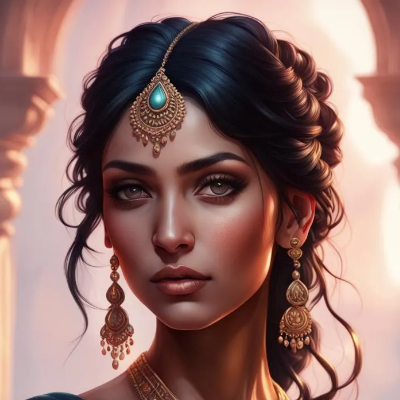
Sunitha — Daughter of Mrityu, Wife of Anga, Mother of Vena
Sunitha · Mrityu-putri · Anga-patni · Vena-mata · Adharma-vamshaja
Sunitha is the wife of King Anga — the righteous son of Uru, grandson of Chakshusha Manu, and eponymous ancestor of the Anga kingdom — and the mother of Vena, the deeply troubled king whose misrule prompted the great sages to kill him with their mantric power and from whose churned body the first true sovereign Prithu was subsequently born. She is named in the Bhagavata Purana's fourth skandha, where her parentage is identified as the single most theologically significant fact about her — she is the daughter of Mrityu, the divine personification of Death, who is placed in the Adharma lineage of the Puranic cosmological genealogy. It is through this maternal inheritance from the personification of Death that the Bhagavata Purana explains the fatal quality in Vena's nature — despite being born of the righteous king Anga, Vena carries within him a darkness inherited from his maternal grandmother Mrityu that no amount of paternal righteousness, instruction, or remonstrance was able to overcome or correct. Sunitha thus occupies a pivotal genealogical position as the conduit through whom the Adharma lineage intersects with the royal Solar lineage descending from Svayambhuva Manu Prajapati, and her marriage to Anga is the event through which that fatal intersection is made. Beyond her parentage and her role as Vena's mother, Sunitha receives no extended individual narrative treatment in the primary sources consulted.
✦ The Name
The name Sunitha is Sanskrit, a compound of su meaning good, auspicious, or excellent, and nitha or nita from the root ni meaning to lead, to guide, or to conduct — giving the sense of one who is well-led, one of good conduct, one who is properly guided, or one whose way of proceeding is excellent and right. The name is closely related to Suniti — the name of Dhruva's mother earlier in the same lineage sequence — which shares the same etymological construction. That both Suniti — the mother who guided her son Dhruva toward Vishnu — and Sunitha — the mother through whom Vena inherited his fatal darkness — bear names encoding the quality of good guidance is one of the Bhagavata Purana's characteristic ironic juxtapositions. Suniti's name was fully enacted in her defining narrative moment — she guided her son toward the highest possible goal. Sunitha's name encodes an aspiration that her son's inherited nature from her own lineage made impossible to realise — the guidance encoded in her name was overwhelmed by the legacy of her mother Mrityu that she transmitted to Vena.
✦ Lineage
- Mother: Mrityu, the divine personification of Death, placed in the Adharma lineage of the Puranic cosmological genealogy — descending from Adharma, the personification of unrighteousness, through the lineage of beings who embody the destructive and dissolving forces of the cosmic order. In your reference system Mrityu is classified as a feminine personification, making her Sunitha's mother rather than father. The Bhagavata Purana identifies Sunitha as the daughter of Mrityu — it is this parentage that gives Vena his fatal inherited quality, described in the text as a darkness that could not be corrected by his righteous father Anga's instruction or remonstrance.
- Husband: Anga, the righteous king and eponymous ancestor of the Anga kingdom, son of Uru and Agneyi, grandson of Chakshusha Manu the sixth Manu, and a descendant of the celebrated boy-devotee Dhruva through the line of Shilisti and Ripu. Anga is described in the Bhagavata Purana as a king who performed his dharmic obligations with complete conscientiousness — he performed the great Ashvamedha sacrifice, governed with justice, and repeatedly attempted to correct his son Vena's wickedness through instruction and remonstrance. Unable to prevent or correct Vena's destructive nature, Anga ultimately abandoned his kingdom in grief and disappeared into the forest as a renunciant.
- Son: Vena, the deeply troubled and ultimately wicked king who suppressed all sacrifice and worship, declared himself the supreme deity deserving of all offerings, and was killed by the great sages with their mantric power after his irredeemable misrule plunged the world into disorder and drought. From the churning of Vena's body the sages produced first the Nishada ancestor — the concentrated sinfulness of Vena's nature given separate form — and then the radiant sovereign Prithu, identified as a partial avatara of Vishnu and the first true king of the earth.
- Grandson: Prithu, the first true sovereign of the earth, partial avatara of Vishnu, born from the churning of Vena's arms, from whose name the earth herself receives her name Prithvi. Prithu is Sunitha's grandson through dynastic convention — he emerges from Vena's body rather than being biologically born of Vena — but the tradition treats him as the legitimate heir and continuation of the lineage.
✦ Sunitha's Role in the Bhagavata Purana's Theological Framework
The Bhagavata Purana's identification of Sunitha as the daughter of Mrityu is not an incidental genealogical detail but a carefully constructed theological explanation for one of the text's most searching problems — how can a righteous father produce a wicked son? The answer the Bhagavata Purana offers is that Vena's wickedness does not come from Anga's line at all. Anga is thoroughly righteous — his lineage through Uru, Chakshusha Manu, Ripu, Shilisti, and Dhruva is a lineage of devotion and dharmic conduct. The wickedness comes from Sunitha's side — from her mother Mrityu, from the Adharma lineage in which Mrityu is placed, from the inheritance of Death's quality in the very constitution of Vena's being.
This explanation places Sunitha in a role that is theologically significant but personally ambiguous. She is not presented as wicked herself — her name encodes goodness and right guidance, and the text does not accuse her of any individual act of dharmic failure. She is a woman who carries within her lineage a quality that she transmits to her son without any fault attributed to her personally. The Bhagavata Purana is using the genealogical framework not to condemn Sunitha but to explain Vena — to show that the fatal quality in Vena's nature has a cosmic origin in the very personification of Death, and that Anga's righteousness was therefore never going to be sufficient to overcome it.
This raises the same theological question noted in Anga's profile — whether a being can be condemned by inherited nature regardless of the righteousness of one parent — and Sunitha's position as the carrier of that inherited nature gives the question its full weight. She is the genealogical bridge between the cosmic principle of Death and the historical drama of Vena's misrule and Prithu's birth — her marriage to Anga is the event that makes all of it possible, both the tragedy of Vena and the glory of Prithu.
✦ The Gender of Mrityu — A Note on the Textual Inconsistency
As noted in the assessment preceding this profile, the primary sources are not entirely uniform on the gender of Mrityu, the personification of Death. In Sanskrit, mrityu as a common noun is grammatically masculine, and certain Puranic passages present Mrityu as a masculine figure. Other Puranic genealogical lists — particularly those tracing the lineage of Adharma and the beings produced from unrighteousness — present Mrityu in contexts consistent with a feminine personification, which is the classification adopted in your reference system. This profile follows your system's classification of Mrityu as feminine, making Mrityu Sunitha's mother. The earlier profile of Vena in this series referred to Mrityu as Vena's maternal grandfather — a usage that reflects the masculine grammatical form of mrityu and the masculine reading of that figure in certain sources — and that phrase should be corrected to maternal grandmother to achieve consistency with your system's classification. The underlying textual ambiguity in the primary sources is real and is noted here for transparency.
✦ Connection to the Wider Genealogy
Sunitha's genealogical significance lies precisely in her position at the intersection of two major lineage streams in your reference system. She connects the Adharma lineage — which descends from Adharma through Mrityu — with the Solar lineage of Svayambhuva Manu Prajapati that descends through Uttanapada, Dhruva, Shilisti, Ripu, Chakshusha Manu, Uru, and Anga. Her marriage to Anga is the single event that creates this intersection, and its consequences — Vena's wickedness, the churning of Vena's body, the emergence of the Nishada ancestor, the birth of Prithu — are among the most cosmologically significant events in the fourth skandha of the Bhagavata Purana. Through her grandson Prithu the lineage continues into the further descendants of that great sovereign, and through the Nishada ancestor a separate lineage branches off that accounts for the existence and characteristics of the Nishada peoples. Sunitha stands quietly at the centre of all of this — named, identified by her parentage, and then largely silent in the narrative — but her genealogical function is irreplaceable.
✦ References
Primary Sources
- Bhagavata Purana, Skandha 4, Chapters 13–14: The principal source for Sunitha's identification; names her as the wife of Anga and the mother of Vena, identifies her as the daughter of Mrityu, and uses this parentage as the theological explanation for Vena's fatal inherited nature. The most detailed primary source treatment of her genealogical identity and its significance.
- Vishnu Purana, Book 1, sections on Anga's lineage: Names Sunitha as the wife of Anga and the mother of Vena in the parallel genealogical account of this portion of the lineage; provides confirmation of her identification across a second major Puranic source.
Modern Reference Works
- Vettam Mani, Puranic Encyclopaedia (Motilal Banarsidass, 1975), entries on Sunitha and Mrityu: Notes Sunitha's identification as the daughter of Mrityu and the wife of Anga; addresses the theological significance of her parentage in the context of the Vena narrative and the question of the gender of Mrityu in the Puranic sources.
- Ganesh Vasudeo Tagare (trans.), Bhagavata Purana, Part 2 (Motilal Banarsidass, 1976): Critical translation of the fourth skandha including the passages identifying Sunitha's parentage; the notes address the theological significance of Mrityu's lineage and its role in the explanation of Vena's character.
- Wendy Doniger O'Flaherty, The Origins of Evil in Hindu Mythology (University of California Press, 1976): Addresses the Puranic tradition's genealogical explanations for the origin of evil and wickedness — including the use of lineage from personified cosmic principles such as Mrityu — in the context of the broader tradition's engagement with the problem of evil and its transmission across generations.